How Birding Can Save the World

Before I get into this, here is a little bit about me. My pronouns are he/him. I am a citizen of Cherokee Nation and white-presenting (that is, I look like a white male).

1. Everyone likes birds.

Everyone. Regardless of age, gender, sexual orientation, race, socio-economic status, political orientation, urban or rural background, if you asked them if they like birds, they’ll say yes. They may complain about a few problem birds that crap on their car, but in general, people will say they like birds. And they put their money into it. The public spends about as much on backyard bird feeding as it does on movies and television. Birds are beautiful. They fly. They evoke freedom and encourage us to dream.

2. Birding is a pathway to greater environmental knowledge and belief in science.

To get to know birds is to learn about migration, seasons, weather, ecology, habitats and threats to habitats. To watch birds is to see the human/nature interface in bright daylight – the dog that chases the endangered Snowy Plover, the development that removes the woods on the edge of town, the cat that kills the sparrows that migrated here from central Alaska. Birders overcome Nature Deficit Disorder. They become ecologically educated, understanding environmental issues.

3. Birders support environmental causes and the fight against climate change.

In general, birders are environmentalists. Cooper et al (2015) found that birders (and hunters) were “4 to 5 times more likely to engage in conservation behaviors,” such as supporting environmental causes. They concluded, “Strategies that include programs to encourage both hunting and birdwatching are likely to bring about long-term gains for conservation.”  

4. There are far fewer birders than there should be.

There could be a lot more, but certain demographics are underrepresented in the birding community. This includes non-white ethno-racial groups, younger people, and less educated people.

Ethno-racial categories

In their 2021 paper, Racial, ethnic, and social patterns in the recreation specialization of birdwatchers: An analysis of United States eBird registrants, Jonathan Rutter et al (no relation to Jordan Rutter of Bird Names for Birds) analyzed a survey of 30,000 eBird users. That paper, especially Table 3, is the basis for the graphs presented here. Note that the eBird data comes from 2016-17 and the US population data comes from 2011-15. There has almost certainly been an increase in diversity in both datasets since then, especially the eBird data. In 2016, eBird was still fairly limited to certain social circles. The number of eBird users has nearly doubled since then. A new survey would show far more diversity.

Pie graphs of US adult population and eBird users by ethno-racial group.

Going back further, in 2005, John Robinson found that, while the majority of Blacks expressed a high level of interest in the environment, very few participated in birding (or other outdoor activities) and very few had ties to environmental organizations. He famously said that “the average bird watcher will meet no more than two or three African-American bird watchers over a 20-year period.” That has changed.

This underrepresentation has been correlated with other outdoor activities, as well as membership in conservation organizations – and especially in leadership – more on that below.

With respect to birders, are we talking about backyard feeder watchers or avid listers? Rutter et al dived into this, what is termed the degree of “specialization” – how avid and dedicated one is. They asked questions such as: How often to you travel from home to look for birds? How often do you use eBird? Do you own a scope? How many species can you identify by ear? They found no effect on specialization by race. In fact, race, age, gender, knowing a close friend or relative who is a birder, income, and education combined only “explained 6.7% of the variability in how central birdwatching was to respondents’ lives.” No matter what your background, once you start, you are equally likely to head down various paths of birding obsessiveness.

The huge racial divide then, occurs at step one, the decision to start looking at birds. After that, the birds do the rest. Rutter et al concluded, “Future efforts to diversify the birdwatching community, therefore, may be most effective if focused on increasing initial participation rates of underrepresented groups.”

Gender

Nearly every study shows there are slightly more female than male birders. This holds across all ethno-racial categories. (Note, this data, collected in 2016-17, makes no reference to non-binary or refuse-to-state responses. The total in the graph sums to 99.9%. I don’t know if this is rounding error or reflects alternative responses, or if alternative responses were removed from the analysis.)

pie graph of male and female birders

Regarding degree of specialization – how avid and dedicated and experienced they were – men scored higher than women on these questions, but only by a small margin, just 1.7 points on a scale with a median score of 17 (e.g. perhaps men averaged 17.7 and women 16.0).

While there are lots of women birders, and they are nearly as specialized as men, they are far less likely to be in leadership. Most prominent birders – the ones who lead Christmas Bird Counts, serve as eBird reviewers, serve on state or national bird records committees, work as bird guides, speak at conferences, write field guides, etc. – are white men. (A notable historical exception: the first field guide that popularized birding for the public was written by Florence Merriam Bailey in 1889.)

Looking at the top 10 or 20 birders on eBird – in any state or region for any given year – women are typically only represented by a few individuals, whether looking at number of checklists submitted or – a decidedly more competitive and obsessive measure – number of species seen in a given year.

The dearth of women in leadership continues across environmental organizations in general. In 2015, Dorceta Taylor looked at 324 such groups, finding that “though females exceed males on the staff of environmental organizations, women are underrepresented in the top leadership echelons of the institutions.”

In academia, however, change is afoot. While ornithology professors are still mostly men, this varies across universities. The new generation is far more diverse. At the 2023 AOS annual convention, women won 19 of the 23 awards. Additionally, diversity, equity, and inclusion topics were prominent among the papers and presentations.

Age

For all ethno-racial categories, birders (in green) average older than the overall population (in blue), with the breakpoint generally in the upper 40s. Again, this data is dated, and more young birders now avidly embrace eBird. White birders skew older more than any others, and have, in proportion to their population, the fewest young birders and the most older birders. Asians are at the other end of the spectrum, with the most young birders as a proportion of their population. Asian young people are more than twice as likely to take up birding than their white counterparts. Latinx, Blacks, and Native Americans are between, in that order, with the Latinx closer to the Asian graph below. 

graph of birders and overall population by age categories -- for white and Asian birders

The take home here is that there are many potential birders among those under 45 – and even more under 35 and yet more under 25. And young people of color are more likely to take up birding than white young people.

Education

Relative to the overall population, birders are extremely educated. One big caveat here: It could be that there are plenty of less-educated birders, but they just don’t use eBird as much. The survey showed that nearly half (48%) of the 30,000 eBird users surveyed had advanced degrees, compared to just 12% of the other whites (age 18+). This is even more true among birders of color. Latinx birders were 10x more likely than other Latinx to have advanced degrees. Blacks and Native Americans were 6x more likely. A person with an advanced degree is 13x more likely to be a birder than a person without a Bachelors.

education level of birders and general public

The October 2021 issue of Birding magazine explored the least birded counties in the nation, based on the number of eBird checklists. Of the bottom 20, 18 were in Kentucky, Mississippi, or West Virginia, all small rural counties. Sure, they have fewer people than a major metropolitan county. King County (Seattle) generates many times more eBird checklists in a single day (about 700/day) than these counties have in the history of eBird (all with fewer than 100 checklists total). At the same time, I wonder if these low rural county birding rates are partly explained by the education graph above.

Hunting is popular in these areas. 60% of duck hunters are from small towns or rural areas. Surveys of duck hunters show some similarity to birders (e.g. predominantly white), but a different trend regarding education. While they still skew slightly toward more educated, their graph mimics the general population fairly closely.

As someone who learned to bird from my father’s duck hunting blind in a small rural county, I can also assure you that plenty of lesser educated hunters and anglers love the outdoors and know birds pretty well. An advanced degree is not required for bird identification, and certainly not to be an avid birder. Lesser educated rural people could become birders. The take home here is that there are millions of potential birders among those who are less educated, and certainly among hunters who support environmental causes.

Income

Despite their exceptionally higher education level, birders do not earn more money than the general public. This is pretty consistent across all ethno-racial categories. If anything, birders earn slightly less. For example, 24% of the general public earns between $100K and $200K per year. Only 21% of birders do.

income level of birders and general public

To summarize where we are, there are three main demographic groups (which no doubt have some overlap with each other) that bird at lower rates: people of color, younger people (especially whites), and less educated people. While there have no doubt been significant increases in these groups since this survey was done, it is still clear that there is a lack of birders of color and women in leadership roles. This is where there are opportunities to grow birding and the environmental movement in general. And research suggests that knowing other birders is key to start birding.

5. Because underrepresented people are not included – and are actively excluded.

In recent years, there has been a rise in historically-marginalized identity-based birding clubs and ornithological organizations, a kind of alternative birding universe where people can experience birding in a closer-knit community with different social rules, expectations, and styles of communication than in larger white-male-dominated birding circles. Here are some of those groups (and a podcast):

  • In Color Birding Club – we strive to make the birding experience a positive one for BIPOC folks and their allies.
  • Anti-Racist Avid Birders – dedicated to making the outdoors—and birding in particular— accessible and safe for people who find themselves under-represented or unacknowledged in traditional birding communities.
  • Always Be Birdin’ podcast – aims to change the narrative of birding. How we bird, where we bird and who is birding. Join me as I go out into the field with BIPOC birding experts, novice baby birders like myself and nature enthusiasts.
  • Freedom Birders – a racial justice education project.
  • Melanin Base Camp – to increase ethnic minority and LGBTQ+ participation in the outdoors (more focused on adventure sports).
  • Feminist Bird Club – dedicated to promoting inclusivity in birding.
  • The Galbatross Project and Female Bird Day – focusing attention on the importance of female birds.
  • World Girl Birders – to find solutions and creative approaches to supporting women in birding.
  • Rainbow Lorikeets – the AOS caucus of the National Organization of Gay and Lesbian Scientists and Technical Professionals. 
  • QBNA (LGBTQ+ Birders of North America) – to facilitate communication among LGBTQ+ birders and their allies 
  • Frontiers in Ornithology – to educate and inspire youth to take their passion for birds to a higher level.

(Please let me know of more groups I should add to this list.)

There are also many local groups like the ones above, as well as for young birders. And there is Black Birders Week, supported by a wide range of organizations.

Here are some important essays and books on the same themes:

Dominant birding culture

Birding is a pseudo-academic hobby that can take on the vibe of a competitive academic department with a strict, though unwritten, code of behavior. As with any hobby, there is a whole lingo associated with certain activities, especially chasing and listing. Some of it sends subtle messages about how to be a birder, and what it takes to be an Alpha dog.

I drank the Kool-Aid for years. I thought these things were important to cultivate the right kind of birders. I was a gate-keeper. Now I realize enforcing a specific culture and birding etiquette can be a turnoff to new birders, especially those from different demographic backgrounds not comfortable navigating in white male spaces, much less a very specialized and potentially competitive environment. We are, after all, talking about enjoying nature here.

Let’s take one example. Among the cardinal sins for those seeking birding Alpha status is this: do not make an identification mistake in public. When I was a young birder, I loved public debates and discussions about golden-plovers and dowitchers, vireos and accipiters; that’s how I learned. They seem harder to find now – not the birds, the open discussions.

I was recently called “incredibly brave” by a teenage birder for publicly calling attention to a difficult id problem between a rare vagrant and a common species, positing that the bird may be the vagrant. The teen had already figured out the code. The bird, as the odds have it, turned out to be the common one. Later, people were thanking me for initiating the educational discussion online. I’m not brave, just jaded enough that I’m trying to care less about my reputation and am trying to model ‘learning in public,’ which is critical to learning about birds. If gulls and Empidonax flycatchers teach us anything, it’s that everyone must be allowed to make mistakes.

The concept of “slow birding” recently evolved as an even more radical counter to the competitive and obsessive aspects of birding. Slow birding is about bird/life balance, where birding can be an act of mindfulness. The key point is this: There is no one right way to enjoy birds.

Institutional structures

Across academia and many workplaces, we have seen increased diversity over the past four decades. The US Congress has gone from 3% women in 1980 to 28% today. The same probably could not be said for bird record committees, birding tour guides or birding conference speakers.

One way the birding community creates obstacles to diversity is thru various institutional structures and processes. Sometimes it’s just the name. Outside the affinity-based birding clubs described above, most local clubs are “Audubon societies.” In addition to stereotypes of older white people peering thru trees at warblers, both the words “Audubon” and “society” are turnoffs to youth and people of color. It’s a shame because many local groups do great outreach and local conservation. They can be key points of entry for new birders.

I know many who used to work for National Audubon who now boycott them on principle. Some organizational clarification: National Audubon and various state affiliates (e.g. Audubon California, etc.) are all part of a single 501c3. That is the entity that has refused to change its name. Local Audubon societies, however, are separate 501c3’s; they can change their name any time they want. Seattle, Golden Gate, and many others have done so. The challenge now – and what has caused so much delay – is how to do so in a coordinated way, now that National is failing to provide a model for change.

Sometimes the barriers to entry are more substantial than the name; sometimes it’s the actual bylaws. The most dramatic example involves the North American Checklist Committee (NACC) of the American Ornithologists Society. They oversee lumps and splits (and, until recently, English bird names as well as scientific names). The members have advanced degrees in ornithology and are expert taxonomists. That’s no surprise. What is astonishing is that the members of this committee serve unlimited terms and new members are chosen by pre-existing members. Thus, turnover is slower than the US Supreme Court. Some of the members have been on the committee for over 30 years. Five of the eight members who were on the NACC in the year 2000 are still on today. (It has 11 members today, plus two Latina members from Mexico and Central America.) Only one of the nine Supreme Court justices today was there in 2000. The aim, of course, is doctrinal stability, but it comes at a cost. Such policies limit opportunities for younger academics to even aspire to the committee, and certainly retard diversity on the committee.

In the birding world, many state record committees, which oversee state records and evaluate observations of rarities (declaring what is “countable” for listers), have only slightly less-restrictive policies, often resulting in a revolving door of white males. For many of these committees, vacancies are filled only through the nomination by and approval of the existing committee members, just like the NACC. Given that these committees have only a dozen members at most, and there are hundreds of expert birders in most regions, it seems hard to believe there are not women and people of color qualified to serve. Some committee members I’ve spoken to say they try to reach out to other demographics to nominate them, but their efforts have not succeeded. 

I’m not questioning the qualifications or bird decisions of these committees. Their service is commendable. Regardless, the appearance is of an entrenched aristocracy that appears to exclude women and people of color.

Even Christmas Bird Counts (CBCs), usually terrific opportunities for outreach, are not immune to institutional barriers to entry. There are some CBCs that are run as private clubs, closed to outsiders and beginners. On others, beginners are shunted off to less exciting routes.

Public gate-keeping

While there are plenty of legitimate questions and alternative perspectives for any issue in birding, recent discussions about birding and diversity issues (e.g. regarding committee membership and the re-naming of certain birds) have often crossed a line, being particularly insensitive to women, younger birders, and birders of color.

Recently, a friend of mine, a younger person of color and a beginning birder, joined a local former-Audubon bird club field trip for the first time. As the group began to gather – all older white men and women – the leader initiated a group gripe session about the proposed bird name changes.

I don’t know exactly what words were said, what arguments were made. Just the big picture – that an initiative, motivated by diversity and inclusion concerns, is being most criticized by white men over 65, the exact demographic that is most included and overrepresented in leadership positions – is not a good look.

(I acknowledge there are many prominent white male birders who are supportive of the bird names proposal: Kenn Kaufmann, David Sibley, Nate Swick.)

Apparently it is too much to hope that birding’s enormous diversity problem would somehow frame the overall conversation. Instead, some of the common arguments are premised as if the only people in the room are white, using entire frames of reference that exclude marginalized people from the conversation. In a public forum, these arguments essentially declare birding as white space.

Three examples that my friend may have heard:

1) When society’s morals change, the present morals should not be applied to people of the past.
~ This is a white issue. By “society,” they mean white society. Blacks have always opposed slavery, Natives have always opposed ethnic cleansing. We can debate how much white society has changed. What has most obviously changed is that now there are other voices at the table. These voices have grown up with different narratives about history and about how their families were impacted.

2) This is “wokeness” and “virtue-signaling.”
~ These are accusations by whites of whites. One doesn’t say a Black person is virtue signaling when they talk about police brutality. And one doesn’t call a Native woke when they talk about tribal sovereignty. No, woke and virtue-signaling are modern variations on “n-lover” and “squ*w men.” The use of these terms presupposes that the new initiatives are coming from white liberals. In fact, there are lots of people of color involved.

3) Competency and quality (for example, as a committee member) should always come before diversity.
~ This is insulting to women and people of color. It echos claims that underqualified people are given positions as charity, as “diversity hires.” Women and people of color have their own narrative – that they work twice as hard to get half as far. That they are, in short, often over-qualified. Diversity strengthens organizations so they don’t make the kinds of mistakes we are witnessing today, and also serve as inspirations to attract new people from across the demographic spectrum.

Another version of this is to point out how accomplished and important the angry white men are – that the bear has been poked too much, and thus the pace of change should slow down. Such arguments are both circular and ironic. The whole point is that there should not even be a bear. And if the bear is so angry about a symbolic measure, what about more concrete measures? We should all be on the same team, building a better world for birds and birders.

My friend didn’t go into detail about what arguments he heard at that bird walk. All he told me was that he won’t be going back.

6. Making birding more inclusive requires structural change and specific actions.

If the online debates don’t offer concrete solutions to make birding more inclusive, all those affinity-based groups I listed above do. Those birders are already acting! Some of the books I highlighted above are filled with ideas. I’m going to do a separate blog post later on creative ideas to increase diversity in birding. In the meantime, here are a few:  

  • Increase diversity in leadership positions. Both Robinson (2005) and Rutter et al (2021) found that a lack of role models is a significant barrier to entry. Robinson compares Black participation in birding to golf, noting that, after the rise of Tiger Woods, the number of Black golfers nearly doubled in four years.
  • Change the bylaws of committees to allow for greater turnover (thru meaningful term limits). Use external nominations and external appointments or voting to fill vacancies.
  • National Audubon, which oversees CBCs, should require all CBCs to welcome beginners, and create and provide tools to make that easier. (There are some awesome examples from Canada. Check out this one, where a youth team was given the prized pelagic route on a cool Zodiac donated for the day by a local orca-watching company.)
  • Local clubs should offer a range of birding opportunities, targeting different demographics (e.g. youth, women, underrepresented ethno-racial groups). In Robinson’s survey, one respondent said that “a change in advertising and possible programs scheduled in the right areas, along with support from Blacks who back this effort, can change everything.”
  • Along with trips to Ecuador, promote 1MR and 5MR birding (birding within a 1 or 5 mile radius of your home), which increases bird/life balance, knowledge of local birding patches and environmental issues, local community, and birdability for those unable to travel long distances. It’s also a great way to find rare vagrants, especially at feeders in winter. In a similar vein, promote county birding and environmental big days and big years (walking and/or biking).
  • Outreach to hunters, who have a lot of commonalities with birders. We can be allies.

Finally, if you comment on this blogpost, don’t just say why something won’t work; focus on solutions. Positive suggestions for edits are also welcome. We’re all on the same team, birds are for everyone, and they need more allies.
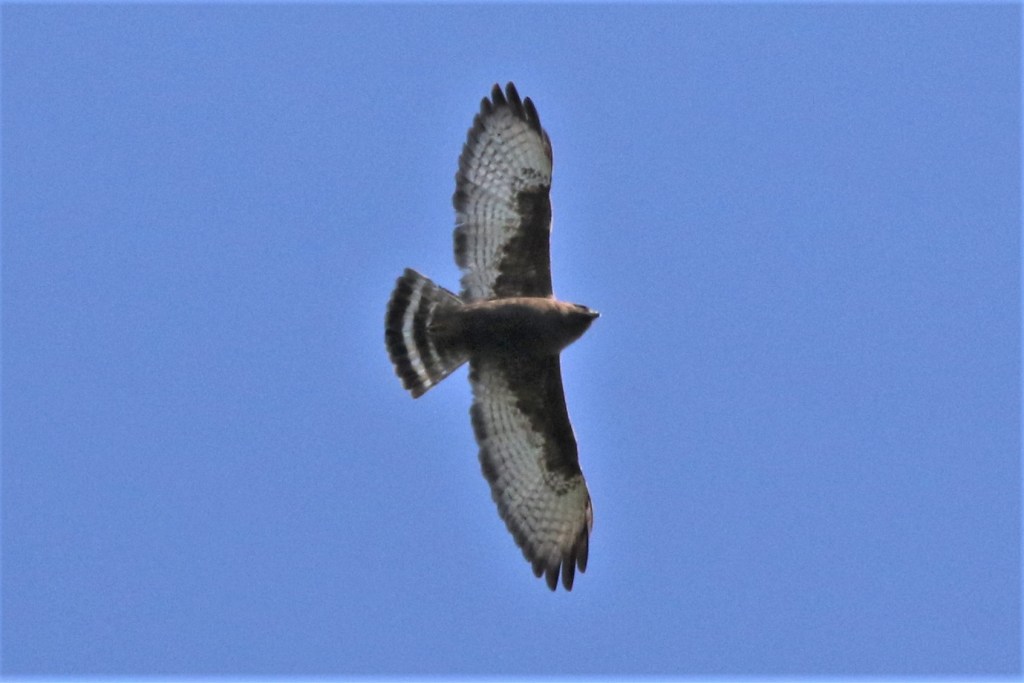
Dark morph Broad-winged Hawk, Port Townsend, WA. May 19, 2021.

References

Cooper, C., Larson, L., Dayer, A., Stedman, R. and Decker, D., 2015. Are wildlife recreationists conservationists? Linking hunting, birdwatching, and pro‐environmental behavior. The Journal of Wildlife Management79(3), pp.446-457.

Robinson, J.C., 2005. Relative prevalence of African Americans among bird watchers. In In: Ralph, C. John; Rich, Terrell D., editors 2005. Bird Conservation Implementation and Integration in the Americas: Proceedings of the Third International Partners in Flight Conference. 2002 March 20-24; Asilomar, California, Volume 2 Gen. Tech. Rep. PSW-GTR-191. Albany, CA: US Dept. of Agriculture, Forest Service, Pacific Southwest Research Station: p. 1286-1296 (Vol. 191).

Rutter, J.D., Dayer, A.A., Harshaw, H.W., Cole, N.W., Duberstein, J.N., Fulton, D.C., Raedeke, A.H. and Schuster, R.M., 2021. Racial, ethnic, and social patterns in the recreation specialization of birdwatchers: an analysis of United States eBird registrantsJournal of Outdoor Recreation and Tourism35, p.100400.

Taylor, D.E., 2015. Gender and racial diversity in environmental organizations: Uneven accomplishments and cause for concernEnvironmental Justice8(5), pp.165-180.

eBird Trends maps reveal dramatic northward range shifts in Eastern species

Over a year ago, on a webinar hosted by the Washington Ornithological Society (WOS), John Fitzpatrick of Cornell Lab of Ornithology teased us with some screenshots of eBird Trends maps. I was mesmerized. Now, they have been released here at the eBird Science tab. These remarkable maps illustrate population trends for each species across their range, showing exactly where they are increasing (blue dots) or decreasing (red dots).

They do more than that, actually. The color of the dot is correlated to the rate of change — the % change between 2007 and 2021. Dark blue means really increasing; dark red really declining. The size of each dot is correlated to the size of the population in that area (or “relative abundance” in eBird lingo). Big dots mean there’s a lot of birds there, regardless of whether they are increasing or decreasing. If you hover over a dot, the actual numbers pop up. White dots mean the data are inconclusive or show no trend. You can read more of the details at the site, and perhaps I’ll discuss methodology on a later post.

Here’s the amazing thing — each dot represents a 27 x 27 km (16.7 x 16.7 mile) grid square, so just a bit larger than a Christmas Bird Count circle, which are 15 miles in diameter. That’s a remarkable level of detail. I joke that there’s more information in these maps than in all the ornithological research in the last ten years. That’s an overstatement, of course, because professional ornithologists study things that eBirders don’t. Nevertheless, these maps take crowdsourced data collection and present it in ways that are instantly useful for understanding species population trends at a granular level. This has profound implications for targeting conservation.

So, on to my first of probably many posts looking at these maps. My first peruse suggests they strongly support what the climate change research has been saying — that resident and short-distance migrants are shifting their ranges north. Let’s start with some common eastern species.

CLICK TO ENLARGE

To examine each map in detail, go to eBird’s Trends page, type in the species name, and then click “Trends” to the right of the species’ name.

Until now, most of the published literature on northward range shifts have been meta-analyses with conclusions such as “non-migratory species are shifting north by so many km per year”, but no maps, nor even mention of species by name. Here, we get the details in bright colors, at the species and even county level. Wow.

A few observations. For many species, they are declining where they are still common (the red dots are large), and increasing where they are less common or even rare (the blue dots are small). This probably implies that their overall population is declining. It also suggests that climate change may be hurting them in the south faster than it is helping them in the north. It takes time to establish new populations, and/or the new regions may not be as suitable as their old home. Note also that each of these species have different transition isoclines (if that’s what one would call it). For example, Red-bellied Woodpecker and Carolina Wren are increasing in Tennessee, but Tufted Titmouse are declining there.

Here are some relevant papers regarding range shifts in eastern species, but again, these maps communicate their results in new and vibrant ways:

Prince, K. and B. Zuckerberg. 2016. Climate change in our backyards: the reshuffling of North America’s winter bird communities. Global Change Biology 21(2): 572-585. We conclude that a shifting winter climate has provided an opportunity for smaller, southerly distributed species to colonize new regions and promote the formation of unique winter bird assemblages throughout eastern North America.

Rushing, C.S. et al. 2020. Migratory behavior and winter geography drive differential range shifts of eastern birds in response to recent climate change. Proceedings of the National Academy of Sciences117(23), pp.12897-12903. Since the early 1970s, species that remain in North America throughout the year, including both resident and migratory species, appear to have responded to climate change through both colonization of suitable area at the northern leading edge of their breeding distributions and adaption in place at the southern trailing edges.

Saunders et al. 2022. Unraveling a century of global change impacts on winter bird distributions in the eastern United States. Global Change Biology We conclude that climate has generally governed the winter occurrence of avifauna in space and time, while [habitat] change has played a pivotal role in driving distributional dynamics of species with limited and declining habitat availability.

The maps also support some of my previous blog posts: such as the northward expansion of Northern Cardinal, Carolina Wren, Tufted Titmouse, and Red-bellied Woodpecker, the crash of Florida’s white-eyed Eastern Towhees, certain range expansions of the Lesser Goldfinch and California Scrub-Jay, the expansion of many species from California into the Pacific Northwest, and the failure of oak-dependent species (e.g. Oak Titmouse and Nuttall’s Woodpecker) to go anywhere.

In future posts, I’ll look at range shifts in resident birds of the West, the impact of California’s fires (many encompassing several of these Trends dots), long-distance migrants, nationwide species, waterbirds, and seabirds, among other things.

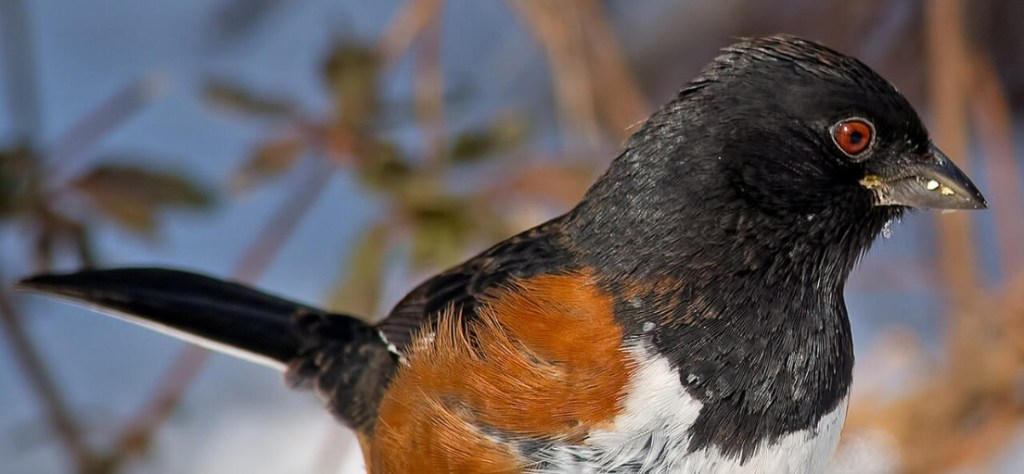
Eastern Towhee: Can the white-eyed subspecies survive even 1.5C climate change?

Pale-eyed and red-eyed forms diverged approximately 18,000 years ago.
Photo by Melissa James/Macauley Library.
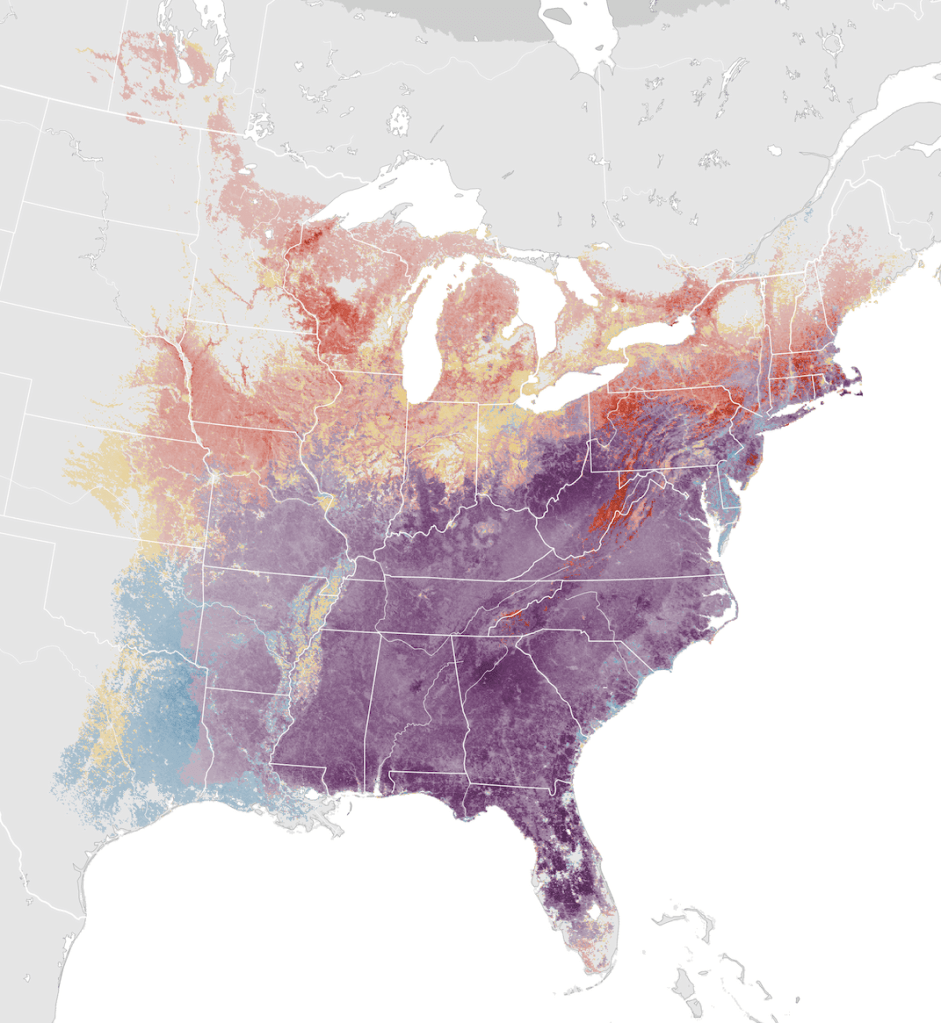
eBird abundance map for Eastern Towhee. It is resident in the southeast, but expands north in summer.

The Eastern Towhee, a bird of scrub and thickets, is a common resident in the southeast United States. One subspecies migrates north in summer.

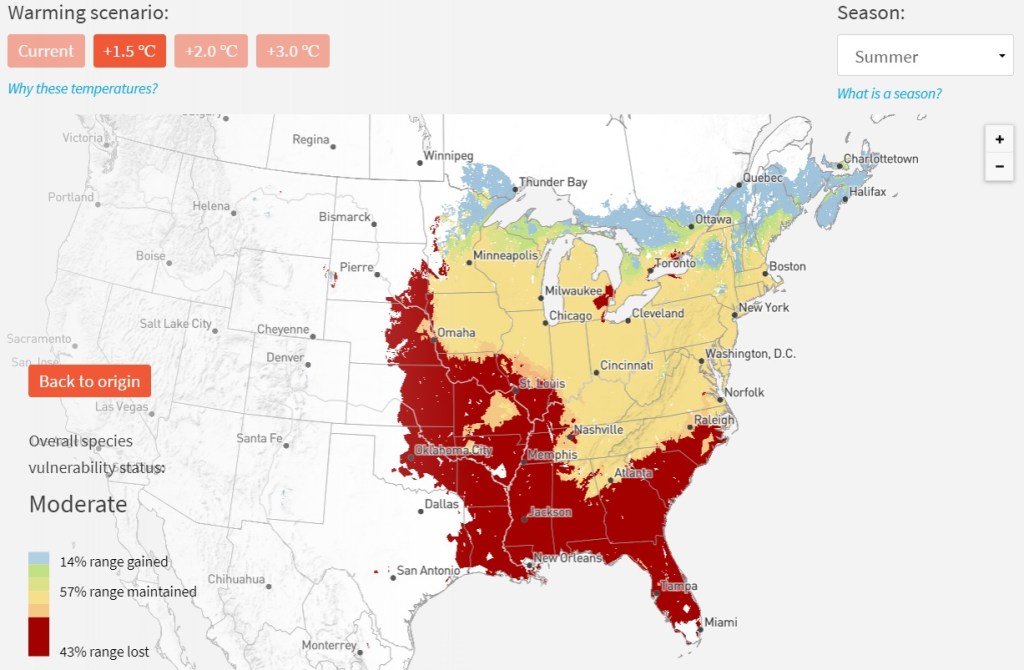
They are a prime example of a species that is considered “Least Concern” by the International Union for Conservation of Nature (IUCN), but “High Risk” in National Audubon’s assessment of birds under climate change. In their 3.0 C scenario, they predict it would lose 83% of its current breeding range, while gaining only 23%.

This is National Audubon’s projection for the Eastern Towhee’s breeding range under just a 1.5C scenario. This would spell extinction for the white-eyed birds of Florida and the deep South.
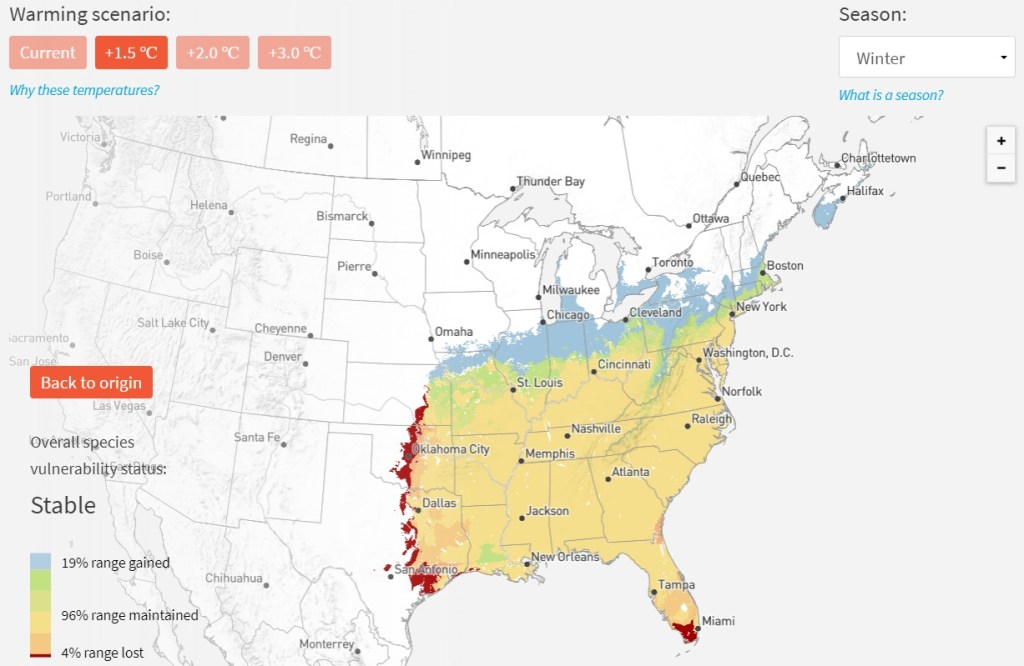
Their winter range is not anticipated to change much.

These projections are consistent with recent literature showing poleward shifts of species ranges– of the northern edge of their range, of the southern edge, and of their range’s geographic center. The predictions for Eastern Towhee are among the most dramatic.

Recent research also suggests that non-migratory and short-distance migrants are more adaptable to climate change than are long-distance migrants, and more able to shift their ranges. Indeed, we are already seeing that with Eastern Towhee. The Audubon projections appear to be in progress.

Based on Breeding Bird Survey (BBS) data, the Eastern Towhee breeding population in Florida has declined over 50% since the late 1990s. The timing of this is consistent with worldwide ecological shifts which began in the mid-1980s.

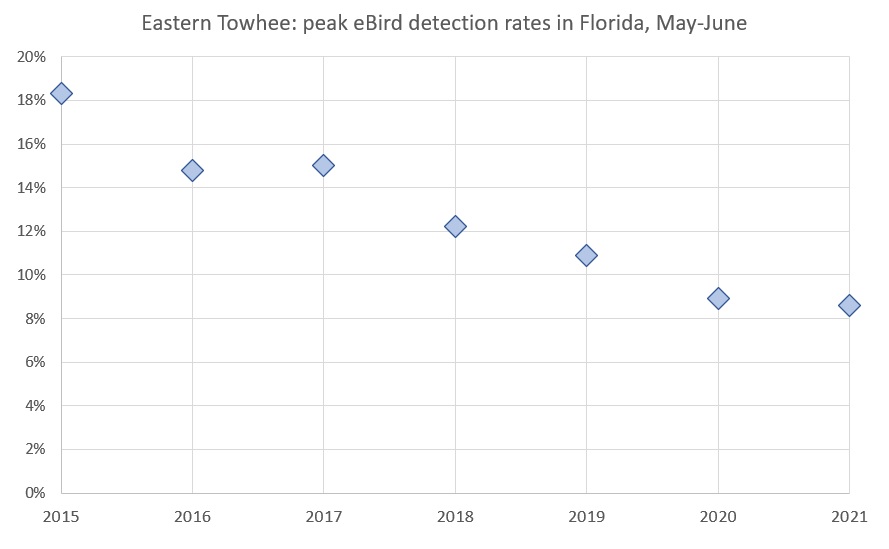
The white-eyed subspecies appears to be already in trouble. eBirders in Florida in May and June are encountering the species half as often as they were just six years earlier.

eBird data from Florida, focusing on frequency of lists reporting the species during the May-June period, shows that the maximum frequency has fallen from 18.3% in 2015 to 8.6% in 2021.

Not all range shifts are due to climate. As a scrub specialist, the Eastern Towhee prefers habitat that is in the act of regrowth, such as after a fire or being cleared. But they don’t want a forest either. To quote the Birds of the World species account for Eastern Towhee: “As farmland is abandoned, successional changes produce suitable midseral habitats that towhees favor, and their numbers increase. But, successional time is against towhees, and their numbers decrease as seres age.” That may be the explanation for the Georgia data (orange dots), which show a decline in the late 60s and early 70s, possibly due to forest growth or land clearance for development, and then a leveling off.  

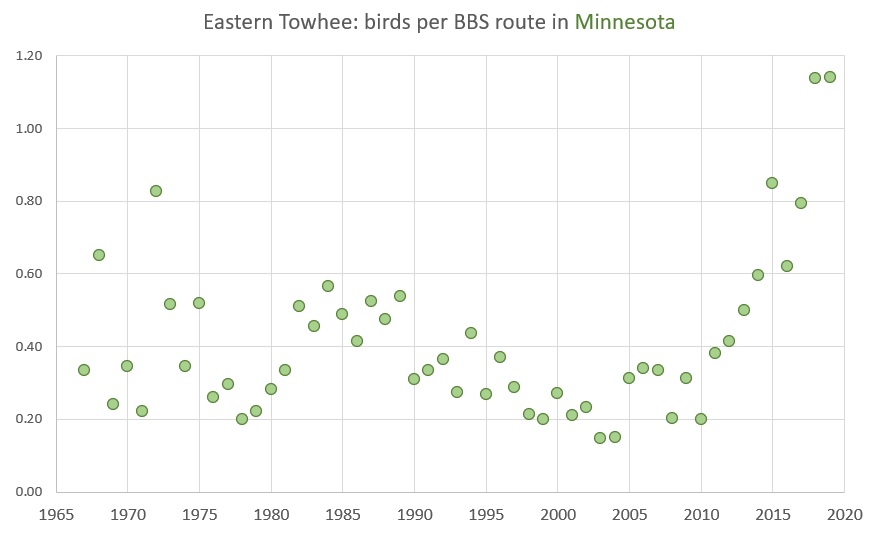
As the climate warms, many species are expanding north and/or declining in the southern part of their range. But these need not happen simultaneously. Opportunities for suitable habitat may open doors in the north, and doors may close in the south, at different times. There is evidence of Eastern Towhee expansion in Minnesota, but look at the vertical axis; it does not compare with the losses in Florida.

In Florida, the white-eyed subspecies faces extinction based on National Audubon’s 1.5C scenario. They appear to have declined dramatically in the past two decades.

Photo from National Audubon website that provides range change projections under 1.5C, 2.0C, and 3.0C scenarios.

For more on climate change impacts on birds, I invite you to join the Birds and Climate Change Facebook group.

Mountain Bird Network seeks eBirders heading into the hills

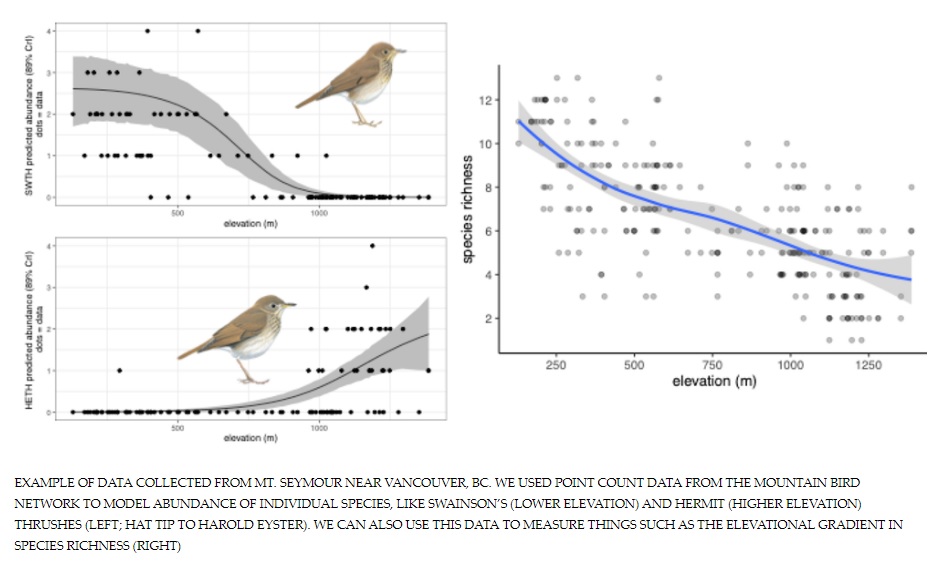
The east side of the Olympics is a staircase of thrushes. The low country is for American Robins. As you get into woodsy habitat, you’ll hear the spiral song of Swainson’s Thrushes. After that, among the tall old growth along the streams, the ethereal Varied Thrush. Finally, up near timberline, you’ll hear singing Hermit Thrushes. Freeman and colleagues are tracking how these ranges are shifting with the climate.

Two 5-minute point counts at each stop as you gain elevation. June 1 to July 15. Entered into eBird. Shared with the Mountain Bird Network.

That’s all Ben Freeman, a post-doc at University of British Columbia, is asking for. And it can be any mountain, any canyon, any road.

The details are here: Mountain Bird Network.

An example of the data and analysis.

And have a great time!

Carolina Wren + Climate Change vs the Polar Vortex

Like so many species, the Carolina Wren is expanding northward. And, like many of those species, this expansion started decades ago, before any measurable climate change, but has exploded in the past decades with climate change.

This phenomenon is most obvious – and even dramatic – among non-migratory species and short-distance migrants. The same thing is happening in the West (e.g. Anna’s Hummingbird, Turkey Vulture, Red-shouldered Hawk, Great Egret, California Scrub-Jay, Black Phoebe, Townsend’s Warbler, and others).

The Carolina Wren has been expanding north since the 1800s due to habitat recovery after deforestation (Haggerty and Morton, 2020 – the Birds of North America (BNA) species account). What makes the recent Carolina Wren data so interesting is that we can clearly see, in its expansion into Canada, its battle with winter weather conditions.

The raw number of Carolina Wrens reported on Christmas Bird Counts in Canada. Over 95% of these come from southern Ontario. The cold waves marked on the graph were particularly record-breaking and long-lasting.

The species is known for “decimation… by severe winter conditions” (BNA) at the northern limits of its range. The same account notes that “severe winters have apparently been infrequent enough during the 20th century to allow populations to expand and move northward.” Indeed, one of the key conclusions of an analysis of climate change in southern Ontario was that there has been “a decrease in the frequency of cold temperature extremes”.  While the wren is aided against cold snaps by bird feeders, the climate trend, at least in Canada, is in its favor. The report noted an overall average increase of 1.5C.

eBird abundance map. The Carolina Wren has primarily been a species of edge habitat associated with moist southern forests.

As the wren expanded, certain record-breaking and persistent cold waves knocked the population back, where it restarted. It’s also clear that it is restarting from a higher position each time, thus building its numbers and continuing its expansion.

The cold snaps denoted on the graph were particularly severe in southern Ontario. A more detailed look at weather data may reveal a more complicated pattern and even greater correlation to warmer winters.

Predicted range changes for Carolina Wren by National Audubon under 1.5C scenario. This map is fairly accurate as the bird continues to colonize the St. Lawrence River corridor.
eBird map for December 2021 showing colonization from Toronto to Ottawa and Montreal and nearly to Quebec City.
A Carolina Wren fluffed up against the cold. Pic from National Audubon website.

Bird names matter: Top ornithologists and organizations endorse name changes for all species named after people

At the American Ornithological Society (AOS) Congress on English Bird Names on April 16, 2021, a host of prominent organizations and individuals endorsed “bird names for birds”, a widespread effort to rename eponymous or honorific species names with more descriptive names, focusing on their physical or ecological attributes. For example, Wilson’s Warbler could become Black-capped Warbler, Townsend’s Solitaire might become Northern or Juniper Solitaire, and Kittlitz’s Murrelet would probably be re-named Glacier Murrelet.

MacGillivray’s Warbler was named by John James Audubon after his friend, William MacGillivray, a Scottish ornithologist who never came to America. Audubon also coined its Latin specific, tolmiei, to honor William Fraser Tolmie, a Scottish employee of Hudson’s Bay Company based at Fort Nisqually during the period of Native removal. Scientific, or Latin names, are subject to international rules and are not the focus of this process.

While specific new names have not yet been chosen, representatives of the American Birding Association (ABA), National Audubon Society, as well as David Sibley and Kenn Kaufmann, all heartily endorsed developing a process to make the changes, noting that new names would engage a larger audience, contribute to greater equity and inclusivity among birders and the interested public, and could aid in public communication and conservation efforts.

The effort has grown out of the national reckoning on racial equality in the aftermath of the George Floyd killing. Movements to change names are underway with regard to parks, mountains, streets, other wildlife, and even rock-climbing routes. Current names generally go back to the eighteenth and nineteenth centuries during European expansion across North America and recall an era of conquest, when species and landforms were “discovered” – and some named after the individual who documented them, or after their friends and colleagues.

An FAQ, full list of the panelists, and a video of the Congress can be found at the AOS English Bird Names website. The direct link to the video is here.

Sibley commented that, the more he learns about the names, “the more they cast a shadow over the bird” and “the name doesn’t mean just the bird anymore. They have baggage.” Out of respect for people and the birds, they “should not have to carry a reminder of our own fraught history.” Choosing between stability and respect, Sibley stated “I choose respect.”

Name changes over social justice concerns began last year when McCown’s Longpsur was changed to Thick-billed Longspur, after widespread outcry because McCown was a Confederate general and involved in the ethnic cleansing of Native Americans. A proposal in 2018 for that name change was roundly rejected. 

Name changes for these reasons are not new; most birders can probably recall the switch from Oldsquaw to Long-tailed Duck in 2000. At that time, the American Ornithologists’ Union, the precursor to the AOS, asserted that the name change was not for reasons of “political correctness” but merely to conform with usage elsewhere.

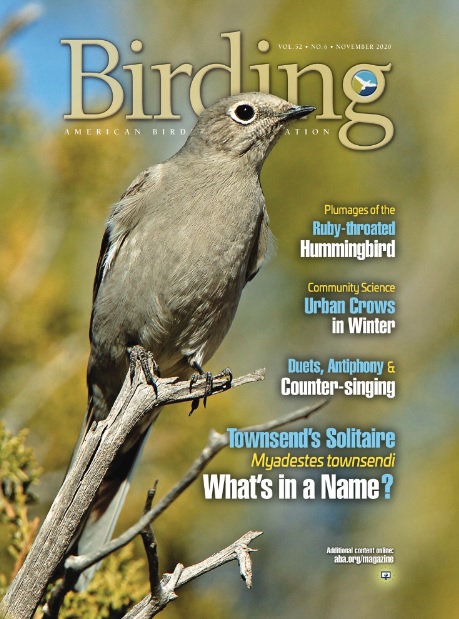
The Bird Names for Birds website includes bios of various people memorialized with bird names. For example, Townsend (of the solitaire, warbler, and storm-pretrel) collected Native skulls for his friend Samuel Morton, author of Crania Americana. The November 2020 issue of Birding magazine focused on name changes, with a strong endorsement by ABA President Jeffrey Gordon and a longer article providing historical background. It is available here for ABA members.

Bird Names for Birds, a group of interested birders, was instrumental in reaching out to the larger organizations to participate in the congress. In their words, “Eponyms (a person after whom a discovery, invention, place, etc., is named or thought to be named) and honorific common bird names (a name given to something in honor of a person) are problematic because they perpetuate colonialism and the racism associated with it. The names that these birds currently have—for example, Bachman’s Sparrow—represent and remember people (mainly white men) who often have objectively horrible pasts and do not uphold the morals and standards the bird community should memorialize.” They describe such names as “verbal statues” that should be removed.

Jordan Rutter of Bird Names for Birds argued that, when reaching out to the public to protect an endangered sparrow, Bachman’s Sparrow has much less appeal than an alternative name rooted in local ecology that the public could identify with. Kaufmann pointed out that Bachmann was a pro-slavery white supremacist and that the species was formerly known as the Pinewoods Sparrow.

In the AOS’s own language, “The Community Congress opens the discussion on the complex issues around eponymous English Bird Names…. The specific aim of the Community Congress is to provide an opportunity for a broad range of stakeholders from the birding and ornithological community to share their viewpoints, including challenges and opportunities from their perspectives, to best inform future next steps to address the issue of naming birds after people.”

The AOS Congress on English Bird Names was superbly moderated by José González, providing a model for the process ahead.

Keepers of various ornithological databases also participated in the Congress, including representatives for eBird, Christmas Bird Counts, Breeding Bird Surveys, and the Bird Banding Laboratory. While noting potential complications with name changes (and changes in four-letter banding codes), they all agreed the hurdles were not insurmountable. Indeed, name changes, as well as taxonomic lumps and splits, occur every year, with name changes being the simplest of the three to address in data management. eBird currently supports bird names in 47 languages, including 14 different versions of English. Where Americans see Black-bellied Plover, Brits see Grey Plover.

Marshall Iliff of eBird pointed out that the effort is also an opportunity to clean up old taxonomic messes, pointing out that Audubon’s Shearwater has been used for eleven different combinations of nine different taxa. In this case, he said, fresh names for specific taxa will provide clarity, not confusion. He embraced a worldwide effort to “dig into the essence of each species” to “find inspired and appropriate names.”

For now, the effort will be limited to primary eponymous English bird names. The effort will not include secondary names (e.g., American Crow, named after the continent, which was named after Amerigo Vespucci). Other problematic names, such as Flesh-footed Shearwater for a bird with pink feet, were not discussed.

Many suggested using Native names for species, though most stated this could be challenging because 1) names from Native languages may have been lost, or 2) most bird species’ ranges span multiple historic aboriginal territories and languages, creating a conundrum over which indigenous word to use. The exception to this is Hawaii, where indigenous names are already in widespread use. Among mammals, moose, raccoon, and skunk are all derived from Algonquian.

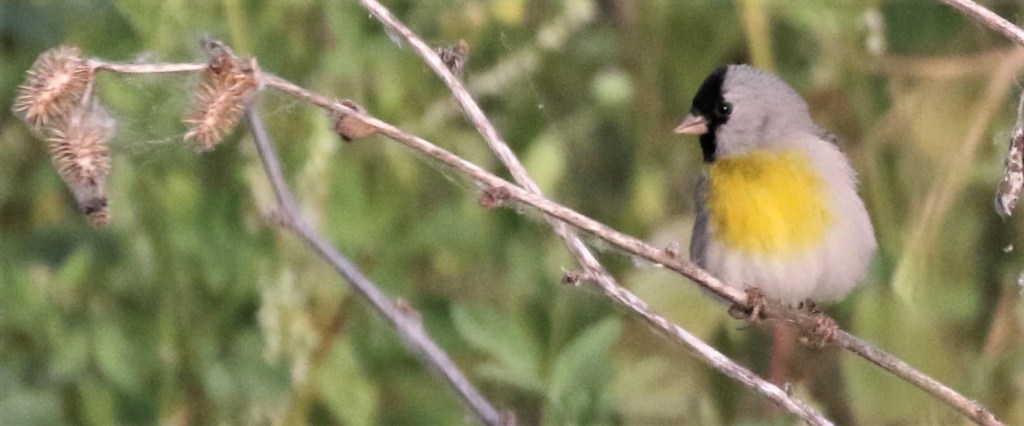
Does Lawrence’s Goldfinch deserve a better name?

Looking at Version 8.0.8 (March 12, 2021) of the ABA Checklist, 115 of the 1,123 species, or a little over 10%, are named after people. Of these, 2 (Bishop’s Oo and Bachman’s Warbler) are considered extinct, and 20 others are Code 4 or 5, meaning they occur extremely rarely in the ABA area (though three of these are regular in Mexico, within the AOS area). The remaining 93 are all Code 1, 2, or 3, and can be expected to be seen in the ABA area regularly.

Here are the 113 non-extinct species from the ABA Checklist.

Ross’s Goose

Steller’s Eider

Stejneger’s Scoter

Barrow’s Goldeneye

Gambel’s Quail

Erckel’s Francolin

Clark’s Grebe

Vaux’s Swift

Rivoli’s Hummingbird

Anna’s Hummingbird

Costa’s Hummingbird

Allen’s Hummingbird

Xantus’s Hummingbird

Ridgway’s Rail

Wilson’s Plover

Temminck’s Stint

Baird’s Sandpiper

Wilson’s Snipe

Wilson’s Phalarope

Kittlitz’s Murrelet

Scripps’s Murrelet

Craveri’s Murrelet

Cassin’s Auklet

Sabine’s Gull

Bonaparte’s Gull

Ross’s Gull

Franklin’s Gull

Pallas’s Gull

Belcher’s Gull

Heermann’s Gull

Forster’s Tern

Salvin’s Albatross

Wilson’s Storm-Petrel

Swinhoe’s Storm-Petrel

Leach’s Storm-Petrel

Townsend’s Storm-Petrel

Tristram’s Storm-Petrel

Murphy’s Petrel

Fea’s Petrel

Zino’s Petrel

Cook’s Petrel

Stejneger’s Petrel

Bulwer’s Petrel

Jouanin’s Petrel

Parkinson’s Petrel

Cory’s Shearwater

Buller’s Shearwater

Newell’s Shearwater

Bryan’s Shearwater

Audubon’s Shearwater

Brandt’s Cormorant

Cooper’s Hawk

Steller’s Sea-Eagle

Harris’s Hawk

Swainson’s Hawk

Lewis’s Woodpecker

Williamson’s Sapsucker

Nuttall’s Woodpecker

Nutting’s Flycatcher

La Sagra’s Flycatcher

Couch’s Kingbird

Cassin’s Kingbird

Hammond’s Flycatcher

Say’s Phoebe

Bell’s Vireo

Hutton’s Vireo

Cassin’s Vireo

Steller’s Jay

Woodhouse’s Scrub-Jay

Clark’s Nutcracker

Bewick’s Wren

Pallas’s Leaf Warbler

Blyth’s Reed Warbler

Pallas’s Grasshopper-Warbler

Middendorff’s Grasshopper-Warbler

Townsend’s Solitaire

Bicknell’s Thrush

Swainson’s Thrush

Bendire’s Thrasher

LeConte’s Thrasher

Sprague’s Pipit

Pallas’s Rosefinch

Cassin’s Finch

Lawrence’s Goldfinch

Smith’s Longspur

McKay’s Bunting

Pallas’s Bunting

Botteri’s Sparrow

Cassin’s Sparrow

Bachman’s Sparrow

Brewer’s Sparrow

Worthen’s Sparrow

Harris’s Sparrow

Bell’s Sparrow

LeConte’s Sparrow

Nelson’s Sparrow

Baird’s Sparrow

Henslow’s Sparrow

Lincoln’s Sparrow

Abert’s Towhee

Bullock’s Oriole

Audubon’s Oriole

Scott’s Oriole

Brewer’s Blackbird

Swainson’s Warbler

Lucy’s Warbler

Virginia’s Warbler

MacGillivray’s Warbler

Kirtland’s Warbler

Grace’s Warbler

Townsend’s Warbler

Wilson’s Warbler

Morelet’s Seedeater

There are also several hybrids (e.g. Brewster’s and Lawrence’s Warblers), prominent subspecies (e.g. Thayer’s Gull and Audubon’s Warbler), and superspecies (e.g. Traill’s Flycatcher) that are used in some databases. It is not clear if these will be addressed at this time.

whit! Sorting out the call notes of western Empidonax flycatchers

After a flurry of migrant Empidonax flycatchers this April in California, a number of us engaged in a discussion about their whit! call notes. Specifically, could we tell Willow from Dusky from Gray just by the whit? Personally, I’m not there yet. I usually only hear them a few times a year, which is insufficient experience, and I suspect there’s individual variation as well as the tricks that wind, humidity, and distance play on sound. But what about analyzing their sonograms with a good recording?

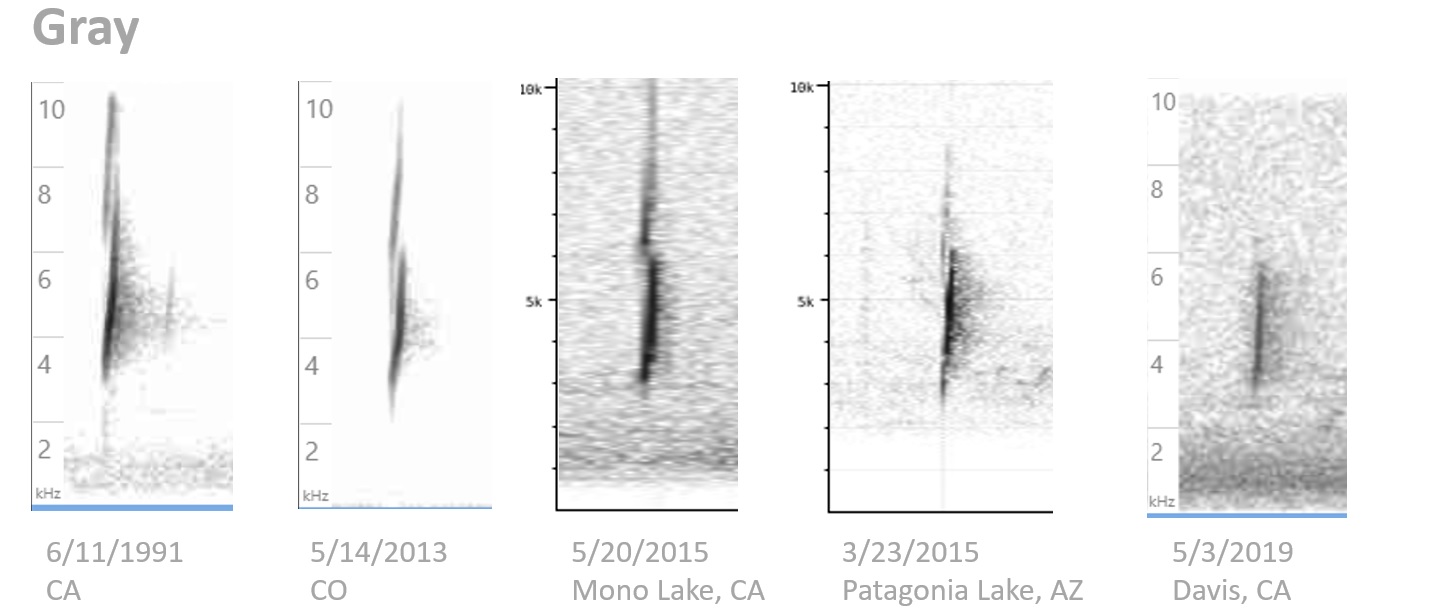
I looked at the very best on-line recordings from the Macaulay Library (collected via eBird, and there’s a collection of the best ones at Peterson Bird Sounds) and from xeno-canto. (Warning: the horizontal axis is different between their sonograms. Xeno-canto sonograms fit about two seconds in the space where Macaulay fits one second of recording, thus compressing the sonogram. Here, I stretched the xeno-canto sonograms horizontally to adjust for that.)

Willow whits

Dusky whits

Gray whits

It appears that Willow, with a good recording, is distinctive, with up to three harmonic tones and that downward slope after the upward slow. To the ear, the Willow whit is softer and sweeter than the others. Dusky and Gray, on the other hand, are both dry sharp whits, and virtually indistinguishable on the sonograms. Gray is more likely to go up to 10 kHz or higher, and that echo line on the first Gray sonogram was consistent on all the calls, at least for that individual recording. For the record, Least was similar to Dusky and Gray, although the triangular dark shadow to the right of the main call tended to be thicker and larger.

iPhone whit

iPhone recording

To the right is a typical iPhone recording, probably a Dusky. Based only on this sonogram, just a shadow of the good ones above, it could be any of the species. The take-home lesson is that one could probably diagnostically identify a Willow whit from a sonogram with a very good recording. The Dusky and Gray whits are too close to call.

Our discussion also focused on spring migration timing and incorporated Hammond’s (as many of these birds are silent). Again, I turned to eBird for some trends.

CLICK TO ENLARGE

whit map

Spring migration for western Empids. These maps are based on 2017-18 data. I excluded a few outliers in each case. Nevertheless, these dates represent the earliest arrivals. Most birds were a week later than the dates shown.

The results are that Hammond’s is the earliest, followed by Gray and then Dusky. For all three, however, there was a pulse of records during the last week of April. Willow is a full month behind the other two. In fact, even in southern Arizona there were very few Willow records before May 10.

Kaufmann empidsMuch has been written about Empid identification. Here’s a link to the Rowland 2009 article in Birding. My personal favorite is the chapter in Kenn Kaufmann’s Advanced Birding. The diagram at left is from the old version; the new one is even better, showing variations within species.
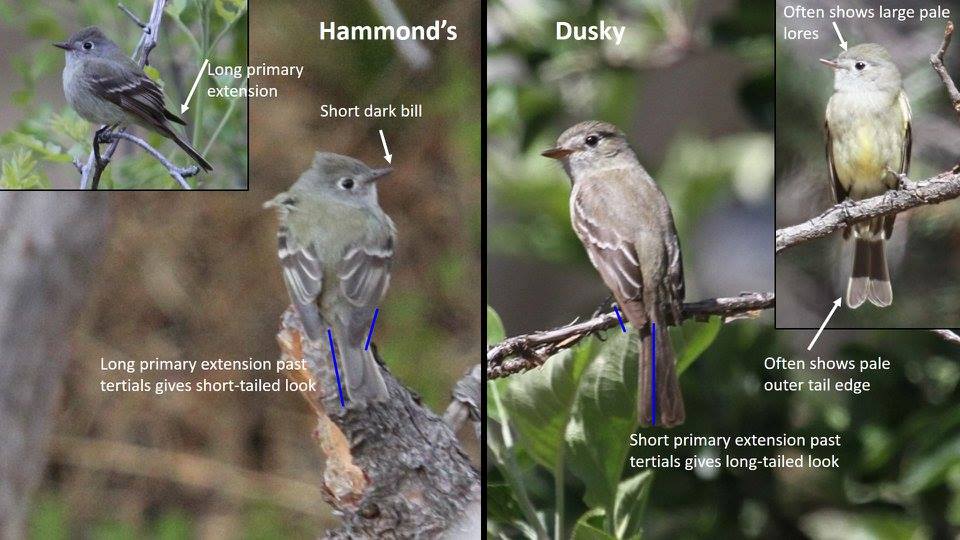
For the Hammond’s/Dusky challenge in spring, I put together the diagram below. These identifications were confirmed by calling birds, which are easily separated (Hammond’s says peep rather than whit).

HammondsDusky

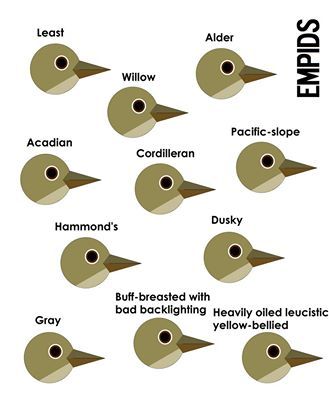
Finally, if you’re still confused, there’s this infamous meme:

empid meme

Two of the nation’s top birding spots threatened by the wall

Of the top 20 birding sites in the entire United States, based on the number of species reported on eBird, six of them are in south Texas. Two of them, Bentsen-Rio Grande Valley State Park and Santa Ana National Wildlife Refuge, are threatened by Trump’s proposed wall.

CLICK TO ENLARGE

RG border map

The map above, taken from an excellent article illustrating all of the natural resources at risk from California to Texas, includes the bird totals for the eBird hotspots associated with the at-risk parks and wildlife refuges. The wall is often constructed hundreds of yards north of the actual border (the Rio Grande River). It typically includes a swath of cleared land on each side of it.  At Bentsen and Santa Ana, the wall threatens to destroy critical remaining habitat and strand the parks in “no-man’s land”, preventing public access. Dozens of articles have been written regarding the impacts to everything from butterflies to ocelots.

Sabal Palm is unique, in that the natural area is south of the wall. Visitors pass thru the wall in order to visit the park. However, there is no guarantee this arrangement will be made at other sites. Should public access be denied at Bentsen, the park could revert back to the Bentsen family per a historical agreement. The national wildlife refuges are especially at risk. As they are already federal properties, the Administration doesn’t have to deal with acquiring private property. Thus, they are the easiest places to build.


The decline of Mountain Plovers in two graphs

I live in Yolo County, California, near Sacramento, where Mountain Plovers used to be an annual winter specialty. Searching for “dirt clods with legs”, we used to be able to find dozens of these unique shorebirds, sometimes over a hundred.

Those days are over. They are now “irregular”, meaning we don’t find them every year. We’ve struck out five of the last eleven years. Before that, we averaged a high count of 72 individuals. The first graph, built from records in the Yolo Audubon Society newsletter, emails to the Central Valley Birds listserv, and eBird, shows the high count each winter in Yolo County.

CLICK TO ENLARGE

MOPL Yolo

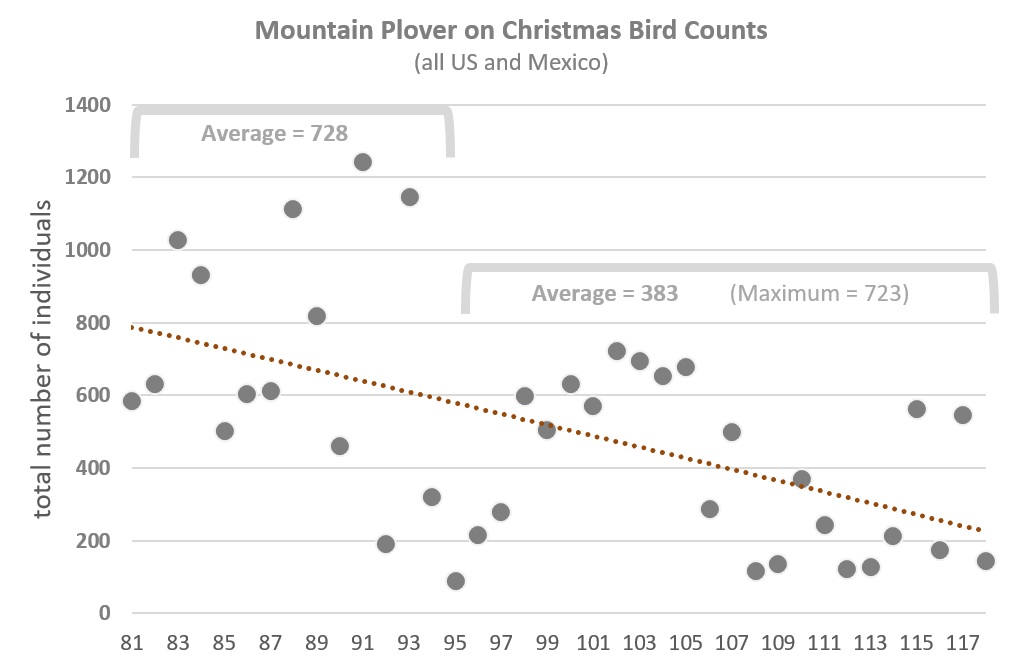
This second graph backs out a bit in space and time, looking at all Mountain Plovers worldwide, starting in 1980. They are a bird of the steppe, breeding mostly on the Great Plains between the Rockies and the flat lands, between the Canadian and Mexican borders. They winter in open country in a vast arc west and south of there, mostly in California, Arizona, New Mexico, and Texas.

MOPL cbc

All the Christmas Bird Counts nationwide, plus Mexico, averaged 728 birds per count thru 1994, but have never hit that mark since. Fewer than 200 individuals have been enumerated six of the last ten years. Adjusted for party hours, the graph basically looks the same.