
Trump’s apparently serious bid to buy Greenland seemed like something out of The Simpson’s or SNL. It is not. It reveals something far more treacherous, like a ploy concocted by the villain in a superhero comic.

Setting aside the massive hubris of white privilege, that land and indigenous people can be bought and sold by colonial powers (and Trump has mentioned trading some US land away to make the deal), and setting aside the question of how to pay for it (perhaps by ignoring Congress and diverting funds from another source, like he did for his wall), his proposal means he believes in climate change and wants to profit from it—from the suffering of billions and the destruction of earth as we know it.
It’s not hard to understand the mastermind of Trump. His strategies are as transparent as a third grader’s plotting to steal cookies. At the Arctic Council meeting in May, Secretary of State Mike Pompeo dismissed climate concerns and instead highlighted “new opportunities for trade” created by the melting ice, the “opportunities and abundance” created by an ice-free Arctic. In preparation for the Arctic summit, Pompeo was probably briefed about the economic opportunities of an ice-free Arctic Ocean—not just the shipping lanes but also the massive reserves of oil under the seabed. And perhaps that briefing mentioned Greenland, with massive reserves of coal and uranium and an estimated 13% of the world’s undiscovered oil reserves.
Pompeo shares the information with Trump. Trump offers to buy Greenland. Ca-ching.
They’ve also figured out that Greenland is melting. And it is melting much faster than climate scientists predicted. A new report by NASA revised its estimate of sea level rise from Greenland alone from 3 feet to 5 feet over the next 200 years. During a heat wave last month, it melted at a rate that it was not predicted to reach until 2070. While billions will be underwater, Trump sees opportunity and abundance.

A dramatic photo of pooling meltwater on sea ice off Greenland. July, 2019.
In the same way he has hijacked the Republican Party and wed it to a small and diminishing demographic (rural white men), he has wedded his personal investment strategy to “disaster capitalism”, a plan to make money off the destruction of the earth. Along with all of Big Oil and the Republican Party, he has a financial conflict of interest with curtailing CO2 emissions. If Greenland was part of his investment portfolio, he’d also have a conflict with solutions to climate change. He’d even have a conflict with a magic technological breakthrough that sequesters carbon. He’d need the ice to melt.
He has become the diabolical villain of superhero cartoons. The desire to make money off the destruction of the earth is not only an impeachable offense, it disqualifies him from any responsible role on the planet. He is a threat to all humanity and the world.
The only superhero to thwart him is us, the unorganized millions. It’s time to stop tweeting about his hair and his wife and his rudeness and his gaffes. It’s time to think strategically and take to the streets. It’s time to make his life a living hell before he does that to the planet.






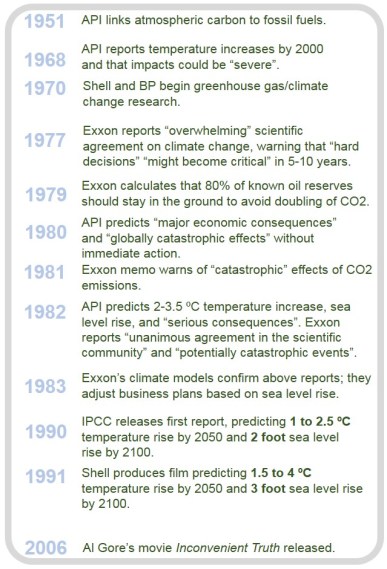 knew pretty much what we now know today. They have been studying, researching, and modeling climate change as a result of their greenhouse gas emissions for over 50 years. Their research was in concert with the scientific community and decades ahead of public knowledge of the problem. Their predictions were typically exactly in line with the rest of the scientific world, and actually more aggressive than predictions by the United Nations’ Intergovernmental Panel on Climate Change (IPCC).

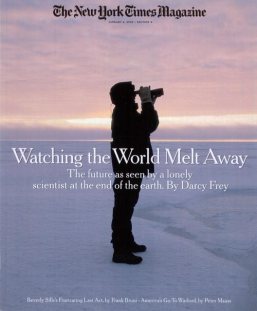 “Watching the World Melt Away: The future as seen by a lonely scientist at the end of the earth.” The article was about seabird biologist George Divoky and his decades of work studying the black guillemot, a high arctic seabird, on Cooper Island off the coast of Barrow, Alaska. The guillemots were struggling to feed their chicks. Their preferred food, Arctic cod, lived at the edge of the sea ice. In the past, this was five miles from the island. Now it was thirty. Divoky, moreover, found himself sharing his tiny island with several hungry polar bears stranded by the vast expanse of open water. At the time, the story was one of the first concrete examples of climate change impacting an ecosystem in way that was easily seen and understood.

 The Putah Creek Christmas Bird Count, an annual effort to count all the birds in a 15-mile diameter circle near Winters on one day each December, has tracked winter bird populations since 1971. In recent years, the number of neotropical migrants found on the count has swelled. These include warbling vireo and Wilson’s and Townsend’s warblers, in addition to the species mentioned above. Perhaps the most dramatic shift in the count data has been with the turkey vulture. With the absence of tule fog, these birds, which rely on warm thermals to give them some lift, have gone from sparse, rarely more than 15 birds on a count through 1985, to over 150 individuals per count in each of the past eight years.
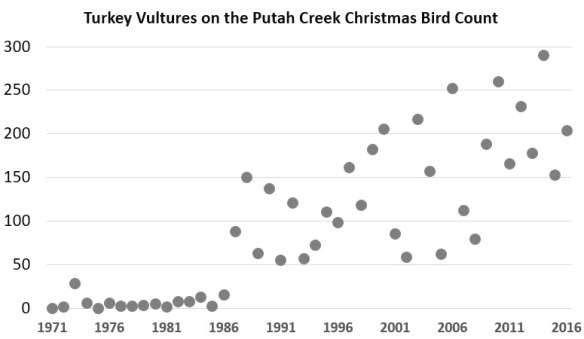 A warming climate is expected to create more increases than decreases in bird life in Yolo County. This is because species diversity is greatest in the tropics. As bird ranges shift north, we expect to see more arrivals than departures. Among the departures are some northern species that are growing scarcer in winter. Most notable is rough-legged hawk, a tundra species that journey south to agricultural areas to eat rodents in winter. They have, however, become decidedly hard to find in recent years, perhaps finding the Willamette Valley and other more northern valleys suitable for their wintering grounds. Another species to watch is the beautiful cedar waxwing, which descend on fruits and berries in the winter months. The more they can find food in the north, the less likely they will come this far south. They are erratic from year to year, however, so it is too early to identify a trend.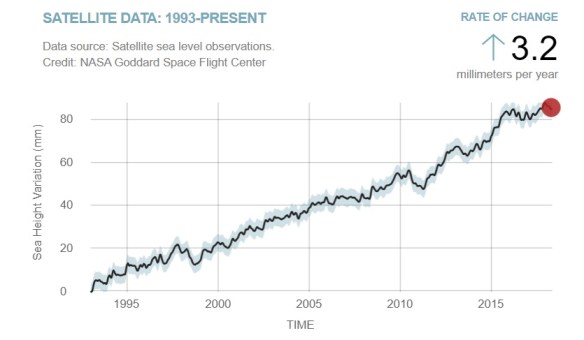
 The Cottonwood Post