There are 21 subspecies of Spotted Towhees, but only three of them occur in the Pacific Northwest. Even then, there is confusion.
Our local oregonus birds, like so many PNW subspecies, are dark and dusky. I call them Nearly-spotless Towhees. But sometimes in winter we see more spotted ones. In my quest to uncover the differences between curtatus and arcticus, the most likely candidates, I discovered there are more questions than answers.
Figure 1: The breeding ranges of oregonus, curtatus, and arcticus, the only three subspecies that occur in the northern US and southern Canada. The data (in red) is from summer eBird reports. The solid lines reflect the crude subspecies map in Birds of the World (in Figure 2 below). The dotted lines and question marks were added by me; the dotted lines reflect obvious breaks in breeding densities along the Continental Divide, rather than transecting riparian corridors where there are lots of towhees. An analysis of their songs (at the bottom of this post) suggest my dotted lines are more accurate, and the breeding birds in interior British Columbia, Washington, and Idaho are actually curtatus, not arcticus.
The confusion goes back to the 1800s. To quote from Rick Wright’s Sparrows of North America (2019), the taxonomy of Spotted Towhees is a source of “much confusion.” He’s actually quoting William Brewster from 1882. Yet, 137 years later, Wright spent the next 15 paragraphs describing decades of confusion – which persists to this day.
According to the Birds of the World (BOW) species account: “There exists no review of subspecies and no modern, quantitative study of geographic variation” outside of Mexico and the Pacific Coast (which was studied by Swarth in 1913).
Because there are so many subspecies – some of questionable legitimacy – they are grouped. Even the groupings are confused.
CLICK TO ENLARGE
Figure 2: Spotted Towhee subspecies with BOW and Pyle groupings.
At present, BOW divides the 21 subspecies into 5 groups. Of relevance to the PNW, oregonus is in the oregonus Group, curtatus is in the maculatus Group, and arcticus is by itself, presumably because it the only Spotted Towhee that is entirely migratory and it also shows the most sexual dimorphism – that is, the female arcticus is quite distinctive.
(There are other Mexican subspecies separate from all of this, such as soccorroensis, which has been considered a separate species altogether.)
Because eBird uses the BOW approach, birders in PNW coastal regions encountering a heavily-spotted Spotted Towhee typically see these options on their app:
By “maculatus Group,” eBird, at least in the PNW, implies curtatus. Though arcticus is not listed, it does tempt birders to figure out how to distinguish arcticus from curtatus, because simply using “maculatus Group” on eBird implies the bird is not arcticus.
Oregonus is largely resident (though some go south in winter). Curtatus retracts from the northernmost part of its breeding range. Highly migratory, arcticus winters entirely south of its breeding range. Both are candidates to visit the West Coast of Cascadia, though curtatus is far more likely.
Despite its proximity (and the BOW range map), there are no confirmed eBird records of arcticus in Washington, and Wahl et al (2005), Birds of Washington, assert only oregonus and curtatus are expected. British Columbia has just two winter records for arcticus (2014 and 2016), both from south Vancouver Island, and one July record from just north of the Washington/Idaho border (perhaps based on the BOW map?).
Peter Pyle’s Identification Guide to North American Birds, 2nd Edition (2023) suggests a very different taxonomy (though tentative, as we all still await a DNA study). His 1st edition was similar to BOW, but even then he had arcticus with curtatus in what he called the Interior Group. In his 2nd edition, oregonus is limited to just itself; the rest are in the coastal megalonyx Group. (Peter tells me he’s suggesting reducing Spotted Towhee’s 21 subspecies down to seven, based on morphology.) As with his 1st edition, all the interior subspecies north of Mexico City are in the same group, which he now calls the arcticus Group. The maculatus Group is reduced to just four subspecies in southern Mexico and Guatemala.
By putting curtatus and arcticus together in the same group (and suggesting they be merged?), Pyle makes our lives easier – we don’t need to worry about the identification challenge to use the eBird subspecies offerings. Except Pyle calls it the arcticus Group, while eBird calls it the maculatus Group.
Let’s set aside the taxonomic and range map questions. Can we even tell them apart? Answer: sometimes.
Identification
Focusing on oregonus, curtatus, and arcticus, I’m relying on BOW, Wright, Pyle 1st and 2nd editions, photos on eBird, and personal observations (at least for the first two subspecies). Note that upperpart color tone varies depending on lighting, and the differences are subtle. Likewise, dorsal spotting appears to vary tremendously across individuals, and varies with angle of view and posture of the bird due to feather ruffling. Tail spots (the big white spots on the underside) may be the most definitive, yet there is overlap between forms and often they are difficult to see.
These sources also discuss how pale or bright the rufous flanks are. I’ve not included this, as the photos seem quite variable in this regard, probably due to lighting.
Of all the Spotted Towhee subspecies, Sibley only illustrates oregonus (which he calls the Pacific Northwest form) and arcticus (the Great Plains form), the least- and most-spotted forms.
oregonus
curtatus
arcticus
Upperpart color tone
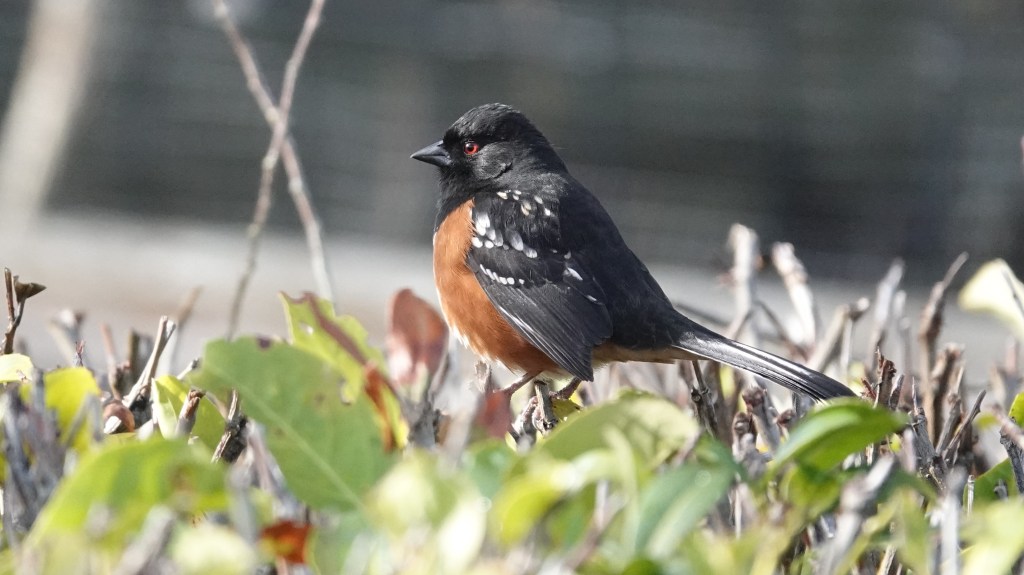
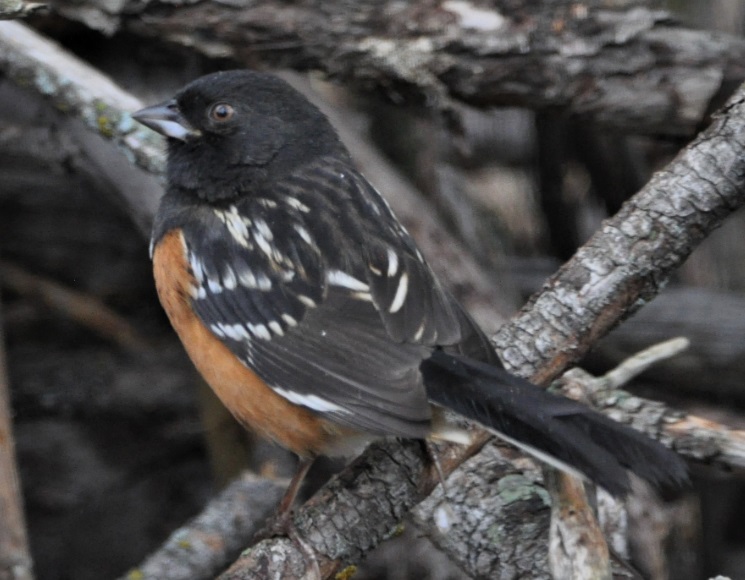
Male: glossy black; any streaking/mottling variable, but often quite limited. Female: dull black, sometimes with a hint of brown, with faint bold black and dark gray streaks on the back.
Similar to oregonus, but less glossy, more flat black in male.
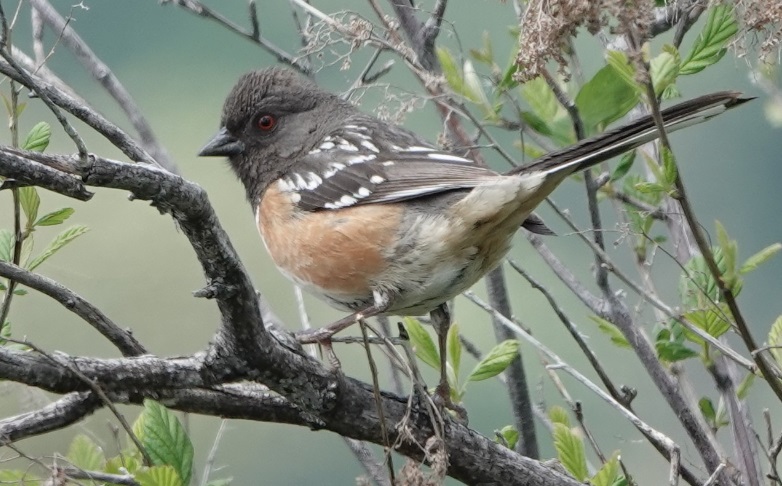
Male: dull to grayish black with bold black and gray streaks on back. Faint olive tone to rump. Female: brownish; with narrow blonde streaks on back.
Dorsal spotting
White spots largely limited to the shoulder area, with a line of white spots along the scapulars; back largely dark.
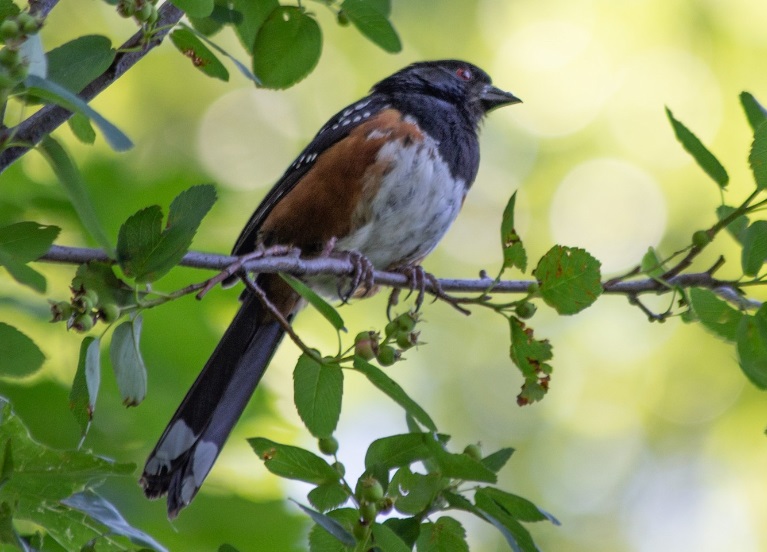
White spots coalescing into bright white streaks in shoulder area, with smaller spots extending onto back.
Similar to curtatus with even more white spotting. May have blondish streaks on back.
Tail spots
About ¼ to 40% the length of the tail. (Pyle: 12-25 mm long on r6)
About 1/3 to ½ the length of the tail. (Pyle: 22-35 mm long on r6)
Can be ½ to 3/4 the length of the tail. (Pyle: 27-42 mm long on r6)
The National Geographic Society guide, 3rd edition, illustrates these tail spots and undertail coverts – dark in oregonus; paler in every other form. I assume curtatus would be similar to montanus. Note that tail spot sizes have considerable variability (see chart above). Thanks to Dave Irons for alerting me to this illustration.
The photos below are mine or from eBird. It is frustratingly difficult to find photos of females in summer when they should be on their breeding range, and thus known.
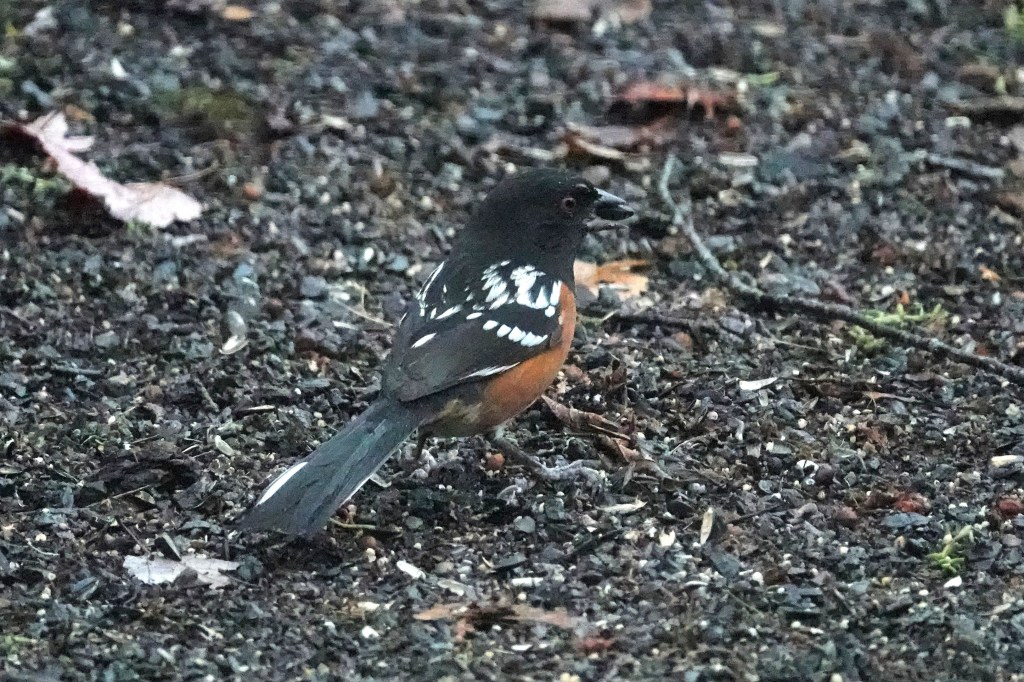
Figure 3a: oregonus male; Port Townsend, WA; 6 Jan 2022. A typical nearly-spotted look. Note slight mottling on back.Figure 3b: oregonus male; Port Townsend, WA; 4 Mar 2024.Figure 3c: oregonus male; near Issaquah, WA; 21 Jun 2019 (from https://ebird.org/checklist/S67832978 Glen Chapman). This bird is showing a lot of white.Figure 3d: oregonus male; Port Townsend, WA; 27 Jun, 2023 (from https://ebird.org/checklist/S142894263 Michael Long). Illustrating rather small tail spots, only about 1/4 the length of the tail.Figure 3e: oregonus male; Port Townsend, WA; 16 Mar 2024. This one has larger tail spots, about 40% of the length of the tail, which would overlap with curtatus. But the undertail coverts are dark rufous.Figure 3f: oregonus female; Port Townsend, WA; 10 Mar 2024. A typical female, showing some back streaking, visible in good light.Figure 4a: curtatus male; near La Grande, OR; 30 Jun 2023 (from https://ebird.org/checklist/S143142401 Glenn Pannier). Much more boldly streaked white than any oregonus.Figure 4b: curtatus male; near Summer Lake, OR; 25 Jun, 2012 (from https://ebird.org/checklist/S100771094 Scott Carpenter). Note the tail spot, nearly 1/2 the length of the tail, and the undertail coverts are paler.Figure 4c: curtatus female; south of Asotin, WA; 25 May, 2023 (from https://ebird.org/checklist/S139221422 Dave Koehler).Figure 5a: arcticus male; near Crawford, NE; 15 Jun 2019 (from https://ebird.org/checklist/S57397630 Steven Mlodinow). Note the tail spots over 1/2 the length of the tail, and the paler undertail coverts. Figure 5b: arcticus male; South Sioux City, NE; 27 Oct, 2022 (from https://ebird.org/checklist/S121410819 Bill Huser). Note the boldly streaked back, though this bird is currently showing only modest white spots, which could be due to ruffled feathers. Many arcticus pics on eBird are wintering in areas where Eastern Towhee occurs. That’s why they got their picture taken and were identified to subspecies.Figure 5c: arcticus male; south of Bismarck, ND; 16 Jun, 2021 (from https://ebird.org/checklist/S90269105 Ted Wolff). Note the large white tail spots, well over 1/2 the length of the tail.Figure 5d: arcticus female; near Dickinson, ND; 4 May, 2018 (from https://ebird.org/checklist/S45246538 Jesse Kolar). Note the brownish hood and buffy streaks on the back.Figure 5e: arcticus female; Ontario, CAN; 12 Feb 2021 (from https://ebird.org/checklist/S81352507 Brad Carey). Another out-of-range arcticus pic, illustrating the distinctive fawn brown female with buffy streaking on the back.
Songs
An analysis of their songs suggest a different story — that oregonus and curtatus are very close to each other, but arcticus is quite separate, and with aspects similar to Eastern Towhee.
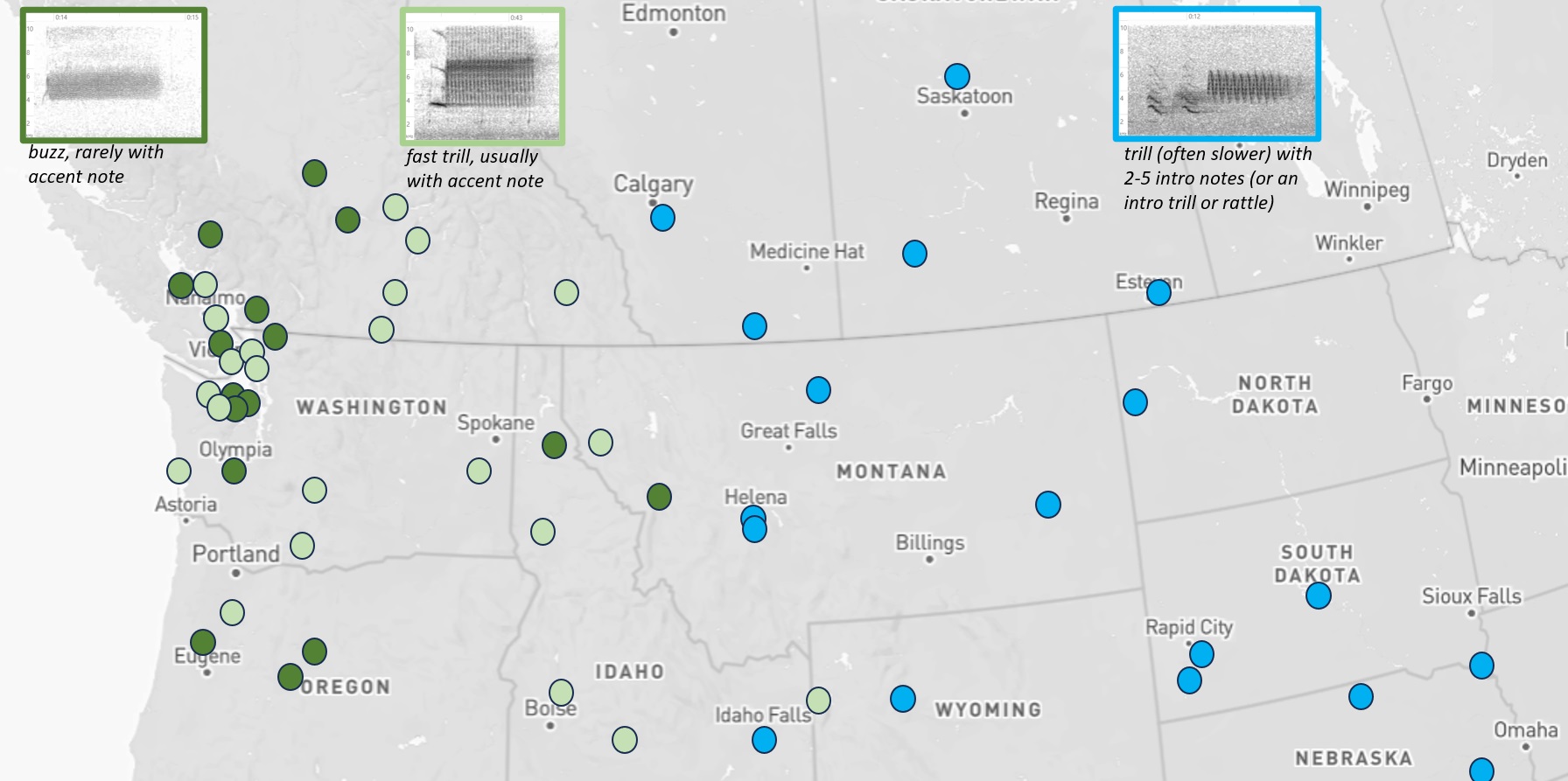
Spotted Towhees give two types of songs: a buzz or trill; and a slower electronic rattle or what I call the “shaka-shaka” song (example: https://macaulaylibrary.org/asset/587645701). I focus only on the former, and limit my window to May thru July, focusing on breeding birds in their summer range. They all give a distinctive “mew” call, quite different from Eastern Towhee, and rarely a few odd calls, such is a sharp “piew” that sounds like an Evening Grosbeak (example: https://macaulaylibrary.org/asset/447207011)
On to the buzz or trill songs. There are basically three different types:
The buzz (dark green on the map). Example: https://macaulaylibrary.org/asset/584320661. This is often too fast to see the distinctive notes (vertical lines) on an eBird sonagram, unless it’s a very high quality recording. It seems more common on the Pacific slope (thus, oregonus), but is also given in the curtatus range. I could lump #1 and #2 here, as there seems to be a cline between them.
The fast trill, often with a high-pitched introductory accent note or squeak (light green on the map). Example: https://macaulaylibrary.org/asset/464938911. The accent note seems more common and pronounced in the interior (the curtatus range). The same bird can give both the buzz and the fast trill.
The trill with 2 to 6 sweet or scratchy intro notes, or even an intro trill (light blue on the map). Example: https://macaulaylibrary.org/asset/104621711. This song is the only one recorded on eBird in the arcticus zone, and it may be diagnostic for arcticus. Birds further east and around the Black Hills seem more likely to have more than two intro notes or an intro rattle. This song can be quite similar to Eastern Towhee, though Eastern typically has two different intro notes. With arcticus, the intro notes are alike. I found one exception, an arcticus with two different intro notes: https://macaulaylibrary.org/asset/220722981. (I can add another recording to the data from my personal experience with arcticus. Here is a song which I recording along the Cannonball River, Standing Rock Sioux Nation, in June 2024. It has 3 to 4 intro notes: https://macaulaylibrary.org/asset/620346161.)
CLICK TO ENLARGE
Figure 6: Trill songs by type, as posted to eBird, using only data from May – July, all years.
The map of song types also suggests the BOW map of subspecies is indeed off. The song type I’m associating with arcticus seems largely limited to east of the Rockies, though it does cross the Continental Divide and extend further west near Idaho Falls and also into eastern Utah near Dinosaur National Monument (not on map). That is beyond the scope of this post.
Summary
A heavily-spotted Spotted Towhee in western British Columbia or Washington, presumably in winter, is far more likely to be curtatus than arcticus. In eBird you would choose “maculatus Group,” even though, for Pyle, that would mean a form from Oaxaca or further south. Identification can be made by the back spotting and size of tail spots, though both are subject to overlap in appearance.
Figure 7: apparent curtatus male; Port Townsend, WA; 22 Nov 2022. Out-of-range winter bird in my backyard.
arcticus vs curtatus
arcticus can be separated from curtatus if: 1) it sang its distinctive song (unlikely in winter?); 2) the tail spots were large, more than 1/2 the tail length; 3) this was supported by a streaked back (with blonde or grayish streaks); and/or 4) it was a female, which are distinctive.
Thanks to David Bell and the Cascadia Advanced Birding Facebook group for alerting me to Pyle’s treatment of these birds, and for inspiring me to do this deep dive. And thanks to all who posted pics and audio to eBird! I’ll never look at towhees the same again.
References
Bartos Smith, S. and J. S. Greenlaw (2020). Spotted Towhee (Pipilo maculatus), version 1.0. In Birds of the World (P. G. Rodewald, Editor). Cornell Lab of Ornithology, Ithaca, NY, USA. https://doi.org/10.2173/bow.spotow.01
Dunn, J.L. and Alderfer, J. eds., 1999. Field guide to the birds of North America, Third Edition. National Geographic Books.
Pyle, P., 2023. Identification guide to North American birds: a compendium of information on identifying, ageing, and sexing” near-passerines” and passerines in the hand. 2nd Edition. Slate Creek Press.
Pyle, P., 1997. Identification guide to North American birds: a compendium of information on identifying, ageing, and sexing” near-passerines” and passerines in the hand. Slate Creek Press.
Wahl, T.R., Tweit, B. and Mlodinow, S., 2005. Birds of Washington.
Wright, R., 2019. Peterson reference guide to sparrows of North America. Peterson Reference Guides.
Whether you want to nerd out on gull molt or argue over Olympic vs Glaucous-winged Gull criteria, this is your one-stop shop. This is my primer on gull identification and frequency in Puget Sound, from the perspective of Port Townsend. Most of these pics are from Port Townsend or elsewhere on the Olympic Peninsula, though a few are from farther afield.
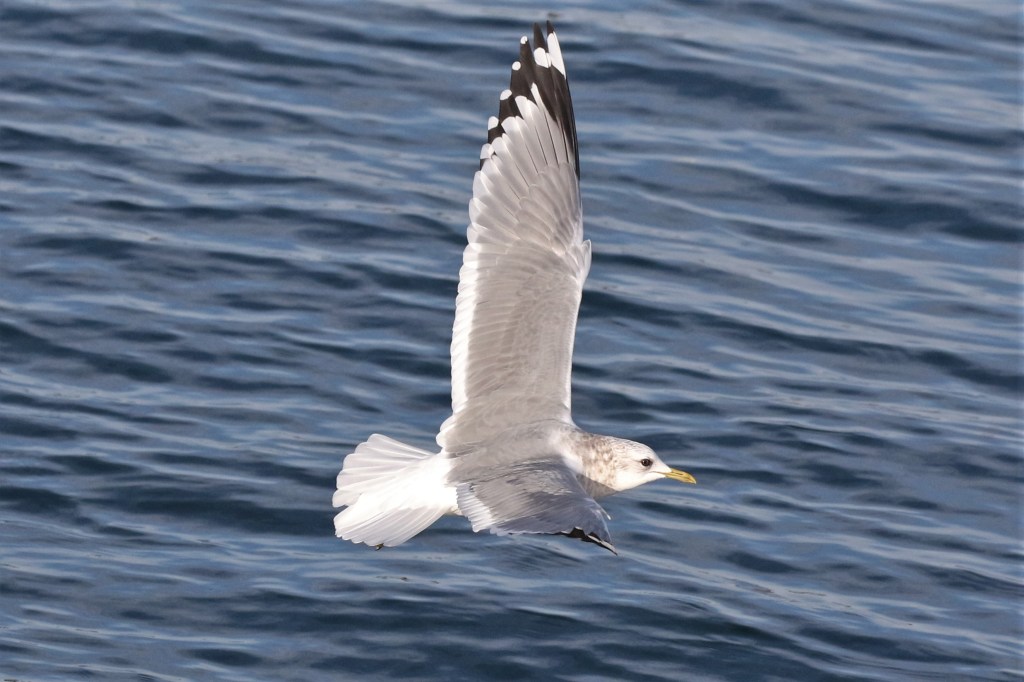
I present them roughly in order of abundance. I start with the forms I see in numbers at various times through the year: Olympic, California, Short-billed, Heermann’s, and Bonaparte’s.
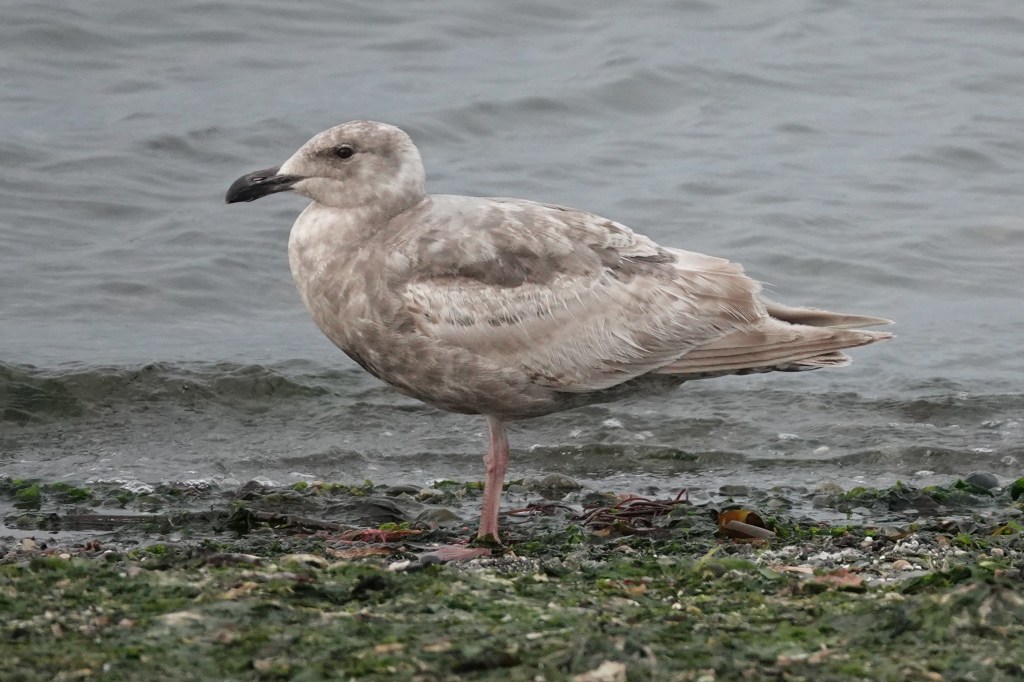
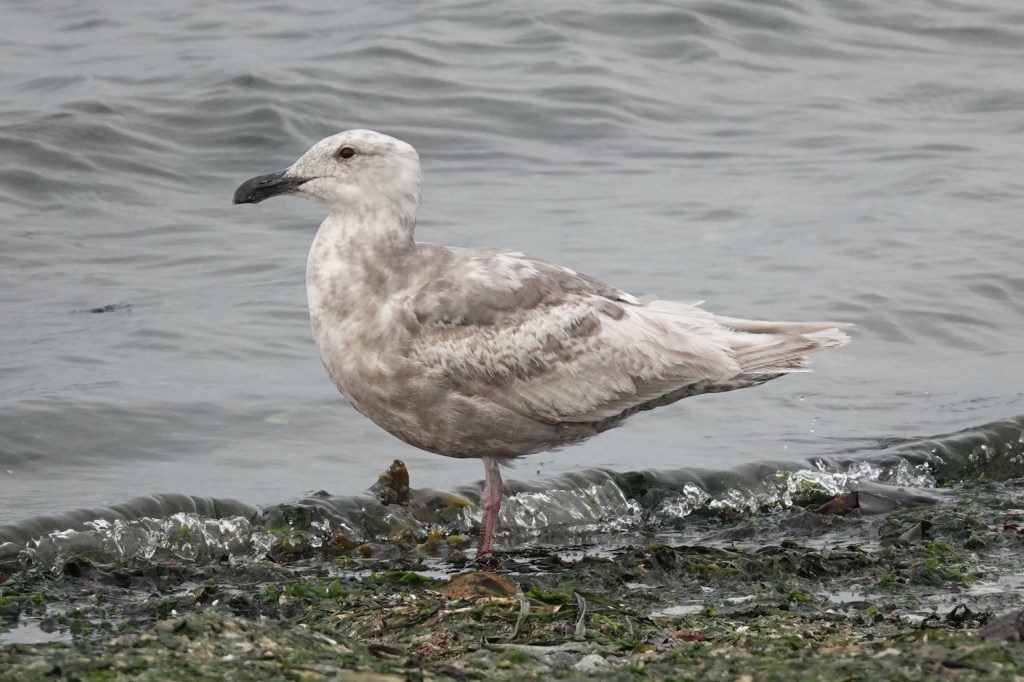
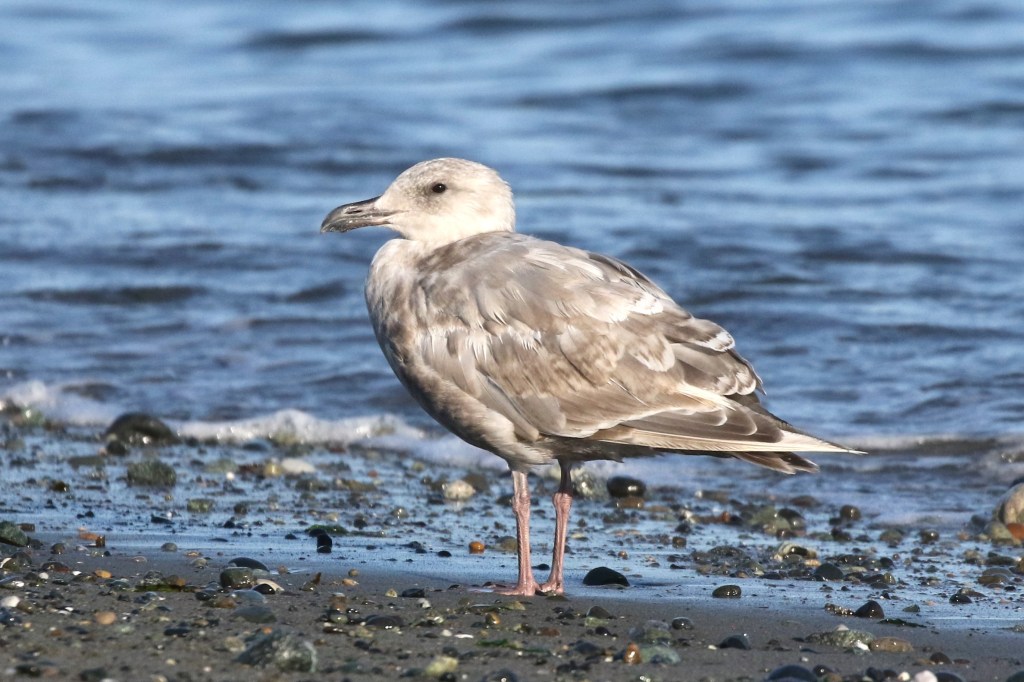
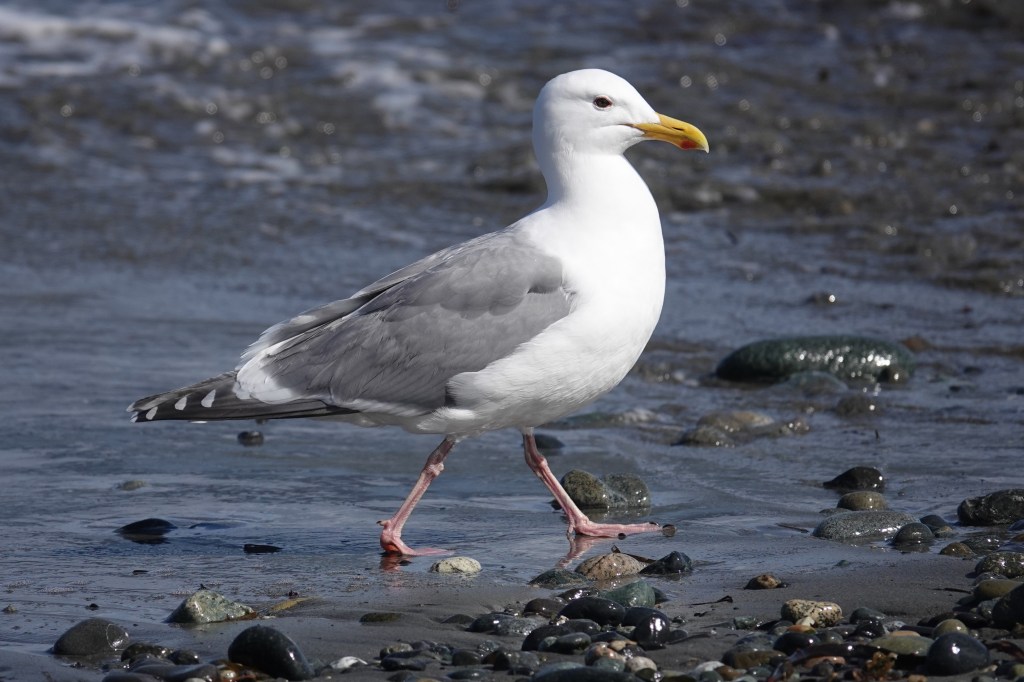
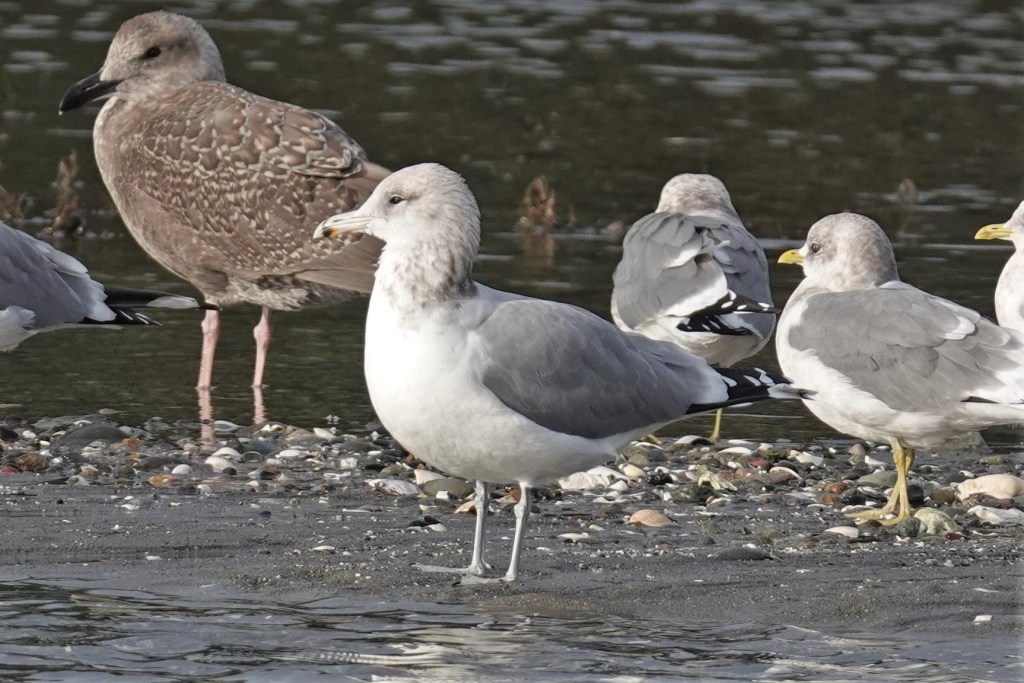
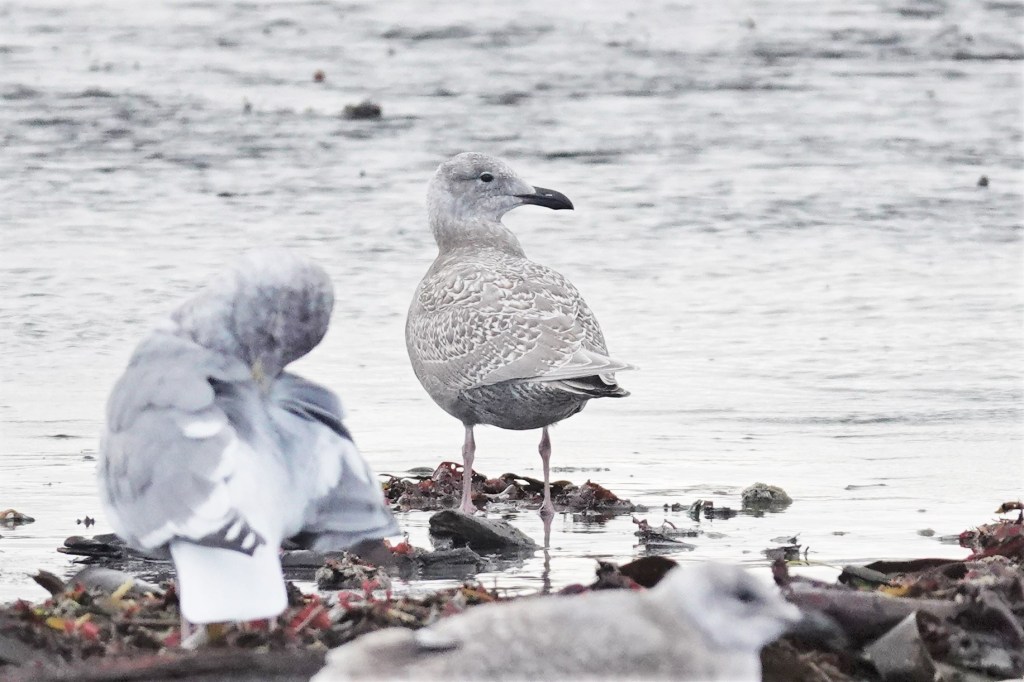
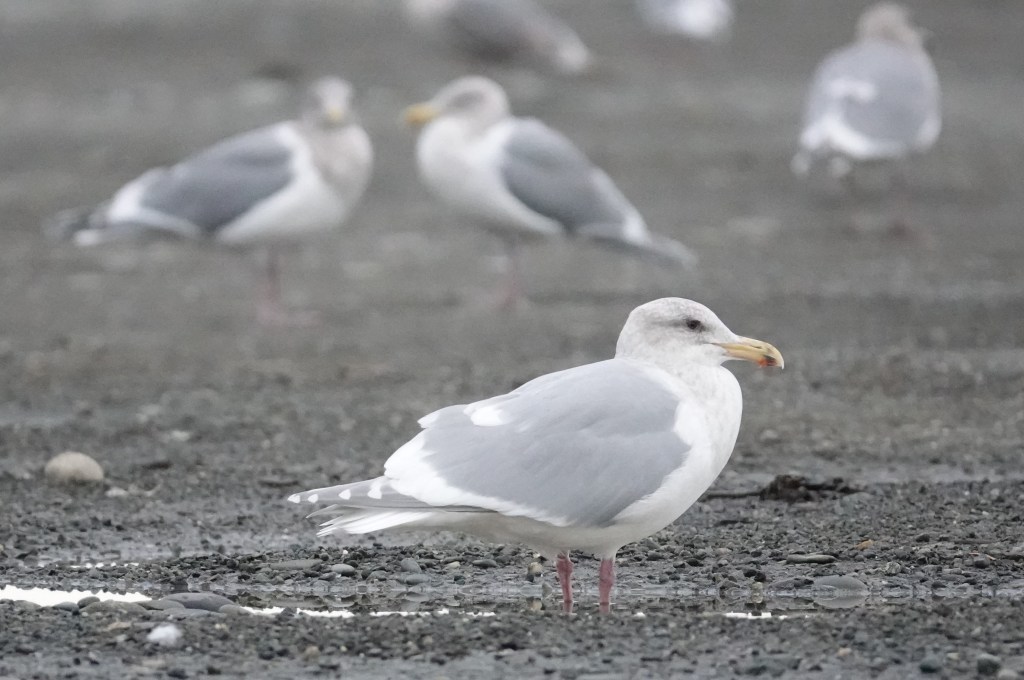
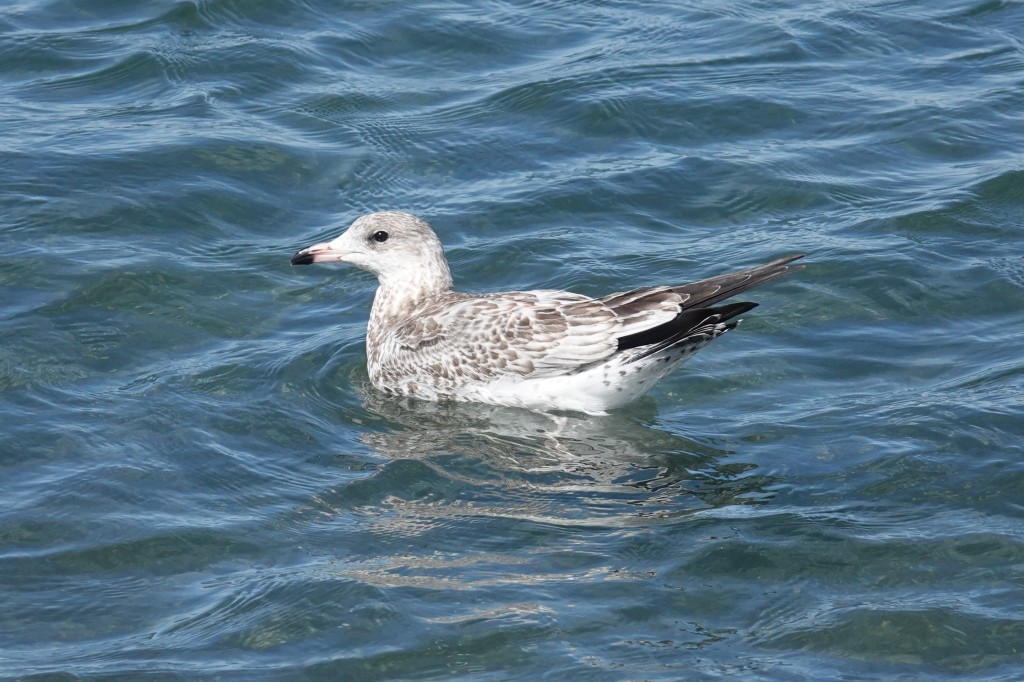
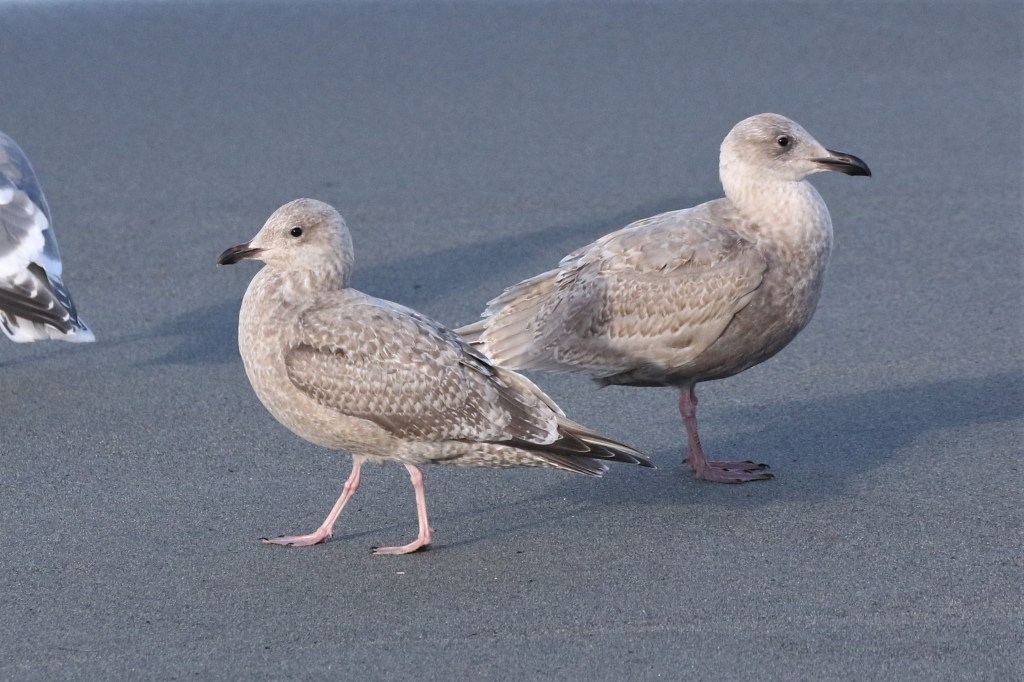
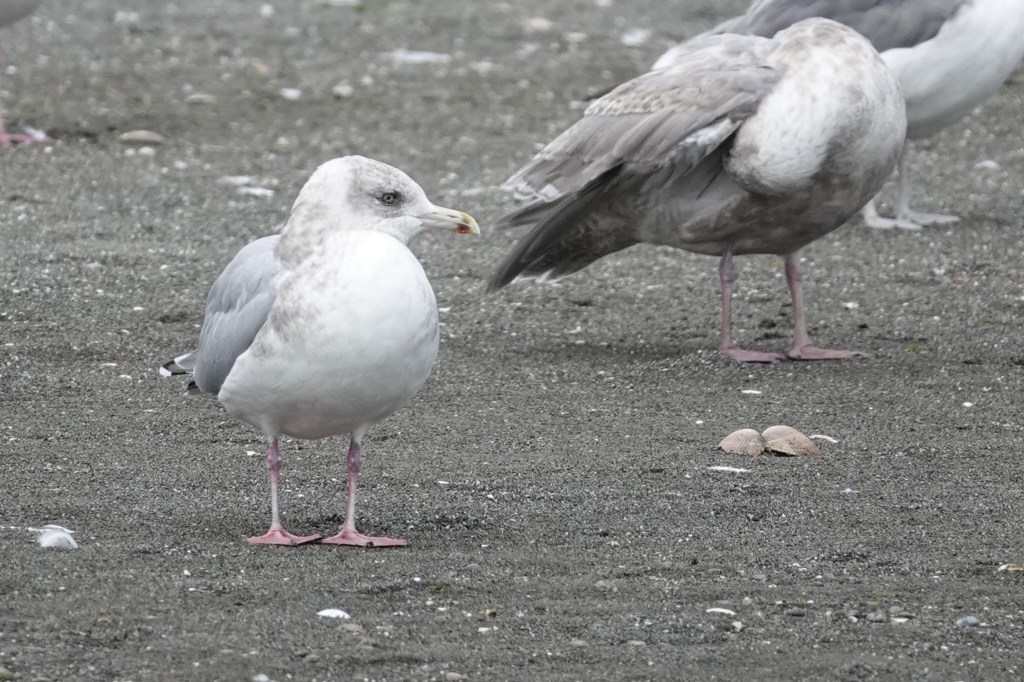
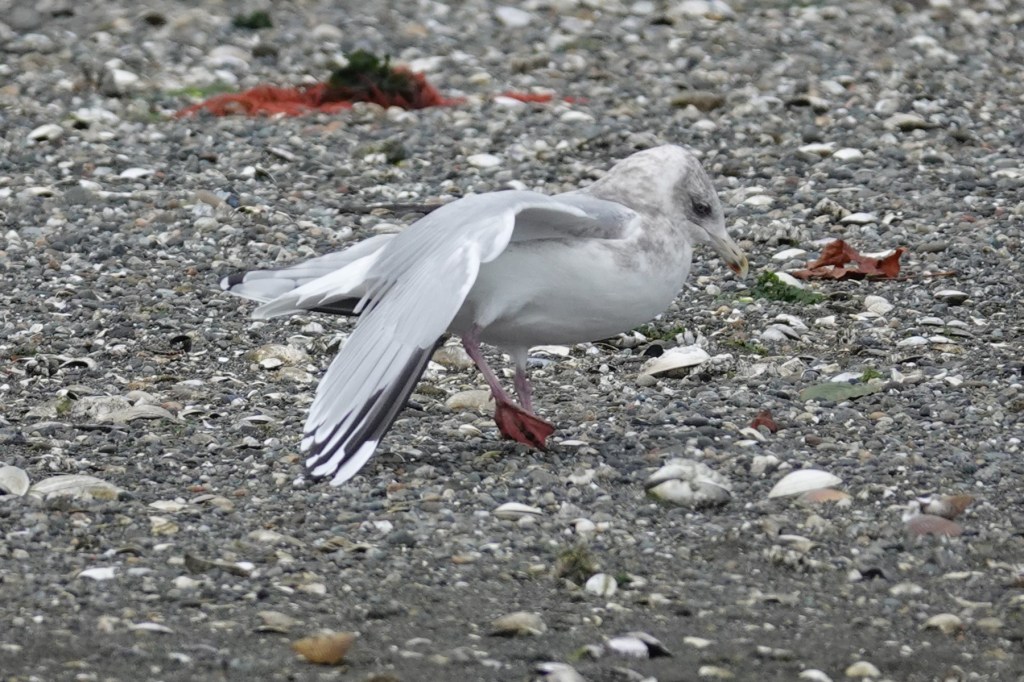
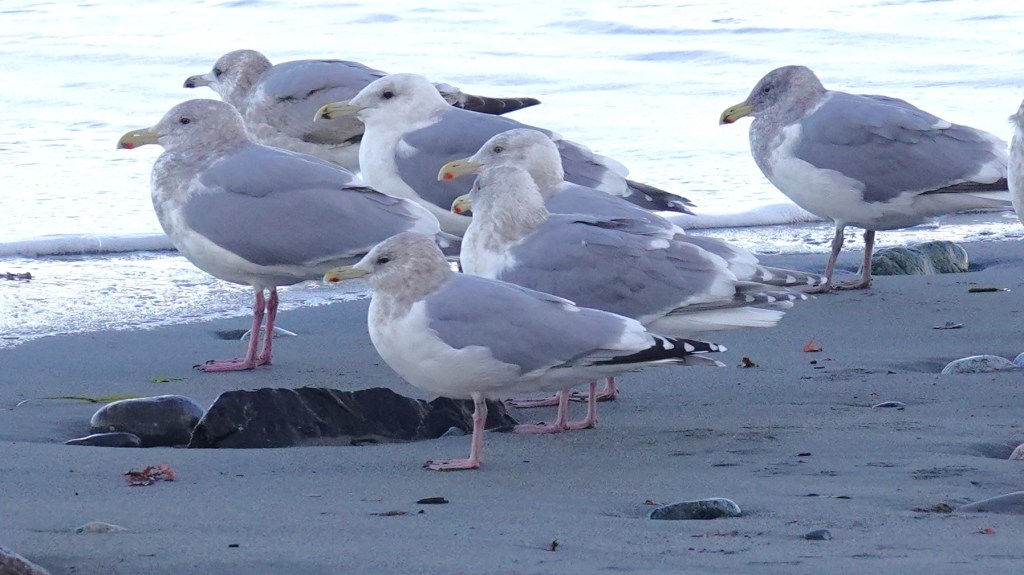
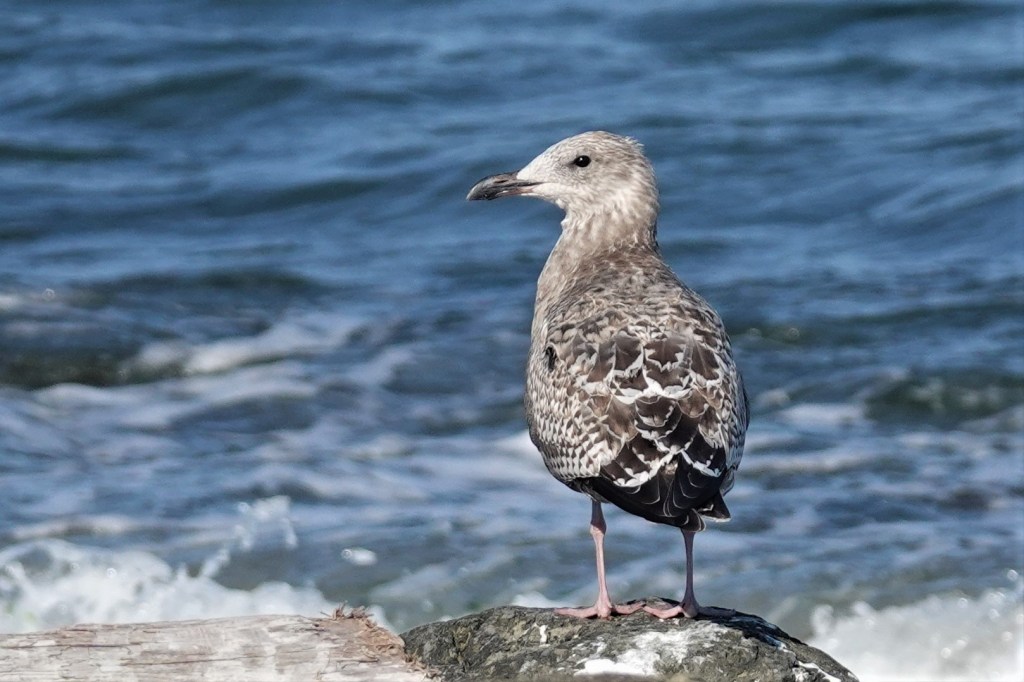
Then I move onto others I see in small numbers: Glaucous-winged, Ring-billed, Thayer’s Iceland, and Herring.
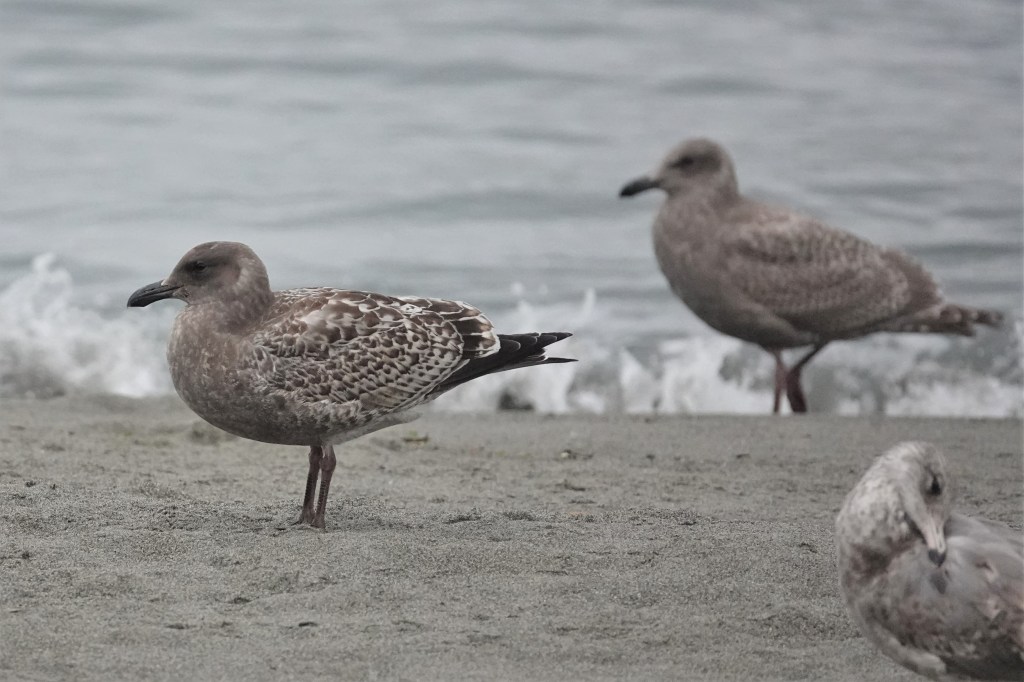
These regularly-occurring forms can practically be identified by bill, head, and body shape. These are all first cycle birds here. A word of caution: there is some variability in bill shape – and it can really change from one still photo to another based on angle and lighting. Also, male gulls are 15-20% larger than females, so size can be a moving target.
Finally, I cover some I rarely see: Western, Cook Inlet, and Glaucous.
Gulls take several years to reach adulthood – three for the smaller gulls, four for the larger ones. During this time, they molt and fade and molt and fade. Season is everything. Gull identification in fall, when the birds are fresh and crisp, is completely different from spring and summer, when they are a faded, tattered mess. With each of these taxa, I’ll present the photos in order of age, so we’ll follow them as they age thru the months and thru the years.
Western x Glaucous-winged Gull (“Olympic Gull”)
Let’s start with the most common gull year-round – by far (with a few exceptions as noted below). When I’m birding, my default position is that all large gulls are Olympics until proven otherwise. (Personal shoutout to Shonn Morris for educating me about Olympic vs Glaucous-winged identification.) The nickname Olympic Gull was possibly first coined by Bob Boekelheide on a Tweeters post on January 13, 1997. Puget Sound Gull was another term batted about at the time.
Hybridization between these two species has been documented since 1908. A nice summary of the early observations, entirely on the outer coast from British Columbia to Oregon, can be found in Scott (1971). Bell’s thesis in 1992 described “a broad zone of introgression” from Haida Gwaii to Coos Bay. The colony at Protection Island, just around the corner from Port Townsend, has been described as the largest Olympic Gull colony in the world (Megna et al 2014). As described in that paper (see Figure 2 at right), the gulls in Puget Sound are decidedly toward the Glaucous-winged end of the spectrum, and “few individuals” appear to be pure Glaucous-winged. Note this is base on appearance, not DNA testing. This implies a hybrid swarm that has been going on for many generations. We are way past F1 hybrids. We’re more at F50 or more. In this context, Megna et al found evidence of assortative mating, meaning that paler birds were more likely to mate with paler birds, and darker birds with darker birds.
In my experience, and in keeping with Megna’s observations at Protection Island, most of the large gulls in Puget Sound (over 90%) appear to be hybrids at the Glaucous-winged end of the spectrum. That is my default assumption when using eBird. For those not comfortable with that, eBird also offers the option of “Western/Glaucous-winged Gull,” meaning the bird could be either parent species or a hybrid between the two; it’s the catch-all option. Simply calling dozens or even hundreds of birds “Glaucous-winged Gulls” is not correct, though that practice is widespread. That said, my limited observations in the San Juan Islands and Victoria, BC suggest less Western influence up there.
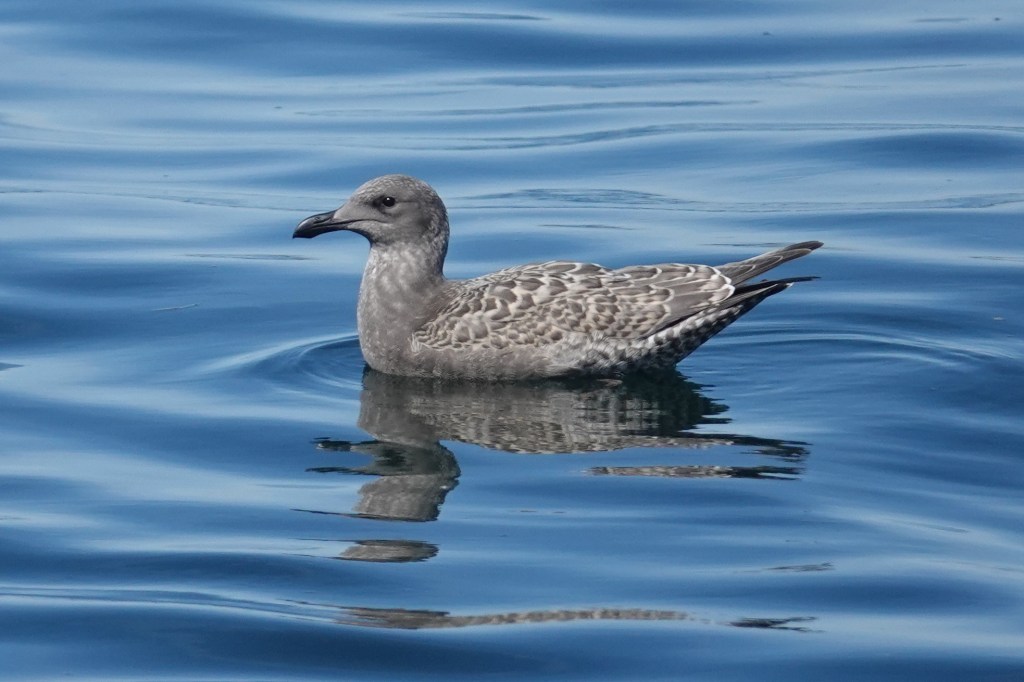
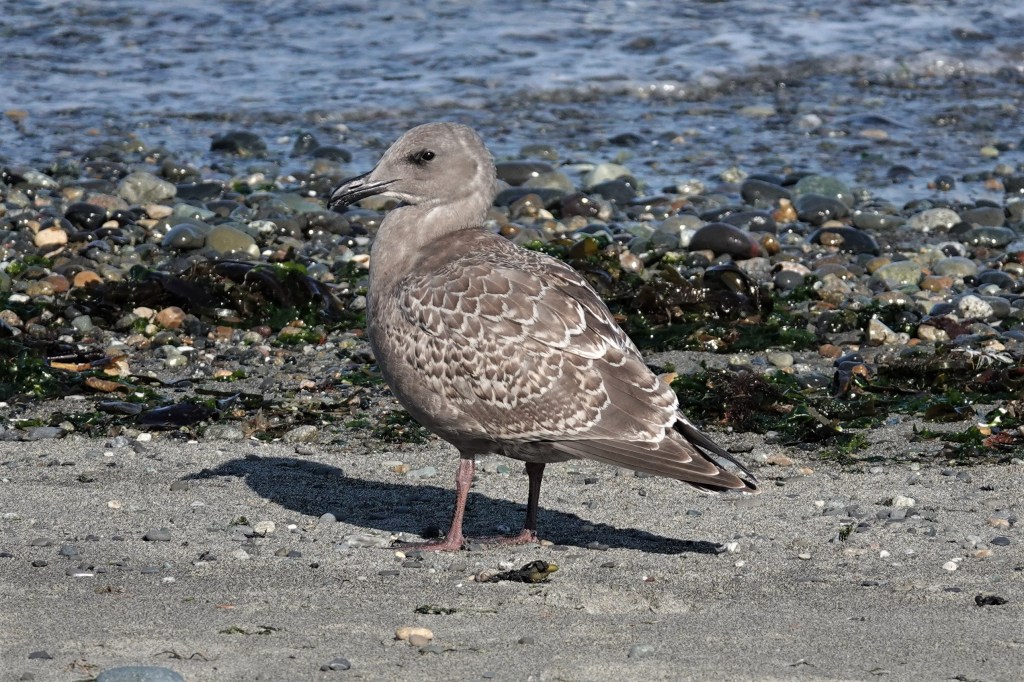
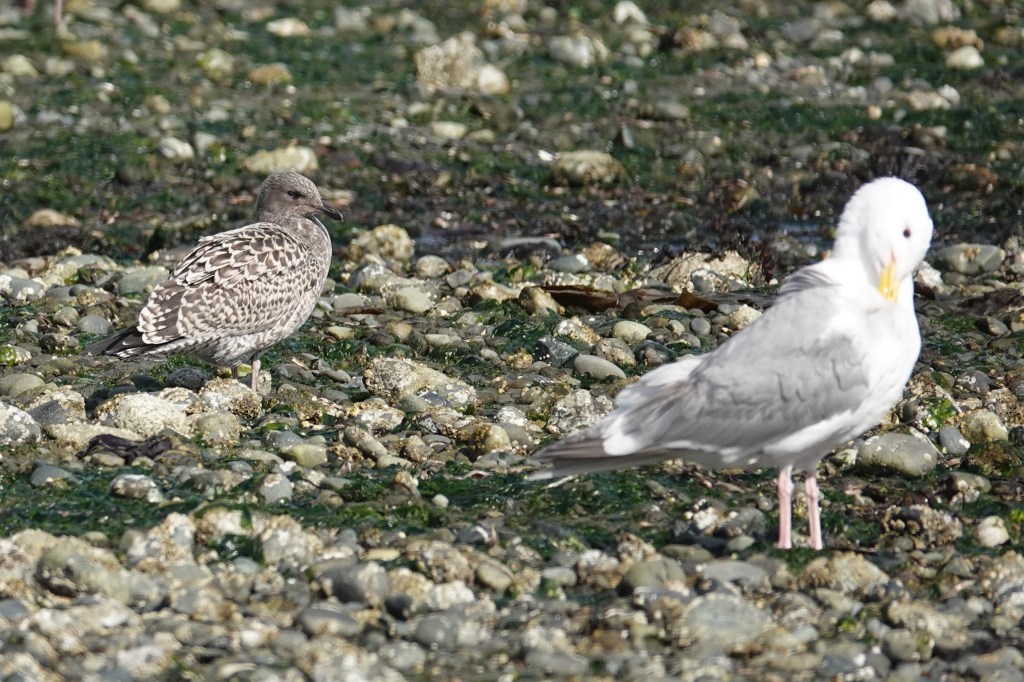
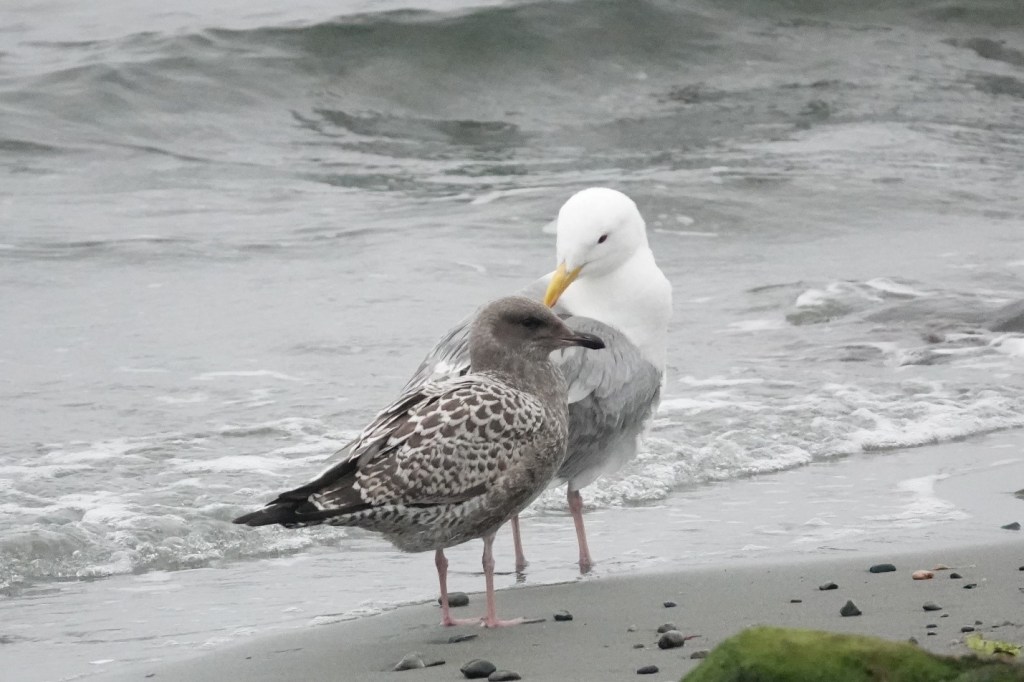
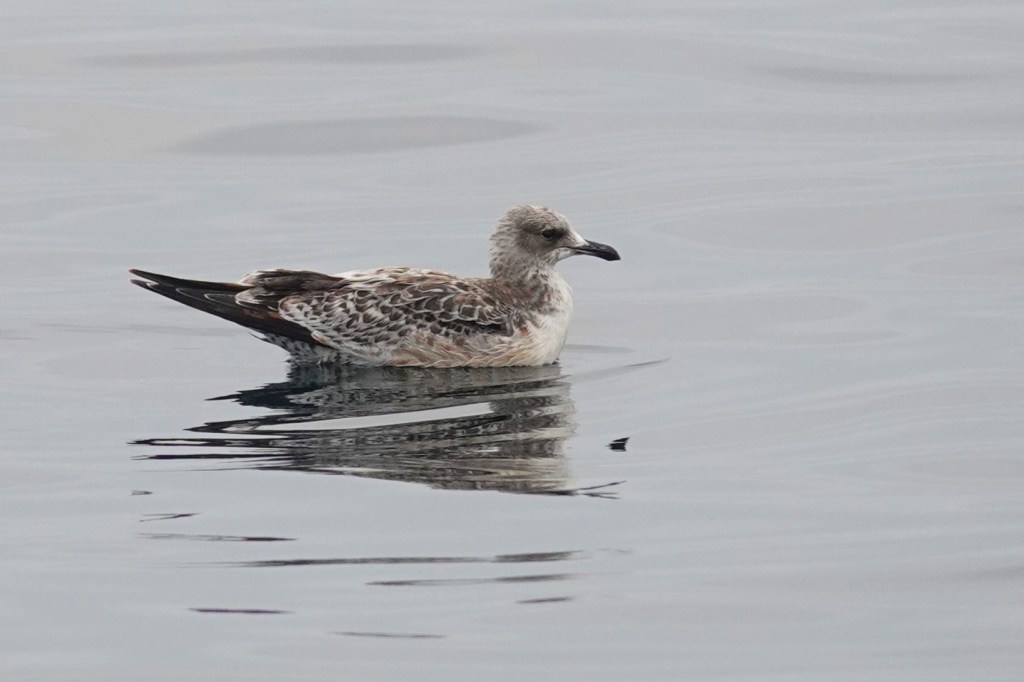
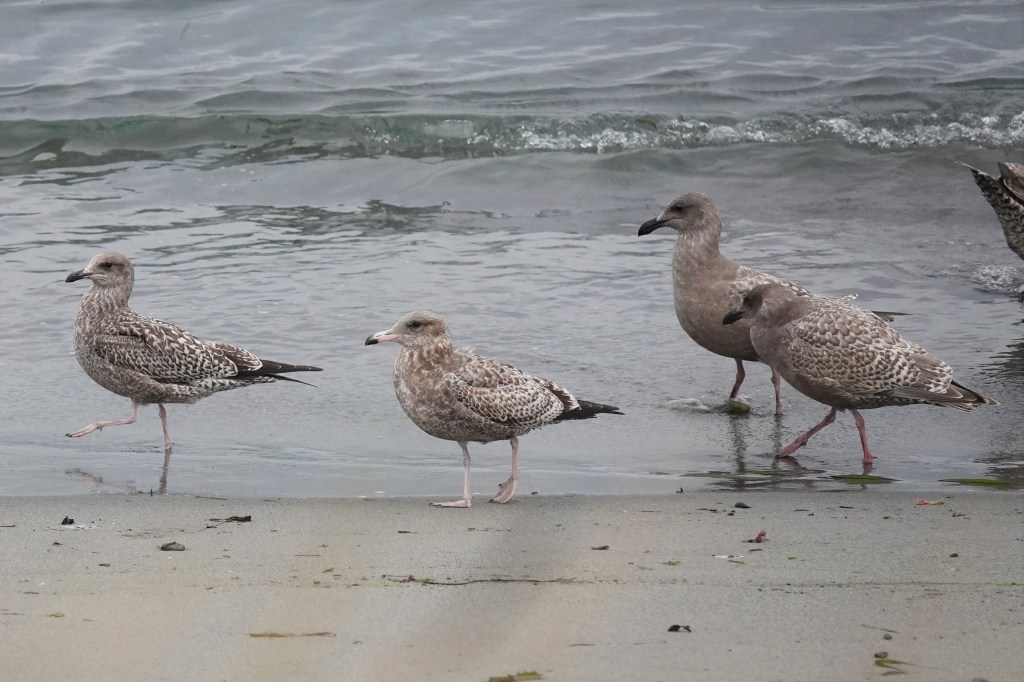
Aug 15 – Mid-August is when the first juveniles descend from the rooftops and appear on the beaches. They are crisp, with uniform brown-gray scaled scapulars and coverts. Their primaries are not jet black as in Western, Herring, California, and most other dark-winged gulls; they are dark gray. The color tone of the wing tips varies, as does the darkness of the entire bird. Like Western, the face has a uniform sooty auricular (cheek) patch, and the bill is black, large, and with a bulbous tip (see the head shots above).
Sept 18 – A month later and they haven’t changed much. This one is a bit paler and browner, which could be a function of sun exposure as well. The scapular pattern varies a bit. Note the overall robust and stocky structure, with short primary extension past the tail (i.e. short wings).
Sept 18 – Here’s another example from the same day. This one has a nearly pale greater covert panel. California Gulls in the background.
Sept 24 – A delightfully coffee-cream version, very Thayer’s-like in appearance. However, the heavy bill, stocky structure, tiny eye on a large head, and short primaries rule out the more sleek and dainty Thayer’s.
Oct 4 – Changes are afoot. It’s October and the juveniles are already molting. The telltale sign are the molting scapulars (the back). (These are actually 1st alternate scaps which they will keep a long time.) Note that the upper half of the brown checkered feathers have been replaced by rather messy patterned ones with some gray tones. Also the head and body are molting in paler feathers, though the sooty cheek remains.
On the right-hand edge of the pic, you’ll see a second cycle bird with a pure white primary sticking out (what’s left of it). This old feather is being replaced by a fresh dark (nearly black) primary. More on that as we move thru the calendar.
Oct 11 – The molting back and scapulars are obvious here as a pale gray-blue patch on the bird’s back. This bird has neat oak-leaf patterned scapulars (very Herring like, though these are rather pale), but they will be molting out soon. Some may be tempted to call this one Glaucous-winged, as it is paler, less sooty gray, overall, and the primaries are nearly concolorous to the body. Yet the overall darkness, the dark belly, and dark auriculars suggest Western influence. That’s a 3rd cycle bird in the back. Note the primaries are obviously darker than the mantle.
Nov 1 – This darker bird has completely molted its back and scapulars.
Nov 1 – This bird is more delayed in its molt cycle; it still has a lot of checkered juvenile scapulars. All the birds in this pic appear to be Olympics.
Nov 12 – Some more late fall examples with molted back and scapulars. How dark or light they appear can change with light and the angle of the bird. These birds are definitely reflecting some sunlight.
June 8 – And now we’re in June. Gull identification in spring and summer is a mess because the birds get quite faded and tattered. Exhibit A in this is the late 1st cycle bird on the right. This bird is now about 10 months old and desperately in need of molting to replace these primaries, which have now faded to nearly white. But that does not make it a Glaucous-winged Gull (same for the adult behind it). The rest of the bird, particularly the face and belly, are still rather dark.
June 23 – Another formerly sooty 1st cycle bird that looks like it’s gone through the wash.
June 23 – As summer wears on, many Olympics will have tertials and primaries that fade to white. This happens even in some dark-winged gulls (e.g. Short-billed). This bird has many Glaucous-winged features, though the dark below and large bulbous bill suggest some Western influence.
July 3 – With birds like this, it becomes impossible to use plumage to separate them from pure Glaucous-winged. The heavy bill with a rather sharp hook and gonydeal bulge are a better fit for Olympic.
July 6 – Here’s another summer bird that is a bit darker, and thus more obviously an Olympic. The exposed primary has a dark shadow on it where it was once covered by another feather.
July 8 – More examples of faded summery Olympics. Note the heavy dark bills and dark bellies.
July 12 – At last, molt has begun. They molt their secondaries and primaries from the inside out. The fresh feathers here are more gray; the old feathers more brown. The old primaries – the last three or four feathers on each wing – are also warn to pin points. Note, on the left wing, the new dark-tipped primary starting to grown in. This is P5 (the 5th one in from the tip, which is P10).
July 12 – A close-up look at P5 coming in.
July 14 – Another individual molting in fresh gray primaries to replace the tattered faded ones.
July 25 – And another individual. Even this rather dark-faced bird had its primaries fade to white. The new one is dark gray.
July 27 – Finding molting birds like this in late summer is fun. This bird is in the process of changing from a white-winged gull (which some might confused with Glaucous) to a nearly black-winged gull (approaching Western)!
July 27 – Taken on the same day as above, this bird is much slower in its molt cycle.
July 30 – Another bird molting from white-winged to dark-winged.
Sept 27 – September again. This bird is now a year and a few months old. It still has one long thin old faded white primary left. It’s new 2nd cycle primaries are dark enough to clearly put this bird in the Olympic camp.
Oct 4 – Another individual with a single white primary left, but new dark gray ones coming it. The other birds are juvenile Olympics, just a few months old.
Oct 11 – And voila, a fully molted fresh 2nd cycle Olympic Gull, ready for the winter.
June 8 – Now approaching it’s third birthday, this late 2nd cycle bird is ready for molt again. Note the bill had changed from black to incorporate the classic school bus yellow of Western.
Sept 20 – A juvenile begs from its parent. You can tell this adult is an Olympic because it’s child is an Olympic (with rather dark primaries). The adult has some faded primaries which are being replaced by a feather with a much darker gray band.
Oct 26 – A fully molted adult with dark gray in the primary pattern.
Jan 17 – Some more adult mid-winter. While the front right bird has rather medium gray primaries, only a little darker than the mantle, note the bill lacks any dark mark (as seen in the bird to the left), which Glaucous-winged should show in winter. The clean yellow bill is a Western feature.
Feb 17 – Thanks to David Estroff for this photo from Port Townsend. This is not a pure Western Gull because: 1) the underside of P10 (the folded wingtip in the back) is not black, but a silvery gray, especially on the inside of the white mirror. In a pure Western, this would be nearly black. 2) the orbital ring is reddish. In pure Western, it should be mustard yellow. Pure Western Gulls are rare in Puget Sound. I usually encounter them after strong west winds in winter. The clean white head is because it’s coming into breeding plumage.
Apr 19 – This adult is in full breeding plumage. When breeding, the bill and legs get brighter and more colorful. Note the primaries are too dark for Glaucous-winged, but too light for Western.
California Gull
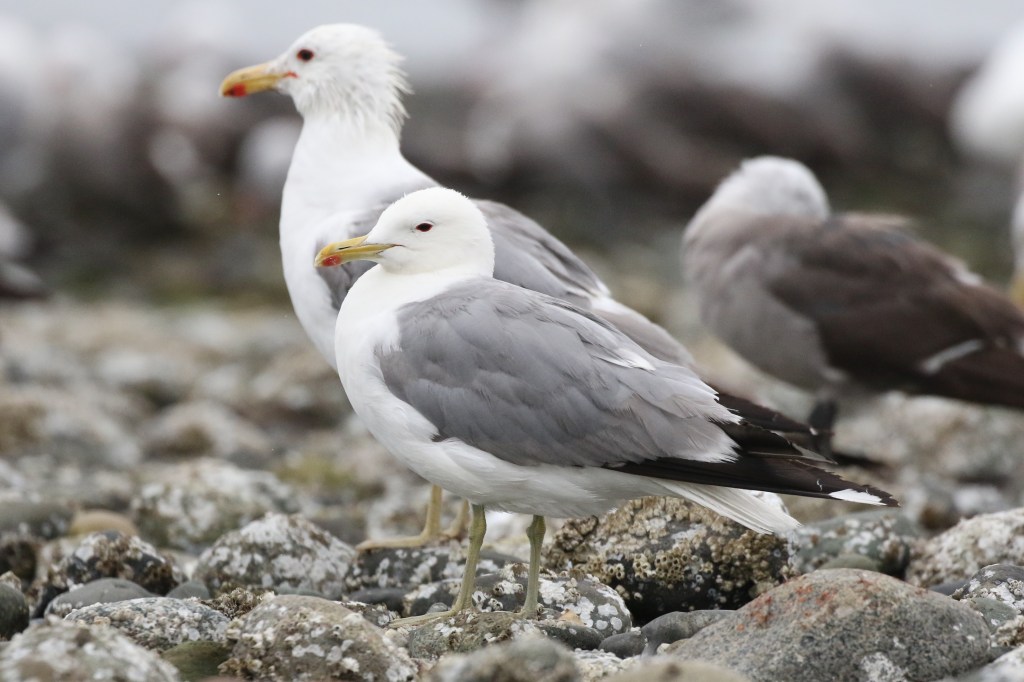
California Gulls are abundant in Puget Sound June thru October, when a wave of post-breeding migrants pulse through the region. Especially in the Strait of Juan de Fuca, they can outnumber all other species combined in late summer. They can be found at other times of the year, though in much smaller numbers.
June 29 – I love it when the first juv Calis show up – little checkered gems on the kelp-covered cobble. They are typically rather skittish, so hard to get close pics. This June bird is my earliest record; usually they show up around July 11. Olympic in the foreground.
July 16 – Here’s another one among the Heermann’s, compared to which they are only slightly larger.
July 25 – Juvenile California Gulls can be confusing because many have all black bills. This one is already turning pale at the base. Compared to Olympic, note the long primary projection past the tail, the jet black primaries (blacker than any Olympic), and more horizontal and sleek posture.
July 27 – Two different juvenile California Gulls, now with the more characteristic dirty pink bill with black tip.
Aug 9 – These birds can look like juvenile Herring (which aren’t expected for another two months), but note the solid dark inner primaries, lacking a pale inner primary window.
Aug 27 – Though they vary from dark to light, this is a very typical juvenile California Gull.
Aug 27 – Taken on the same day as the previous pic, this is what is colloquially called a “cinnamon morph,” rather pale juvs with warm brown tones and whitish underparts. Given the all black bill, it must be quite young as well. These are more regular in California than in the Pacific Northwest.
Sept 18 – Another gorgeous juv. The feathers can often have a cinnamon brown tone.
Sept 29 – California on the left; Olympic on the right. Both of these birds have started molting scapulars. They both have pink legs in first cycle, though Calif Gull legs are paler pink.
Sept 29 – Two California’s on the left; two Olympics on the right. All juveniles. Note the left California Gull still has an all-black bill. The California Gulls stand out by their smaller size, more horizontal backs, and long, black wingtips.
June 26 – We’re now through spring into summer. This bird is approaching its first birthday and is showing the classic tri-color pattern of relatively fresh gray scapulars, faded white coverts, and tattered primaries, now faded from black to brown.
July 6 – A similar late 1st cycle California Gull. Note the legs can turn rather blueish.
July 11 – This fly-by bird reveals it has begun molting its inner primaries – the fresh gray ones.
Aug 2 – This bird is probably a year more ahead, molting from 2nd to 3rd cycle. The legs are still rather bluish gray.
Dec 9 – This bird is a full adult, with black and red near the tip of the yellow bill. The blue legs will turn yellow by spring. Olympic back left; Short-billed Gulls back right.
July 15 – Finally, a full adult California Gull with yellow legs. Note the dark eye with red orbital ring and red gape (where the bill meets the face). The adult in the background with the messed up head feathers especially shows the red gape. Heermann’s back right. The black mark on the bill is much reduced when breeding.
Short-billed Gull
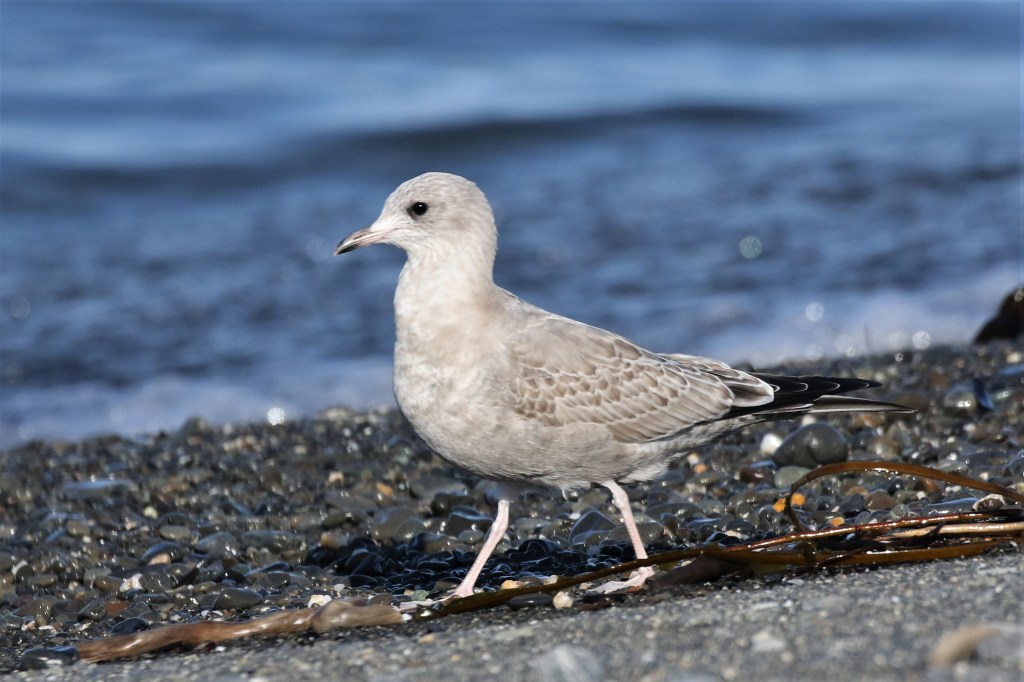
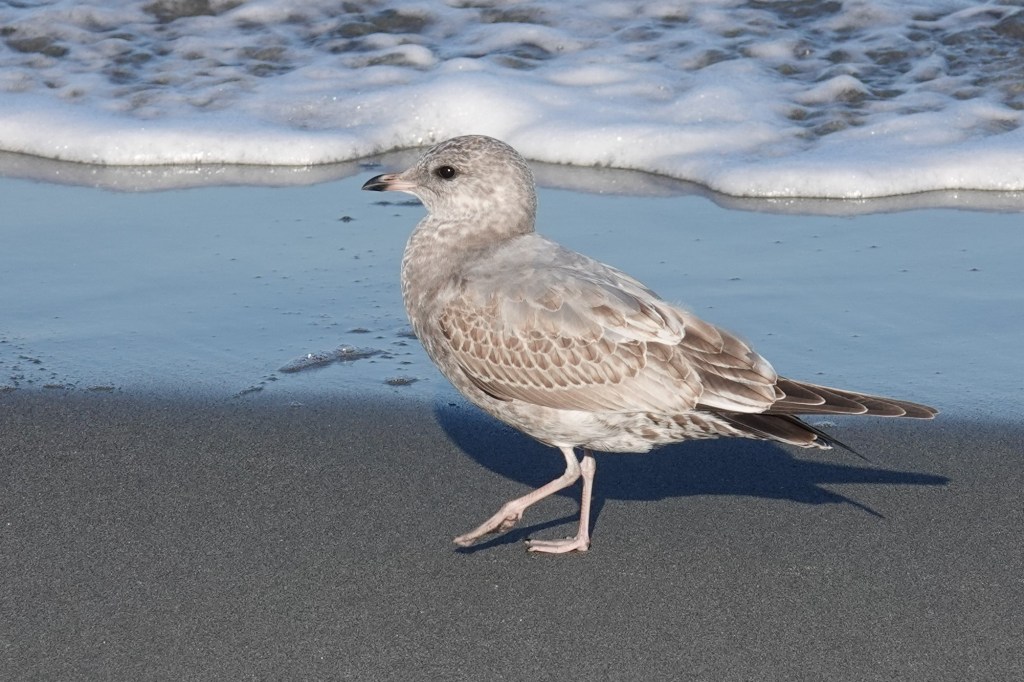
These petite beauties arrive in the fall to spend the winter, departing by May to breed in Alaska and Canada.
Oct 4 – The fresh juvs look like miniature Thayer’s Gulls, but are as dainty as fairies. Note the tiny thin bill and dove-like head with a relatively large eye. Also bantam chicken-like chest and very long tapered wings.
Nov 12 – Because this is a three-year gull, the 1st cycle birds quickly resemble 2nd cycle in large gulls, in that they have “adult gray” back and scapulars. This contrasts with the brown coverts.
Jan 9 – In flight they have a rather solid tail (unlike Ring-billed Gull).
Apr 25 – Here we are in spring. The brown coverts have faded to white, and head and body molt has also created a paler appearance.
July 14 – Occasionally, some late 1st cycle birds will over-summer. These often bleach to a nearly completely white, baffling birders. The bill seems longer than usual because the head feathers are molting.
Sept 18 – This is an adult just arrived from the north. Note the tiny unmarked yellow bill, somewhat unique in the gull world. California, Olympic, and Heermann’s tower over this tiny gull.
Jan 8 – Winter adults are beautiful in flight, with considerable white in the primary pattern: mirrors on P10 and P9, and a white “string of pearls” between the gray and black in Ps 4-8 (the Slaty-backed pattern). The exact pattern is variable.
Mar 25 – The amount of head and neck smudging in variable. Note that some birds will show a yellow eye.
Apr 25 – As spring gets on, the head markings resolve to a clean white head and the bill brightens as the breeding season approaches. This means they’re about to head north.
Heermann’s Gull
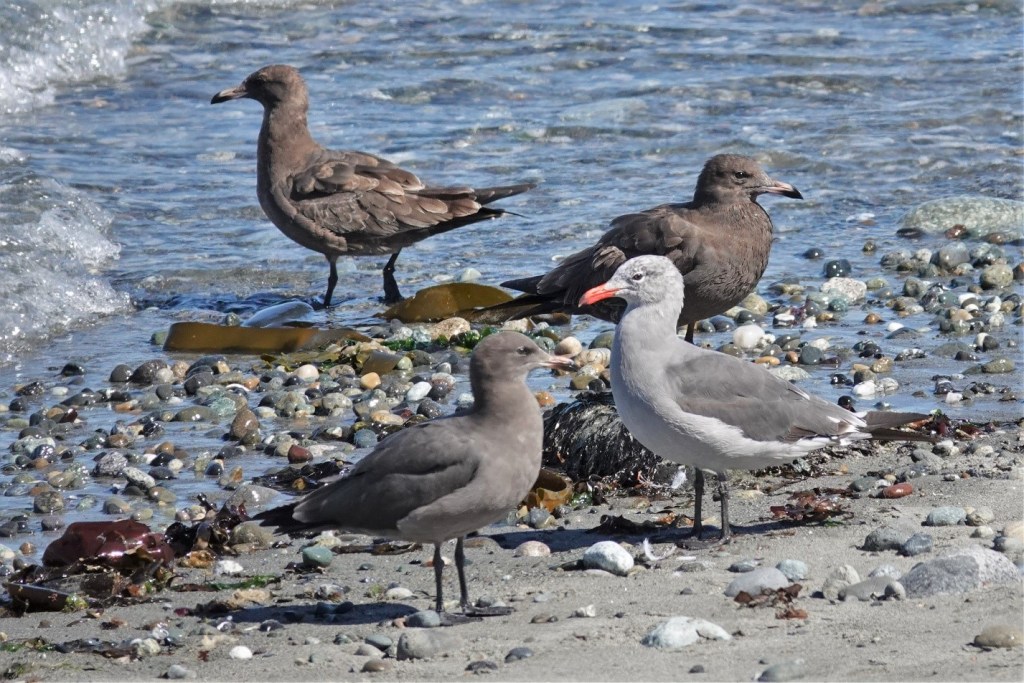
A striking and unique gull, nearly the entire world’s population emanates from tiny Isla Rasa in the Gulf of Mexico. After breeding, they migrate north. About 400 typically spend the summer and early fall around Port Townsend.
July 27 – The fresh juveniles are brown with mostly dark bills. The pale feather edges wear off quickly.
Aug 15 – This is a four-year gull. This photo features two brown juveniles in the back (molting their scapulars), a 2nd cycle front left, and an adult front right. Heermann’s Gulls have black legs at all ages.
Aug 26 – This 2nd cycle bird looks a lot like 1st cycle. It has a more orange bill.
June 29 – Breeding plumage adults are remarkable for their bright red bills, clean white heads, and smoky gray bodies.
Aug 26 – Adults in the August conspicuously molt their flight feathers and tails.
Oct 5 – Adults in complete basic plumage, with mottled dark heads.
Oct 4 – A small percentage of adults show “jaeger-morph” wing patterns, with variable amounts of white in the primary coverts. This adds to their jaeger habits of chasing other gulls.
Bonaparte’s Gull
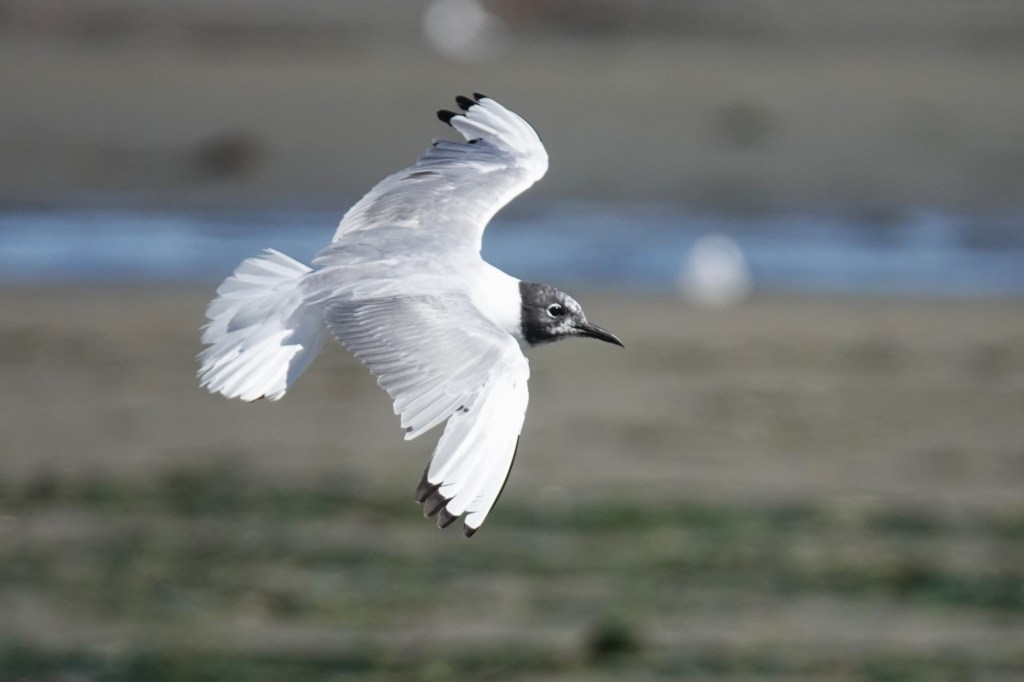
Even smaller and daintier than Short-billed, Bonaparte’s Gulls are easy to identify and a joy to watch. I’ll leave it to other sources to help you pick out a Black-headed or Little Gull among them. Suffice it to say, the former is more larger, and the latter slightly smaller, than Bonaparte’s. These northern breeders are present throughout much of the year – except summer – with pulses during spring and fall migration. Hundreds can be found at Point No Point, often harassed by jaegers in the fall.
Aug 3 – A gorgeous freshly-arrived juvenile with the characteristic black year patch.
Aug 3 – Newly arrived adults, one still with an all-black head.
Aug 3 – An adult in flight, molting its primaries.
Nov 29 – An adult in full basic (winter) plumage. It appears to have an injury in the shoulder area.
Glaucous-winged Gull
Pure Glaucous-winged Gulls are challenging for me to find among the crowd of Olympics. At best, they are uncommon in winter and rare in summer, largely limited to a few over-summering subadults. That said, an influx in winter can match Olympic numbers at some roosts between Sequim and Neah Bay.
Oct 5 – Given the dusky auriculars and rather bulbous bill, this bird probably has some Western in it. Nevertheless, note the even pale tones throughout.
Oct 28 – There’s no question about this bird. The primaries are as pale as they come, as is the tail. The auriculars have no indications of a sooty wash. The coverts are intricately patterned. Note the scapulars are fully molted.
Nov 1 – Olympic on the left; Glaucous-winged on the right. At this date, fading is not an issue.
Nov 6 – This bird shows no auricular patch. The primaries are almost patterned as in Glaucous and Iceland. Note the bill, while heavy, is less blob-ended than Western or Olympic, with a shallower gonydeal angle. The tomium (upper edge) often begins a gentle curve about 2/3 of the way out, rather than a strong hook ¾ of the way out, as is typical in Western and Olympic.
Nov 7 – This bird shows a hint of subterminal arrowhead patterns in the primaries. Note the straight bill without a contrasting blob ending.
Nov 12 – Note the whitish head on this fall bird. The primaries on this one are quite pale. Olympic in foreground.
May 7 – By spring, Glaucous-winged Gulls can fade to nearly all white. Note the bill is beginning to pale.
May 12 – Another spring bird, though this one seems less faded. Again, the bill is paling and more straight than Olympic.
June 29 – As they molt coverts, Glaucous-winged Gulls often produce this striking pattern due to fresh dark coverts.
July 6 – Over-summering late 1st cycle birds often stand out in Puget Sound. Feathers with less melanin (paler feathers) are more prone to wear and fading than darker feathers.
July 14 – This bird could be confused for Glaucous, but a Glaucous would never have dark in the middle of the bill. Given the time of year, this bird is typical of an over-summering one-year-old Glaucous-winged Gull.
July 27 – Another over-summering 1st cycle Glaucous-winged, in desperate need of molt.
June 8 – We’re now a year later. This bird is late 2nd cycle, with a bill that is already acquiring yellow tones.
Jan 17 – A presumed pure adult Glaucous-winged Gull in mid-winter. Note the icy gray mantle and nearly matching primaries (though they are more slate gray than blue-gray), the purplish legs, the rather straight bill, and the straw yellow bill with the dark mark thru the red spot.
Ring-billed Gull
Ring-billed Gulls are rather rare to uncommon around Port Townsend. I only see them in small numbers (usually three or less) in late summer and fall. Apparently they are more common in the South Sound.
Aug 25 – Compared to California Gulls, the juveniles are smaller, whiter, and with brighter pink in the bill.
Nov 15 – In flight, 1st cycle birds have a tail with a messy band. California and Short-billed Gulls have much more solid brownish/blackish tails. Also note the very contrasting wing pattern with very pale window in the inner primaries.
Aug 19 – Adult Ring-billed Gulls have very pale mantles. They can be told from Short-billed Gull at a hundred yards by the lack of a contrasting white tertial crescent between the gray mantle and black primaries. The pale gray just fades into the black with only a small white fringe.
Thayer’s Iceland Gull
Gulling is traditionally best in the winter, when Arctic breeders such as Thayer’s Iceland Gull arrive. This is difficult in Port Townsend, as there are few high tide roosts nearby. In winter, there are rarely low tides during limited daylight hours. Thus, I usually only see a few Thayer’s, if any, on any given day. They are much more regular at the Elwha River Mouth, which also has suitable high tide roosts for midday viewing.
Nov 7 – Of the large four-year gulls, Thayer’s is amongst the smallest. Fresh juveniles resemble fresh Olympics with their checkering and coffee with cream tones, but their structure is very different. Note the thin bill and long primaries, almost always darker than the body and with pale edges.
Jan 9 – Thayer’s on the left; Olympic (or possibly Glaucous-winged) on the right. The main differences: Thayer’s is smaller, longer winged, has a much tinier bill, and generally retains its scaled juvenile scapulars through the winter; the Olympic has already molted them.
Sept 22 – From left to right: Heermann’s, Thayer’s, California, and Olympic. On the Thayer’s, note the dark eye, bright pink legs, and primary pattern with the pale underside of the far primary. This is actually P9 we are looking at. P10 is missing due to molt.
Oct 11 – Thayer’s often appear petite and squat, though they are slightly larger than a California Gull. Note the small bill. Many individuals show a gold eye.
Oct 11 – This is the same bird as above, showing off their unique primary pattern. P10 has a large terminal mirror (all white tip). P9 has a mirror that swirls open toward the inside of the wing.
Nov 15 – Here’s another view of the primary pattern, which produces a striped effect.
Feb 26 – How to pic a Thayer’s out of a flock of Olympic Gulls. It’s the small one in front. Note the jet black in the primary pattern, the thin bill, and the overall petite structure (it probably weighs 30% less than the Olympics). Note also the underside of the far primary on the folded wing is pale — this rules out Herring. The dark eye also rules out Herring (though some adult Thayer’s have somewhat pale eyes). The back left bird is a 2nd cycle Thayer’s — note the thin bill.
Herring Gull
Sept 18 – I see even fewer Herrings than Thayer’s, usually just a few each winter, unless I go to Elwha. Compared to Thayer’s and Olympic, note the black primaries and very dark tertials. The coverts are usually very checkered and contrasting. The bill can vary from all black to dirty pink with a dark tip.
Dec 2 – Here’s another Herring. Note the black primaries and contrasting pale head, a common feature.
Jan 30 – An adult in flight. They always have a very pale straw-colored eye, producing a fierce look. The mantle is pale icy blue. The typical primary pattern has only a single mirror on P10.
Western Gull
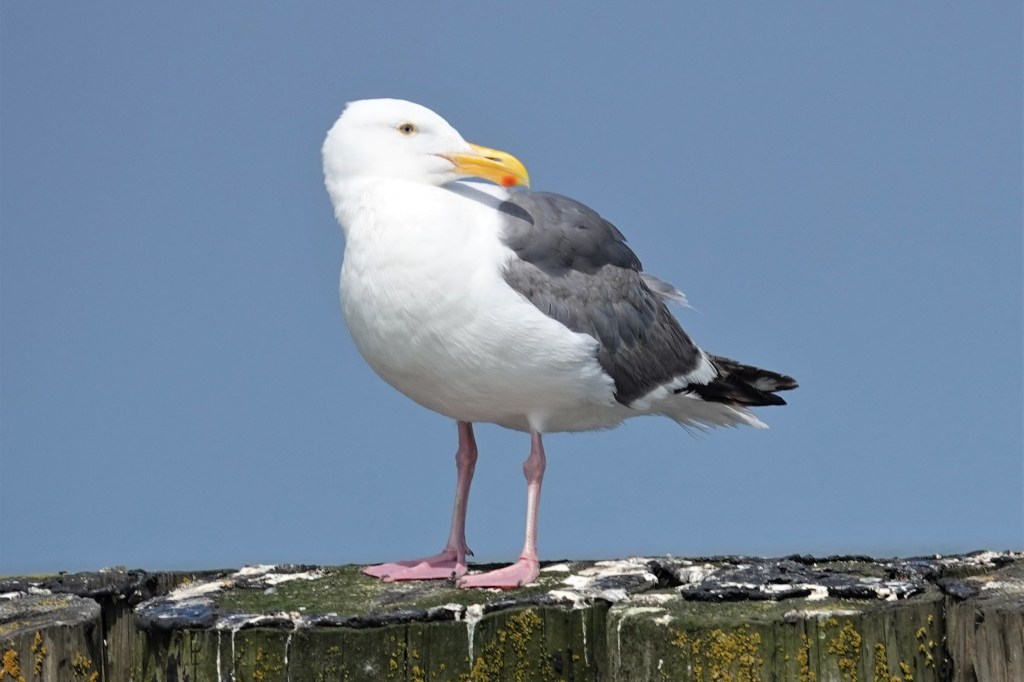
Sept 16 – Pure Western Gulls are rare in Puget Sound. I usually only see them in fall or winter after strong west winds. This juvenile shows a dark sooty face (similar to many Olympics) but also jet black primaries. Note also the more contrasting coverts, not the uniform muddy tones of Olympics. That’s a juvenile Olympic back right.
Sept 29 – This 3rd cycle Western shows a fairly dark mantle and jet black primaries.
July 27 – This summer adult is a classic Western: a clean white head (which they keep year round), a thick bulbous school bus yellow bill, a darkish mantle, and jet black in the primaries. Note also the yellow orbital ring. The eye varies from yellow to dark.
Herring x Glaucous-winged Gull (“Cook Inlet Gull”)
I only report a few of these each winter, usually at Elwha or Neah Bay. They are probably regular but rare in Puget Sound, but they are really a pain to pick out amongst all the Olympics!
Nov 6 – This one is easy to separate from Olympic – it has a pale version of the Herring Gull bill, pale with a black tip. The dark gray primaries rule out black-primaried gulls and imply either a Thayer’s or Gl-W hybrid. The molted scapulars, structure, and gray color tones rule out Thayer’s. Olympic in the background.
Nov 12 – A likely Cook Inlet, with a straighter and more paling bill than found on Olympic. Cook Inlets often retain juvenile scapulars later in the winter, as this one has. Note also the longer-winged structure.
Jan 8 – Another potential Cook Inlet with unmolted scaps (in January!) and a longer-winged structure than Olympic. The more squared off and contrasting pale head also suggests Herring influence. 2nd cycle Olympic in the background.
Glaucous Gull
Large and white, these are rare winter visitors.
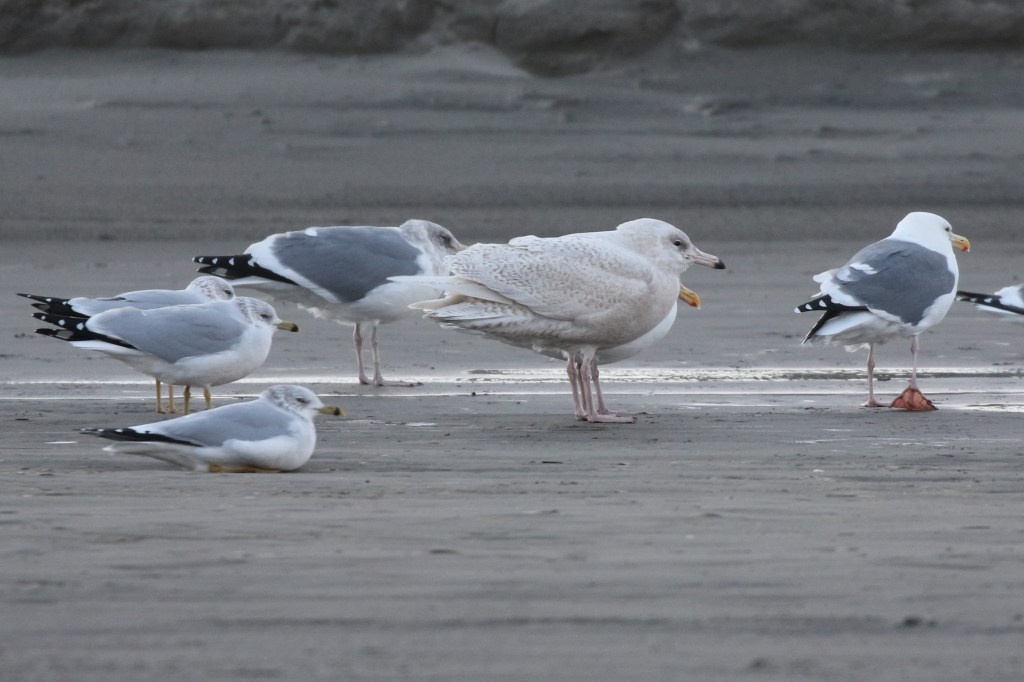
Nov 9 – Most Glaucous Gulls in Washington are 1st cycle birds, like this one. I took this on the beach at Ocean Park. It is accompanied by adult Ring-billed and Western Gulls. The bill is always pink with a well-demarcated black tip. Glaucous-winged never approaches this at any age. Note the bill is also straight and not blob-ended.
Rarities: These species, listed roughly in order of probability, occur less than annually: Franklin’s Gull, Lesser Black-backed Gull, Black-legged Kittiwake, Black-headed Gull, Little Gull, Slaty-backed Gull, Black-tailed Gull, Ross’s Gull
Probability by season
It always helps to know which gull species are around at any one time during the year. eBird data for gulls in Puget Sound is of little use due to widespread misidentifications. This graph is based on my personal eBird data from Pt Wilson and Pt Hudson near Port Townsend. Frequency may vary around the Sound and at other gull roosts. For example, Ring-billed Gull is quite regular in the South Sound earlier in the year, and Thayer’s and Herring are regular at the Elwha River Mouth in winter.
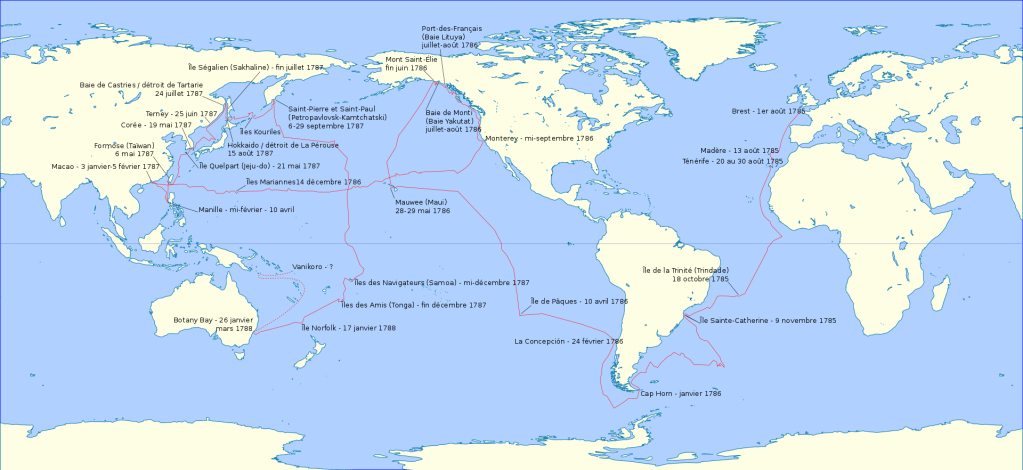
On August 1, 1785, a French expedition led by Jean François de Galaup, comte de Lapérouse (referred to as Lapérouse) set off with a goal to explore the world, both politically and scientifically. Specifically, they were to explore trading possibilities and the activities of foreign powers, both European and indigenous, map the world, and do science. On board their two vessels, L’Astrolabe and La Boussole, were experts in astronomy, geology, agriculture, botany, birds, medicine, and two illustrators.
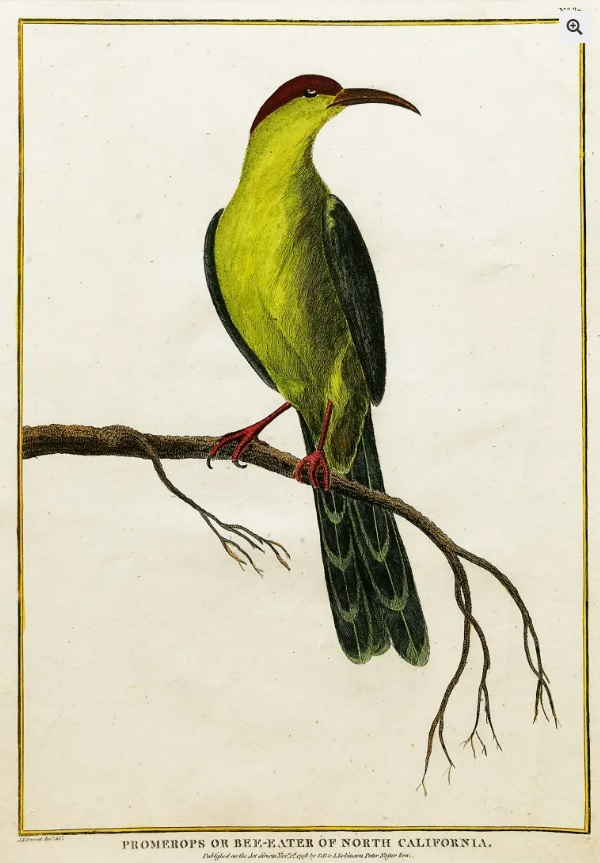
The illustration of a “California Bee-eater”
They visited, in this order, South America, Easter Island, Hawaii, Alaska, California, various locations in East Asia, the South Pacific, and Australia. They departed Australia on March 10, 1788, bound for New Caledonia and the Solomon Islands and were never heard from again. The search for their vessels — and them — has been the subject of eight French investigations. Information gathered from 1826 to 2005 concluded that the vessels wrecked on the Solomon Island of Vanikoro and the survivors were killed by the local inhabitants.
The whole of their visit to California was a brief stay at the Spanish mission at Monterey from September 14 thru 22, 1786. As they were the first foreigners to visit the missions since they were founded in 1769, they provided a unique firsthand account. For the most part, they were appalled by the conditions of the Native “converts” and compared the mission to a slave plantation. It was because of this that I was reading Life in a California Mission, an excerpt from The Journals of Jean François de La Pérouse (Heyday Books, 1989).
This ludicrously colorized version is sold online as the “first known illustration of a California bee-eater”
There are three bird illustrations: one is a pair of California Quail, another is likely a Varied Thrush from Alaska, and the third is this one, identified as a “promerops” or bee-eater. Later publications attempt to identify it correctly, usually as a thrasher (both California and brown!). To me, it is clearly a Yellow-billed Cuckoo. The unique undertail pattern, the bill shape, and the head pattern all match well, and really match no other species. The way it is perched upright in a tree is better for cuckoo than thrasher. I can find no publication that identifies it as a cuckoo. (Nor can I find one that identifies the “Black Bird” below either.)
While eBird only shows a single record for Monterey County in September (Sept 21, 1998; Andrew Molera State Park; Don Roberson), there are a handful of other records for northern California in September. Of course, the species, virtually extirpated from the region now, would have been far more common then, presumably nesting in riparian corridors from the Carmel River to the Salinas Valley, all within the travels of the French expedition.
Here are the other two illustrations of birds.
This “Black Bird” is from Porte des Français, or Lituya Bay, Alaska, near Glacier Bay National Park. It appears to be a Varied Thrush (note Blackbird in Europe is a thrush). Thanks to Jeremy Gatten for the help on this one!
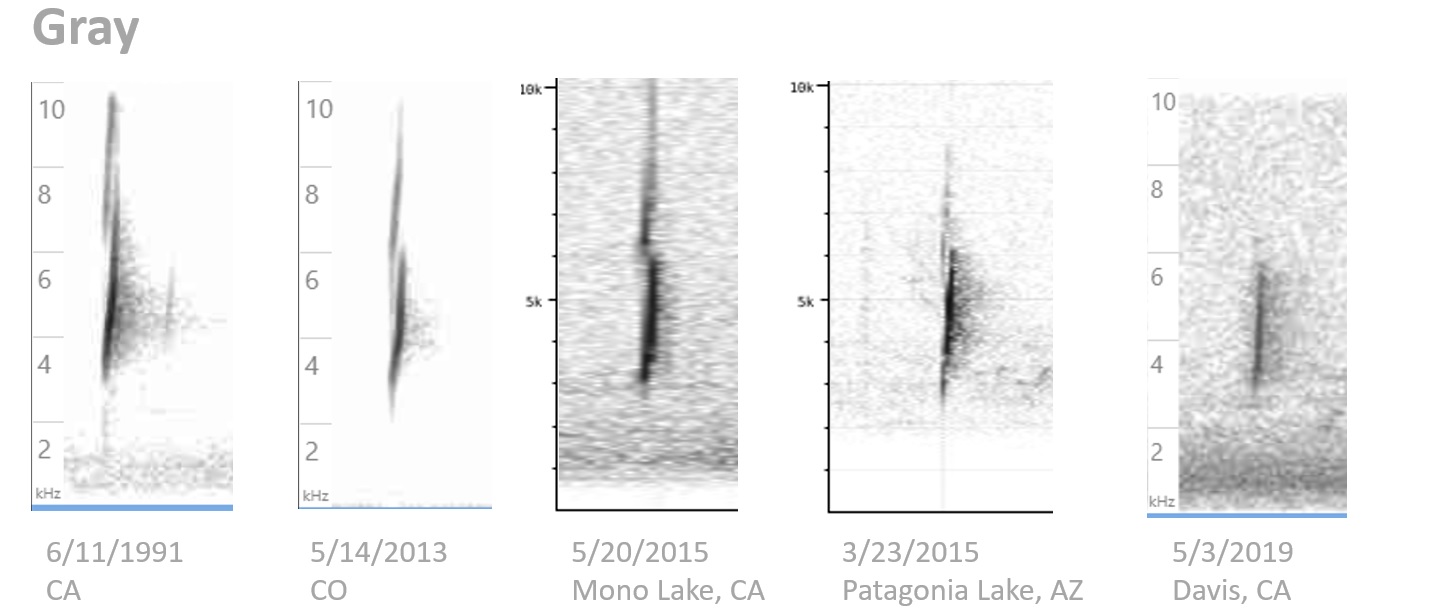
After a flurry of migrant Empidonax flycatchers this April in California, a number of us engaged in a discussion about their whit! call notes. Specifically, could we tell Willow from Dusky from Gray just by the whit? Personally, I’m not there yet. I usually only hear them a few times a year, which is insufficient experience, and I suspect there’s individual variation as well as the tricks that wind, humidity, and distance play on sound. But what about analyzing their sonograms with a good recording?
I looked at the very best on-line recordings from the Macaulay Library (collected via eBird, and there’s a collection of the best ones at Peterson Bird Sounds) and from xeno-canto. (Warning: the horizontal axis is different between their sonograms. Xeno-canto sonograms fit about two seconds in the space where Macaulay fits one second of recording, thus compressing the sonogram. Here, I stretched the xeno-canto sonograms horizontally to adjust for that.)
It appears that Willow, with a good recording, is distinctive, with up to three harmonic tones and that downward slope after the upward slow. To the ear, the Willow whit is softer and sweeter than the others. Dusky and Gray, on the other hand, are both dry sharp whits, and virtually indistinguishable on the sonograms. Gray is more likely to go up to 10 kHz or higher, and that echo line on the first Gray sonogram was consistent on all the calls, at least for that individual recording. For the record, Least was similar to Dusky and Gray, although the triangular dark shadow to the right of the main call tended to be thicker and larger.
iPhone recording
To the right is a typical iPhone recording, probably a Dusky. Based only on this sonogram, just a shadow of the good ones above, it could be any of the species. The take-home lesson is that one could probably diagnostically identify a Willow whit from a sonogram with a very good recording. The Dusky and Gray whits are too close to call.
Our discussion also focused on spring migration timing and incorporated Hammond’s (as many of these birds are silent). Again, I turned to eBird for some trends.
CLICK TO ENLARGE
Spring migration for western Empids. These maps are based on 2017-18 data. I excluded a few outliers in each case. Nevertheless, these dates represent the earliest arrivals. Most birds were a week later than the dates shown.
The results are that Hammond’s is the earliest, followed by Gray and then Dusky. For all three, however, there was a pulse of records during the last week of April. Willow is a full month behind the other two. In fact, even in southern Arizona there were very few Willow records before May 10.
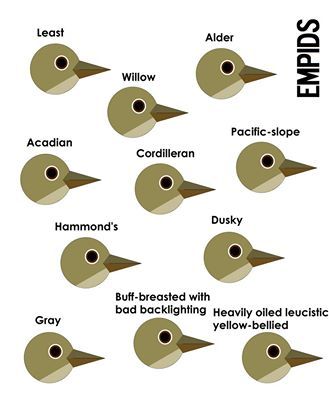
Much has been written about Empid identification. Here’s a link to the Rowland 2009 article in Birding. My personal favorite is the chapter in Kenn Kaufmann’s Advanced Birding. The diagram at left is from the old version; the new one is even better, showing variations within species.
For the Hammond’s/Dusky challenge in spring, I put together the diagram below. These identifications were confirmed by calling birds, which are easily separated (Hammond’s says peep rather than whit).
Finally, if you’re still confused, there’s this infamous meme:
The Eurasian Collared-Dove was first observed in Florida in the late 1970s. These birds likely originated from an accidental release in the Bahamas in 1974. Since then, their spread has been well documented by Christmas Bird Count and by state bird record committees. By the mid 1990s, the species had been recorded throughout the southeast United States. By 2000, Arizona, Idaho, Oregon, Utah, and Washington had documented records. On the 106th CBC (December 2005 – January 2006), over 30,000 individual birds were reported nationwide, compared to just 560 fifteen years earlier. Their rate of increase has averaged 34% per year.
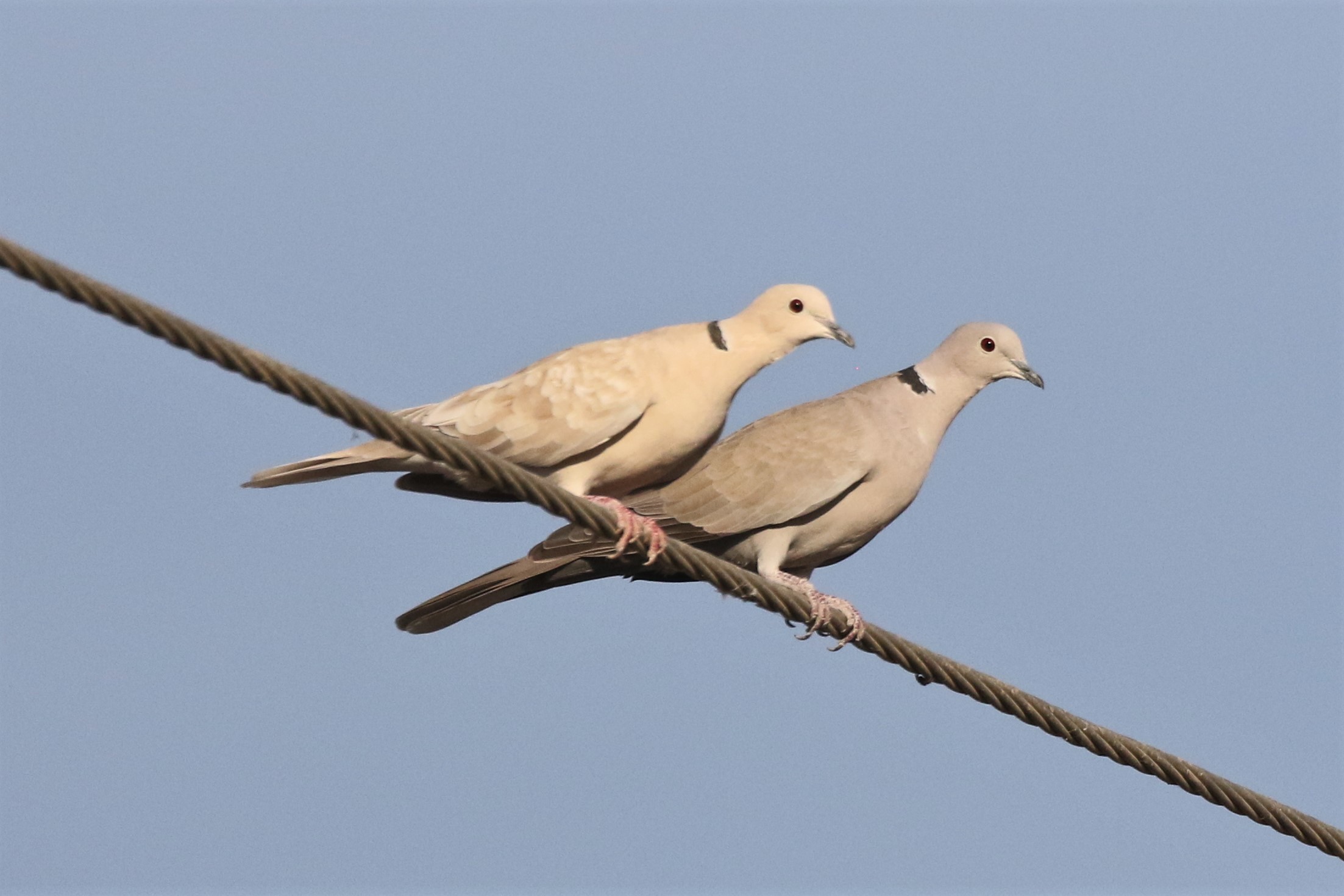
Today, it seems that in any large aggregation of Eurasian Collared-Doves, there are one or two that are unusually pale, blotched with white and cream. They seem to be about 1% of the population or more, though it’s yet to be studied. These birds bare a strong resemblance to African Collared-Doves, which is generally this pale. However, based on the dark outer web of the outermost tail feather (see below), as well as size and vocalizations, these birds are clearly leucistic Eurasian Collared-Doves.
CLICK TO ENLARGE
All of the photos on this page involve the same two darker doves and one pale dove. Above, the tail patterns of the dark dove (left) and pale dove (right) both suggest Eurasian Collared-Dove. Woodland, California, October 2018.
Many birders suspect this is due to the Founder Effect, a phenomenon that occurs when a small population colonizes a large area. Eventually, all of the birds (or other animal species) are descended from few individuals. In this context, certain recessive traits that were once rare may become more common.
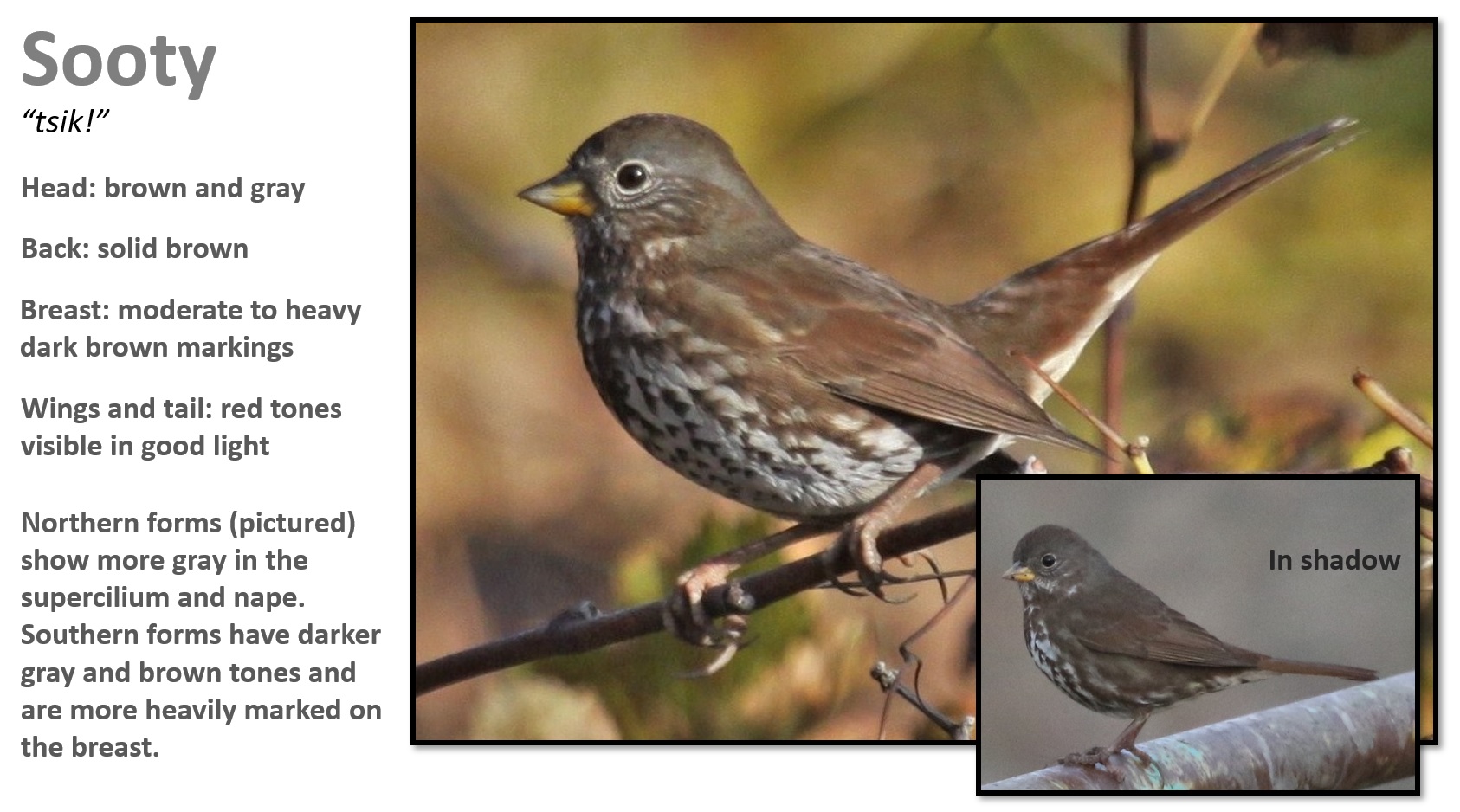
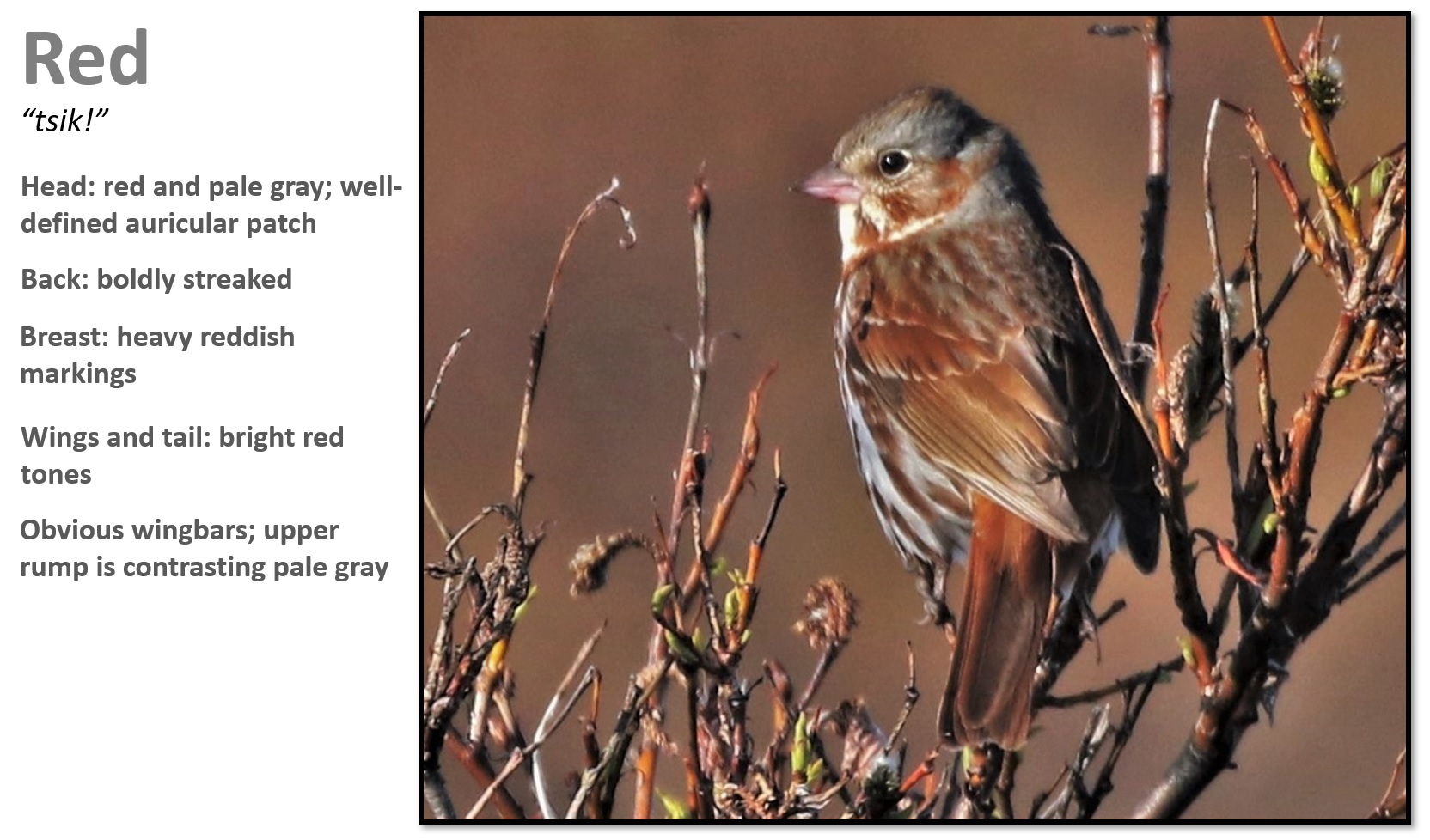
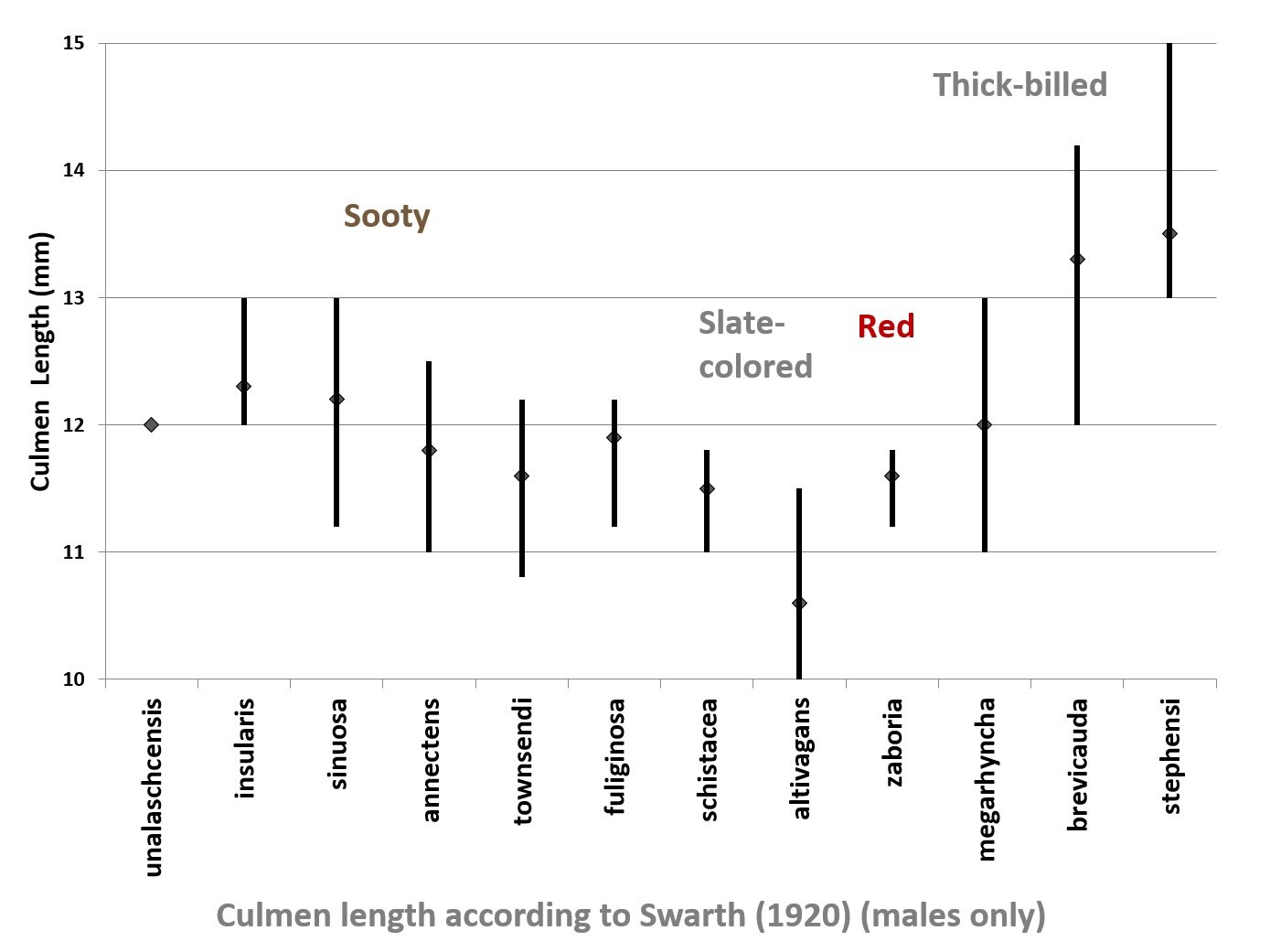
While there are over a dozen subspecies of Fox Sparrows, they fall into four main groups: Sooty, Red, Slate-colored, and Thick-billed. The images and diagrams below illustrate the main differences.
Sooty is the darkest, usually illustrated as dark chocolate in most guides. Even the darkest Sooties, however, show some gray on the face and rusty tones in the wings and tail– especially in bright light. I’ve chosen a photo in sunlight to show how lighting can change a bird from dark brown to bright rust. Regardless, the back is solid brown.
Red is the common form that breeds across the taiga to Nome and Bethel, Alaska, and generally winters in the eastern US.
Slate-colored is the Rocky Mountain version, found throughout much of the mountain West. Note that some consider altivagans, from Alberta, an intergrade swarm between Red and Slate-colored.
Thick-billed is the southern Cascade and Sierra Fox Sparrow, found in the mountains south and west of Slate-colored range.
A key distinguishing feature is back color and pattern.
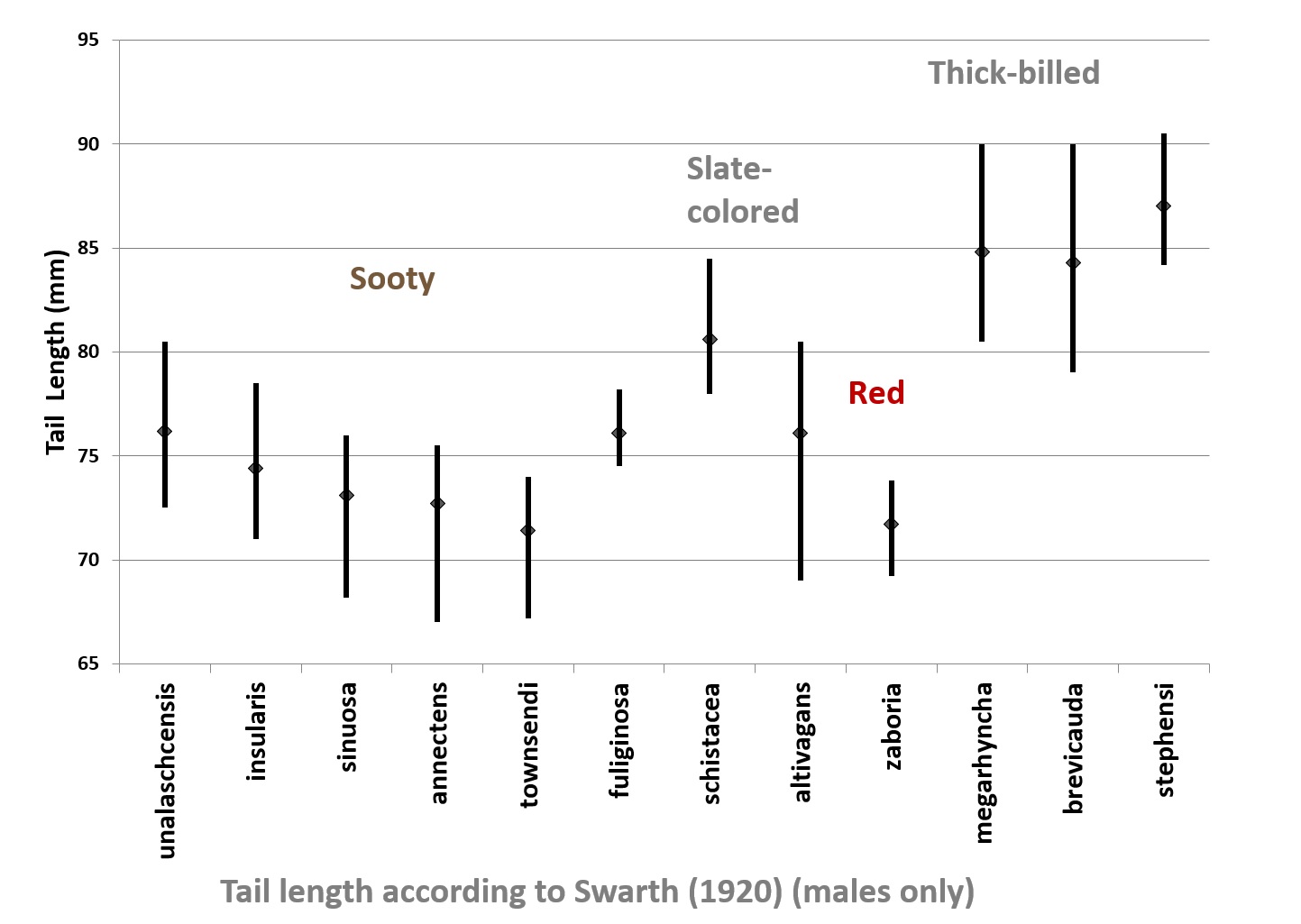
Less useful due to variation, but still helpful, are tail and bill length.
Most forms of Fox Sparrow winter in the lower 48, with southern California host to nearly all subspecies. This photograph shows the green chaparral along the Angeles Crest Highway where a wide variety of Fox Sparrows can be found.
For a more detailed analysis, including discussion of Sooty subspecies, see my paper:




















































 Much has been written about Empid identification. Here’s a link to the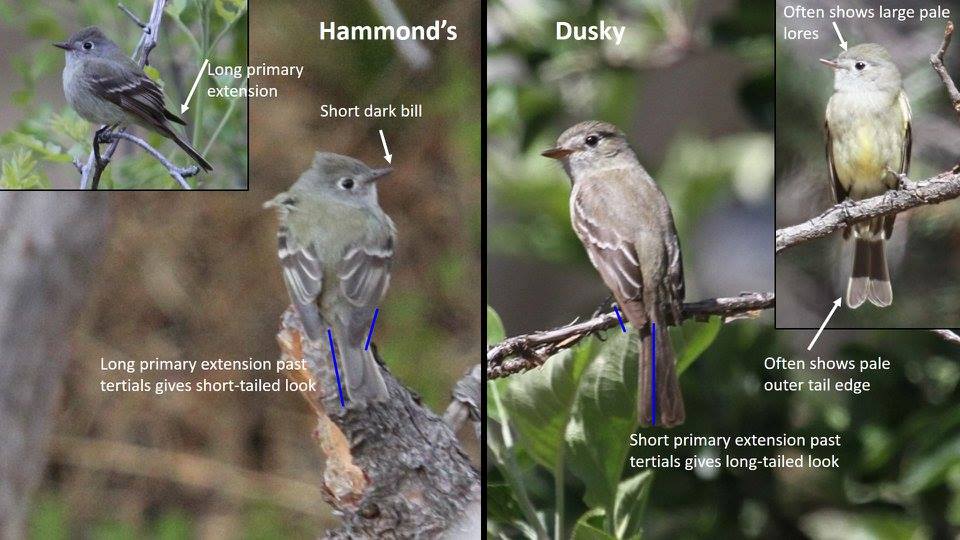
 In 2006, I wrote
 Many birders suspect this is due to the Founder Effect, a phenomenon that occurs when a small population colonizes a large area. Eventually, all of the birds (or other animal species) are descended from few individuals. In this context, certain recessive traits that were once rare may become more common.



 The Cottonwood Post