Red-foot, Blue-foot, Cocos, Nazca: Tropical seabirds moving into the Pacific Northwest

Red-footed Booby among Heermann's Gulls
Red-footed Booby, thought to be a 2nd year intermediate morph, among Heermann’s Gulls in Port Townsend, WA; August 2024.

There are no Indigenous words for these birds in the Pacific Northwest (PNW).

Sailors called them “boobies,” meaning stupid, because they were unafraid of people. They are large, colorful, tropical seabirds, historically only found at the southern edges of the continental United States – Florida, the Gulf Coast, and (rarely) southern California, to quote from my old 1966 Golden Field Guide, the beige one with the three buntings on the cover. That book only mentions three boobies: Blue-faced (since renamed Masked and now with Nazca split off from it), Brown (now with Cocos split off from it), and Blue-footed. Red-footed was so rare it wasn’t mentioned.

booby page from field guide

Here is the range of the Red-footed Booby, as posted on their Birds of the World species account:
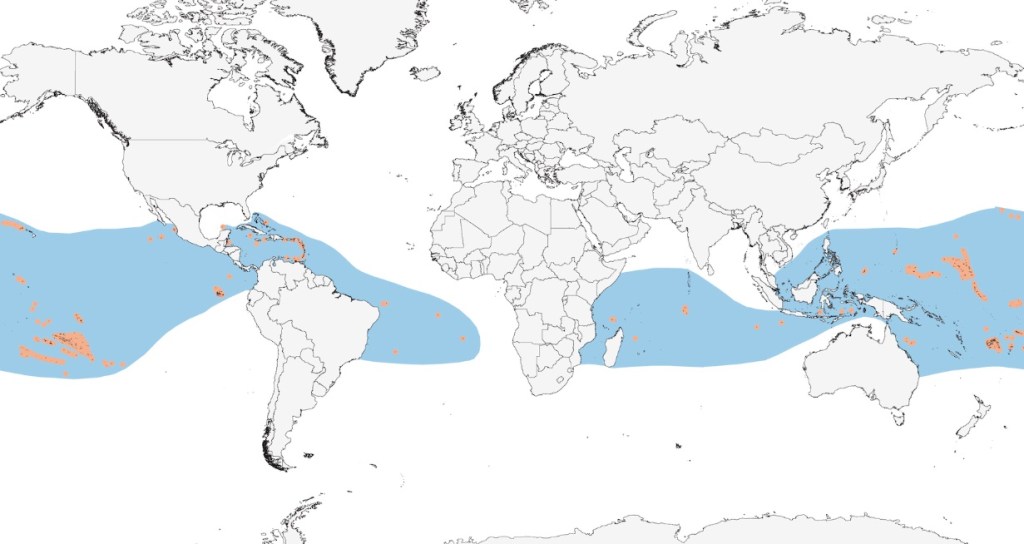
range map of Red-footed Booby

Now, four boobies – Red-footed, Nazca, Cocos, and Blue-footed – are annual in California (where all have been removed from the “review list”) and regular in the Pacific Northwest (PNW, defined here as Alaska, British Columbia, Washington, and Oregon). Prior to the 1980s, the PNW had only a single booby record – a Blue-footed found dead in 1935. Since then, boobies of one species or another have been documented 146 times. 86% of those have been in the last 11 years.

Even adjusting for increased reporting in recent decades, the increase in booby sightings has been among the most hair-raising and mind-boggling developments in the bird world.

Red-footed Booby

The PNW’s first Red-footed Booby was in 2015 in Alaska. Since 2018, they’ve become nearly annual. There are now 13 records:

AK: 6 – Aug 2015; Sept 2015; Sept 2019; June 2021; Sept 2022; Aug 2023

BC: 1 – Sept 2018 

WA: 4 – Sept 2018; Sept 2023; Oct 2023; July 2024

OR: 2 – May 2019; Nov 2019

Red-footed Booby in the PNW graph

The Red-footed Boobies in the PNW most likely emanate from breeding colonies off southern Mexico or the Galapagos. Most were found on vessels far offshore or dead on beaches. The Port Townsend bird represents the most reliable and confiding individual that can be enjoyed by thousands of people.

Most have occurred in August and September, paralleling similar seasonal movements of Brown Pelicans and Heermann’s Gulls, both species which nest primarily in Mexico, migrate up the coast to the PNW in summer, and return in fall. It’s no surprise that Port Townsend’s Red-footed Booby often roosts with several hundred Heermann’s Gulls, its potential traveling companions.

The pattern in California, with a larger sample size, is illustrative of the pattern of increase of boobies into PNW waters. For Red-footed, California’s first record was in 1975. This grew to 19 records by 2012. Since then, they’ve had about 200, including an invasion of 37 birds (though some may involve the same bird moving around) in 2018, the same year the PNW had two. The following year, with 105 records, the California Bird Records Committee removed it from their review list. They now occur regularly, with sometimes dozens of reports each year. These are largely limited to southern California. North of Cape Mendocino, California still has only two records (2021 and 2023).

Red-footed Booby in CA map

Nazca Booby

Split off from the Masked Booby in 2000, many records – and disproportionately older records from before the split and the advent of 400mm lenses – are now treated as Masked/Nazca, as identification cannot be confirmed. Here, I focus only Nazca Booby records, though surely some were around earlier.
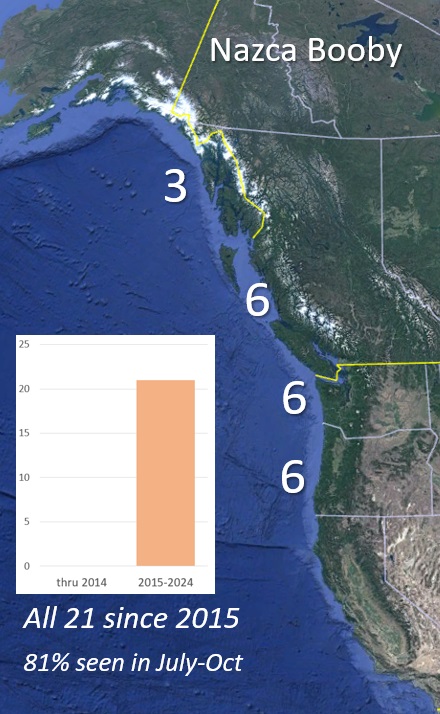
Nazca Booby in the PNW graph

Largely from the Galapagos, the first Nazca Booby in the continental US didn’t occur until one was found dead on Ventura Beach, California in 2013. (This was during the Refugio oil spill. I was involved in the bird injury assessment for the California Department of Fish and Wildlife at the time, and played a small role in this record by ensuring that the carcass was properly examined and identified by Kimball Garrett. The carcass was in poor condition and may have pre-dated the spill.)

Its pattern of occurrence in the PNW is remarkably like that of the Red-footed Booby – the first record was in 2015; it is now nearly annual; and it occurs primarily in late summer and early fall.

AK: 3 – Aug 2017; Sept 2023; Aug 2024

BC: 6 – July 2019; Sept 2020; Feb 2022; July 2022; July 2023; Oct 2023

WA: 6 – Aug 2020, Aug 2022, Sept 2022, Sept 2023, Oct 2023, Feb 2024

OR: 6 – Sept 2015; Sept 2018; Sept 2019; Dec 2021; Feb 2023; Sept 2023

Again, their pattern in California mimics that of Red-footed, with a dramatic increase in records beginning in 2013, a big surge in 2018 (30 records), removal from the review list in 2019, and 20 to 45 birds per year since then, totaling over 150 reports.

Nazca Booby in CA map

Cocos Booby

The Cocos Booby was formerly known as the brewsteri subspecies of Brown Booby. While the Brown Booby occurs worldwide, the form in the eastern Pacific was split off as the Cocos Booby this summer. The name comes from the tectonic plate, as does the impetus for the name of Nazca Booby.

Cocos and Brown Booby range map
Here I’ve annotated their Birds of the World range map with the new Cocos Booby, and I’ve also extended its range based on recent records.

Though the most expected booby on the West Coast, they have still exhibited a dramatic increase in recent years. Before 2006, there were only 96 records in California and 8 in the PNW.

Cocos Booby in the PNW graph

Now they are resident breeders in California (on the Channel Islands, since 2017), and annual in the PNW. They were removed from California’s review list in 2007, from Washington’s in 2018, and from Oregon’s in 2023.

They don’t come from as far away as the Galapagos, and can show up year-round. In both California and the PNW, they’ve occurred in every month of the year, though most are in late summer and fall.

Records of the related Brown Booby in the East have spread remarkably inland, in Limpkin-esque fashion, across the Midwest to the St. Lawrence River. There are now Brown or Cocos Booby records for over 40 US states. These maps compare Brown/Cocos Booby records from 1970-2005 and from 2006-2024.

From 1970-2005, Cocos and Brown Boobies were strictly coastal, except in the Southwest, where birds from the Gulf of California may show up in nearby deserts after storms.

Brown/Cocos Booby in the US 1970-2005
Brown and Cocos Booby, 1970-2005
Brown/Cocos Booby in the US 2006-2024
Brown and Cocos Booby, 2006-2024

You’ll notice just the purple rectangles in the bottom graph, 2006-2024. Even when I shortened the period to just 2020-2024, eBird told me I had exceeded the 2000 point maximum to show the individual points.

Blue-footed Booby
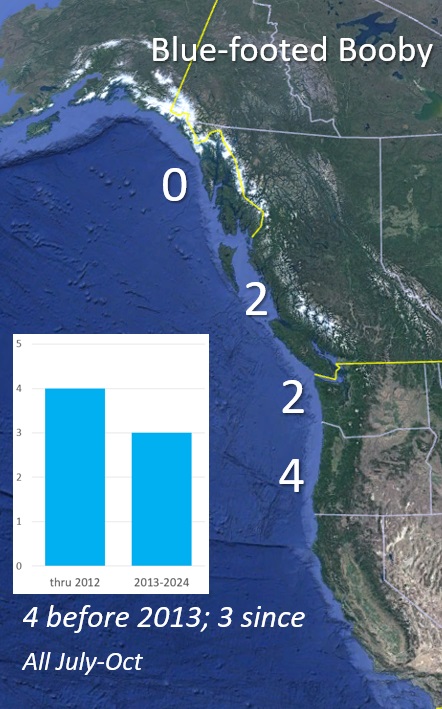
Blue-footed Booby in the PNW graph

The Blue-footed is our most local booby, with large nesting colonies in the Gulf of California. They do not range widely at sea, and thus are not as prone to the wanderings of the species above.

Their northward incursions are like those of Brown Pelicans, with whom they nest in the Gulf of California. In years with high nest success followed by a collapse of prey fish, hungry juveniles spread north up into the Salton Sea, the Colorado River, and up the West Coast. Thru 2012, California had 114 records. In 2013, they had over 200. That incursion year also brought records to BC and OR.

AK: none

BC:  2 – July 1995; Sept 2013

WA: 2 – Sept 1935; Aug 2006

OR:  4 – Sept 2002; 2 in Oct 2013; Sept 2018

But incursions like the one in 2013 are more than one-off episodes. Like the Cocos Booby, they are expanding north as breeders. They started nesting on the Channel Islands in 2021 (2020 if you count a hybrid pairing with a Cocos Booby).

Blue-footed Booby in CA map

Why is all this happening?

The obvious answer is climate change.  After all, these are wide-ranging seabirds who can travel great distances in search of food, and sea surface temperatures are rising dramatically.
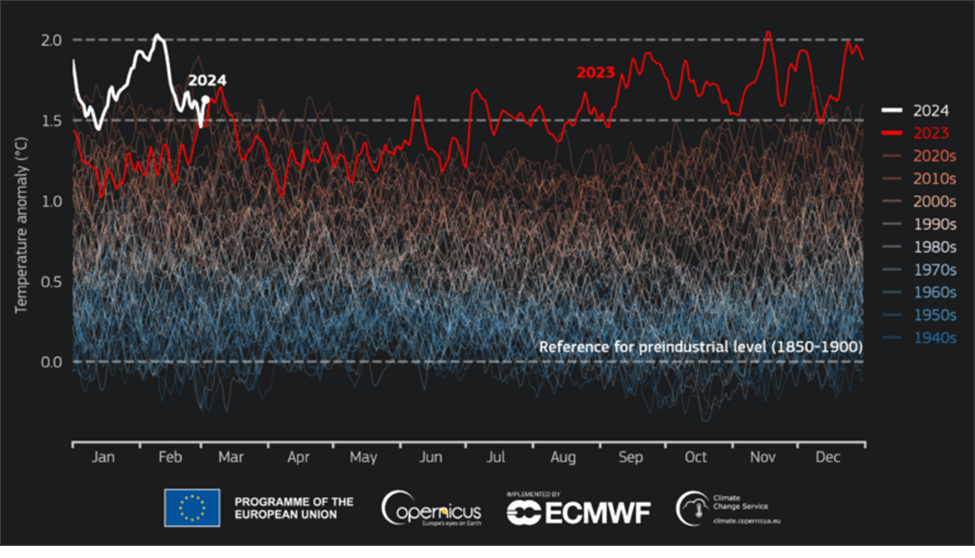
SST over time
This graph, which highlights the dramatic increases in worldwide sea surface temperatures in 2023 and 2024, also shows the gradual rise during the last few decades.

The infamous Blob began in late 2013, creating unprecedented sea surface temperatures (SST) in the North Pacific. By 2015 and 2016, it reached the West Coast, resulting in the collapse of fisheries (everything from Alaska Cod to Dungeness Crab) from Alaska to Mexico and beyond. Humpback whales breeding in Hawaii declined 34%.

SST during the Blob
The Blob in the North Pacific was the largest marine heat wave ever recorded.

Temperatures remain high. Bluefin tuna are reported from the Salish Sea, and mola molas are increasing in Alaska. Meanwhile, warmer waters negatively impact the food chain in the waters around the Galapagos. Boobies might not just be pulled to the PNW by warmer waters, but may also be pushed out of the tropics because fish become too hard to find.

SST today
SST last month

The changes probably started before the first boobies showed up in the PNW. Reid et al (2016), writing in Global Change Biology, documented ecosystem-wide regime shifts in the mid-1980s, resulting in “a major change in the Earth’s biophysical systems from the upper atmosphere to the depths of the ocean and from the Arctic to the Antarctic.”
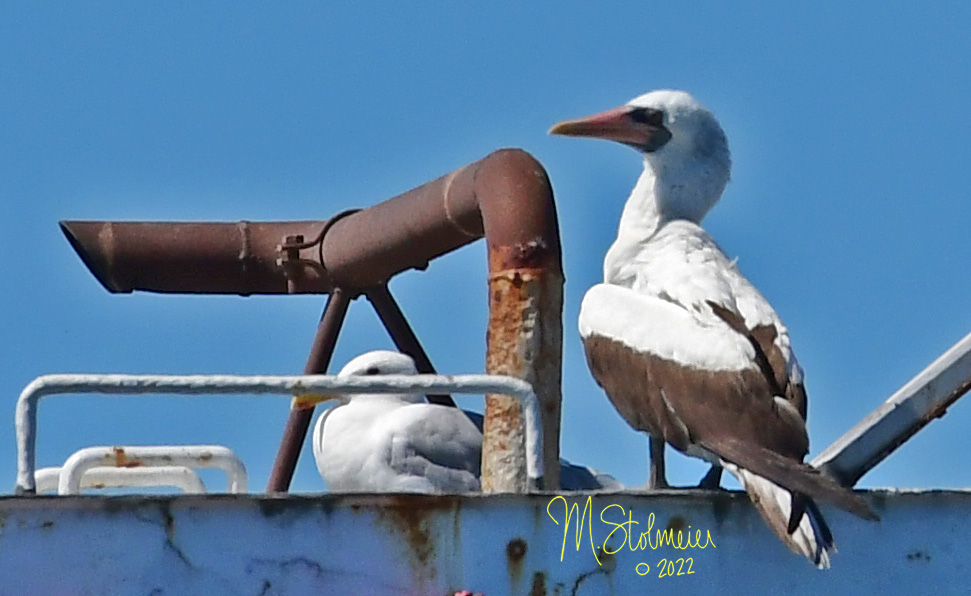
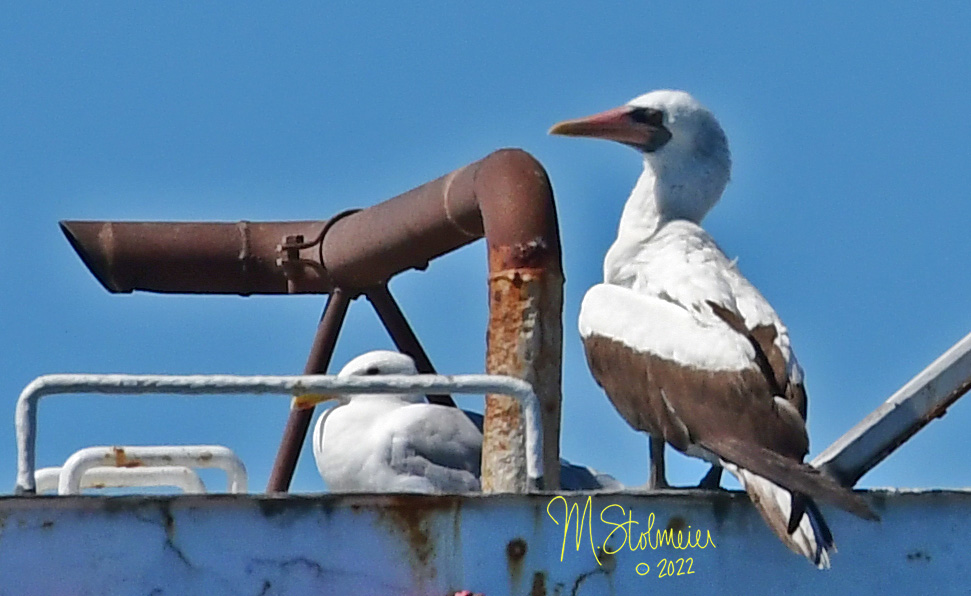
Nazca Booby on a barge in Puget Sound.
Nazca Booby on a barge in Puget Sound. Photographed by Matt Stolmeier. August 2022.

With climate velocity – the speed of climate change – increasing since then, one can imagine a series of regime shifts occurring practically every year. The concern among scientists is that, because the current rate of change is at least 10x faster than the fastest documented changes from prehistoric times (such as during the Paleocene-Eocene Thermal Maximum, or the PETM), many plants and animals cannot adapt fast enough. The PETM, while a spike in the prehistoric record, saw temperatures increase 5C over 5,000 years; that’s 1C per 1000 years. The graph above shows an increase of 1.5C in 123 years; that’s 1C every 82 years. Animals never noticed the PETM warming, and they literally evolved through it. Today, an individual booby may experience a changing climate within their lifetime.
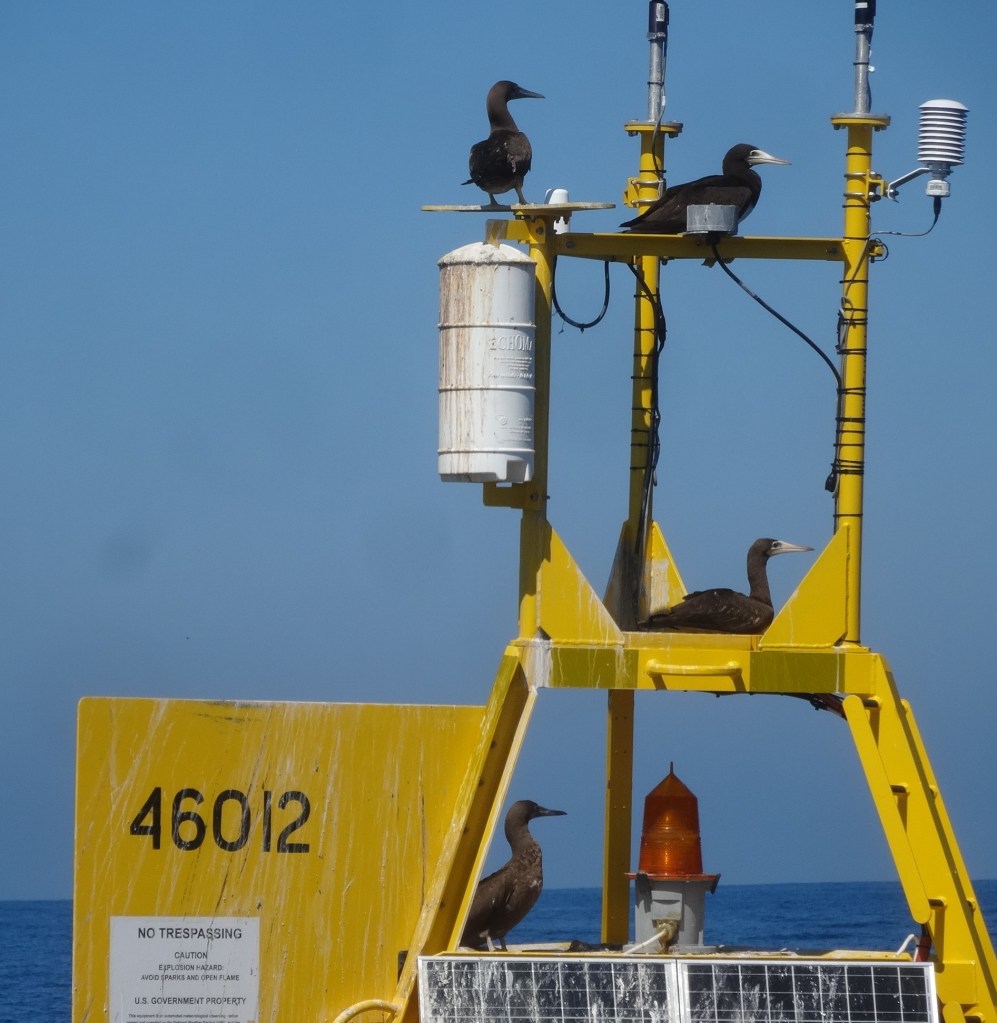
Four Cocos Boobies on the NOAA weather buoy off Half Moon Bay.
Four Cocos Boobies on the NOAA weather buoy off Half Moon Bay. I took this pic from a Shearwater Journeys trip. September 2014.

In oceans, food webs begin with nutrients and plankton and end with fish and fish-eaters such as boobies. Water temperature is everything. Each species adapts – or not – to climate change in different ways, crossing various thresholds at different times. Boobies fly long distances to find food. It remains to be seen whether they can adapt to changing ocean conditions, but it certainly appears they are trying.

Port Townsend's Red-footed Booby on the Hawaiian Chieftain
Port Townsend’s Red-footed Booby on the high wire between the two masts of the Hawaiian Chieftain. August 2024. There is an Indigenous word for this bird in Hawaii: ‘Ā.

UPDATE: For more on Port Townsend’s Red-footed Booby, including who found it when and where experts think it came from, see Port Townsend’s Red-footed Booby: A messenger from the future.
A Nazca Booby, a tug, a barge, and a pit: A climate parable

At 9:30am on August 17, that is, yesterday, I got a text from another birder. A Nazca Booby had just been seen from Discovery Point near Seattle. What’s more, we knew exactly where the bird was now; it was perched on the bow of a barge being pulled by the tug Seaspan Raider.

The Nazca Booby, atop the barge, photographed by Matt Stolmeier, captain for Outer Island Excursions.

The Nazca Booby is a tropical seabird that breeds exclusively on the Galapagos Islands. When not nesting, it occurs at sea in the eastern Pacific, generally between central Mexico and northern Peru.

Breeding (orange) and non-breeding (blue) range of the Nazca Booby.

This was Washington’s third record. The first, quite possibly the same bird, was on August 14, 2020, in pretty much the same part of Puget Sound. The second was a few weeks ago also off Seattle. That one was an immature, not an adult, so we know it was a different individual. It then showed up off Victoria, providing Canada with its third record.

The Nazca Booby first arrived in the United States in California in 2013. I actually played a role in that first record, a dead beachcast bird found in the aftermath of an oil spill. Working for the state’s spill response, I brought it to the attention of the California Bird Records Committee and had experts examine the carcass for identification. That bird was not a one-off event; it was the beginning of an invasion. There were a few scattered records in the following years, followed by an explosion of 26 records in 2018 and 21 in 2019. After that, California removed the species from its “review list”. While some of these records may have been the same individuals, it is remarkable that a tropical bird previously unheard-of in the US was suddenly widespread. Oregon got its first two records in 2018 and 2019.

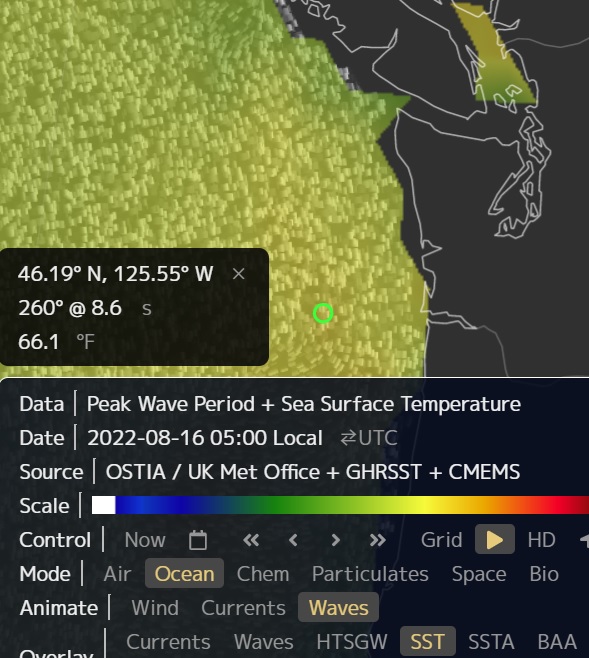
Sea surface temperature (SST) of 66.1F off the Washington/Oregon coast.

Checking sea surface temperatures, I see that the water off the Washington and Oregon coasts is reaching 66F in places, only 4F cooler than on the south side of the Galapagos. Zooming out, it is easy to see a route from there to here where the bird never had to encounter sea surface temps under 60F. The Strait of Juan de Fuca is in the low 50s, but it does approach 60F near Seattle.

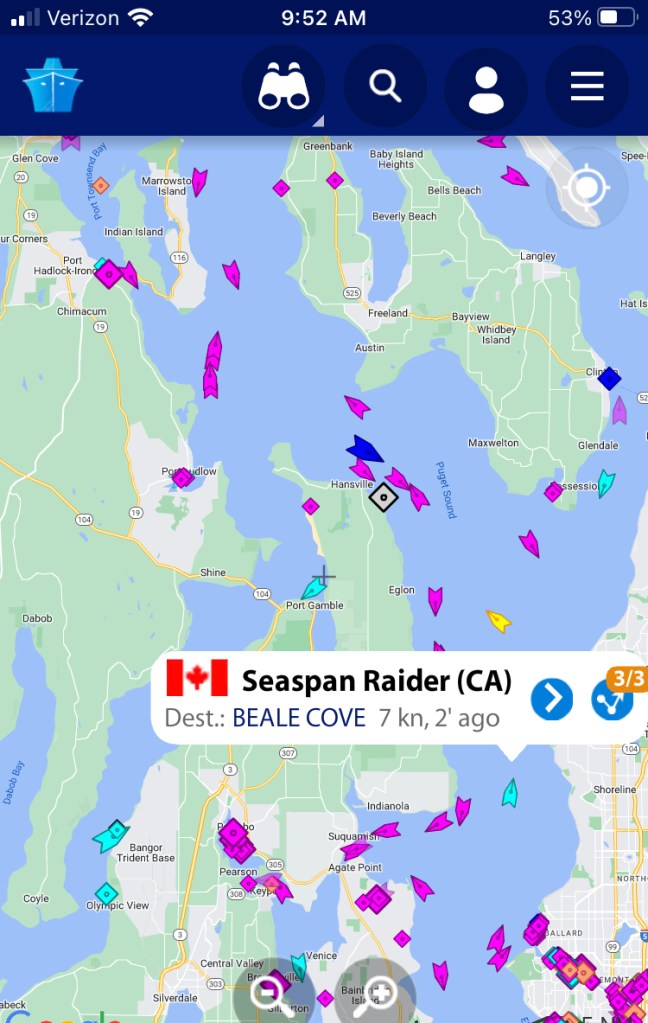
I opened the MarineTraffic app and quickly located the Seaspan Raider. It was southwest of Edmunds, northbound at 7.3 knots. I calculated it would arrive off Port Townsend between 1 and 2pm. Birders scrambled, heading to various coastal promontories on both sides of Puget Sound. I headed to Point Wilson, where Puget Sound effectively ends and meets the Strait of Juan de Fuca. The tug, bound for Canada, would have to pass by me here.

Reports came in. The bird had flown off the barge. It was in the water off Edmunds. It took off. It was seen from both sides. No one knew where it was.

Tracking the tug using the MarineTraffic app.

This wasn’t the only booby in the Salish Sea at the moment. A Brown Booby had been photographed a few days earlier near the San Juans. That was yet another tropical seabird that had already invaded the US, with records from over forty states, including Alaska. Two decades ago, this would have been unimaginable. And this summer, 2022, was already noteworthy across the Midwest and East Coast for the mass invasion of waterbirds typically found only in Florida or the Gulf Coast. Limpkins, Wood Storks, White Ibis, Roseate Spoonbills and many others were showing up hundreds of miles north of their previously known ranges.

Scrolling thru the American Birding Association Rare Bird Alert nationwide posts, limited to just mega-rarities, here is what pops up: Brown Booby in Oklahoma, Neotropic Cormorant in North Carolina, Brown Booby in Wisconsin, two Swallow-tailed Kites in Ohio, Limpkin in Wisconsin, Neotropic Cormorant in Michigan, White Ibis in New York, Wood Stork in Pennsylvania, Heermann’s Gull in Alaska, Limpkin in Illinois, Nazca Booby in California, White Ibis in Nebraska, etc. And that doesn’t even get us back to August 1. These are all birds, mostly aquatic birds, well north of their normal ranges.

Our current rate of climate warming hasn’t been seen since the Paleocene-Eocene Thermal Maximum (PETM) 55 million years ago. Then, there were alligators within the Arctic Circle. Kind of like Nazca Boobies are now a thing in Puget Sound. Actually, our current rate of warming is much faster than then. During the PETM, the climate warmed 5C in five thousand years. The current rate of warming is eighteen times faster. Then, no one would have noticed. Now, there is 1C of warming – and, with it, dramatic changes in climate and ecology – within the lifespan of a single bird. Some seabirds are showing us that they can keep up, thanks to their ability to fly long distances. I’m not sure about the alligators. Or birds that depend, say, on oak trees. The birds can fly, but the oaks can’t.

Two hours passed. I was ready to give up and head home, my only consolation being “MAMU CF”, a Marbled Murrelet making a provisioning flight across the Sound, carrying a fish to its single chick somewhere on a moss-covered Doug fir branch a hundred feet above the forest floor, probably in the Olympic Mountains. I’d only seen that once before. Much of their range in California has been lost to fires in the past five years, so this Olympic chick is important.

The original photo of the Nazca Booby on the barge, by Alex Meilleur.

One birder, who was unable to search for the Nazca Booby, called some of the local orca boats, as he worked on some of them. He let them know about the bird, as some were near it. About twenty minutes later, texts came in. They had re-found it! It was back on the same barge, now approaching Marrowstone Point. I spun my scope south. There, beyond the ferry lane, I could make out the red and white structure of the Seaspan Raider, pulling its barge, all blurry and shimmering in the distant heat mirage, slowly chugging toward me.

Taking advantage of the outgoing tide, the Seaspan Raider was now hitting 9 knots. It is powered by two Niigata 6m G25HX diesel engines. I don’t know what kind of gas mileage it gets, but, because it presumably refueled in Washington, most of its fuel is likely conventional diesel, but a small component may be renewable diesel.

Renewable diesel is not the same as biodiesel. Biodiesel can be mixed with conventional diesel, but only in very small amounts, like 2%. Renewable diesel, on the other hand, is molecularly identical to conventional diesel. It’s a relatively new invention. Made from non-petroleum sources, such as plant and animal material, it is to conventional diesel what corn syrup is to sugar; it is a “drop-in ready” alternative fuel. It can be mixed with or substituted for conventional diesel seamlessly, with no change in gas pumps, pipelines, or engines. In fact, it burns slightly cleaner, so engines last longer. It emits fewer particulates and, most importantly, its greenhouse gas footprint is up to 80% less. Its use is already widespread in California, where two of the state’s largest refineries no longer take petroleum crude.

This is the kind of thing that should have been developed thirty years ago, just after James Hansen of NOAA briefed congress on climate change in 1986. Now it’s late. We’ve already had more than 1C of climate warming, with more coming and probably ten feet of sea level rise built into the system. Stopping carbon emissions is no longer a suitable goal. We’ve already pushed the cart down the ramp. It’s rolling. We need to reverse climate change, to change that ramp so the cart rolls back to where it was. That will require actually sucking CO2 out of the air – negative emissions – which will certainly take a hundred years under the most optimistic scenarios. So get ready for more boobies, maybe even Limpkins and alligators.

Aside about Washington: Washington further delayed action a few years ago when the Department of Ecology required an Environmental Impact Statement from Phillips 66 to convert their refinery at Cherry Point to make renewable diesel. That is to say, Phillips needed to jump through major permitting hurdles because they were changing – that is, reducing — their greenhouse gas emissions. Phillips didn’t want to wait the several years required for this, so they promptly moved their operation to California. Governor Inslee tried to intervene and save the project, but it was too late. Now BP is picking up the baton in Washington.

Renewable diesel is already in widespread use in trucks, especially in California. The ferries in San Francisco Bay are powered exclusively by it. Because diesel is similar to jet fuel, and made during the same refining process, refineries also produce what is called sustainable aviation fuel (SAF). Aircraft are currently permitted to fly with up to a 50/50 blend of SAF and conventional jet fuel. Boeing promises jets that can fly with 100% SAF by 2030. We’ll be approaching 1.5C of warming by then. Nazca Booby will almost certainly be off the rare bird review list, at least in California. Brown Boobies will be breeding on the Farallones and prospecting further north.

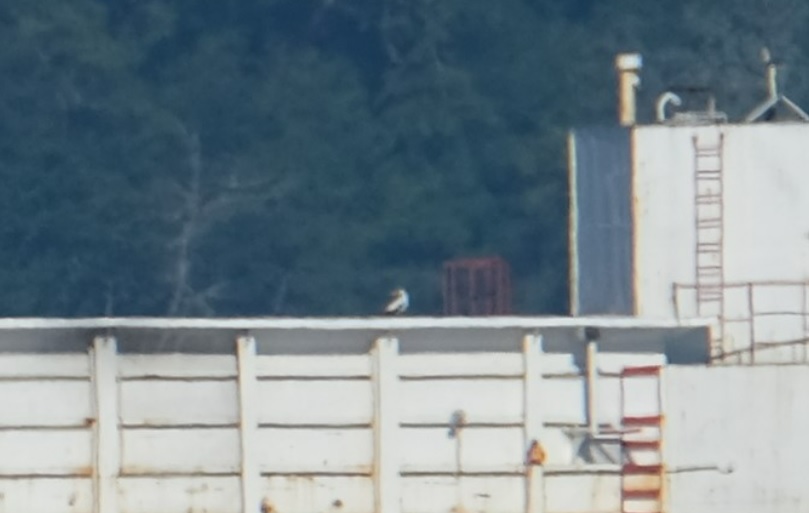
I watched as orca boats came and went from the barge, photographing the Nazca Booby. I was told it was on the starboard side of the roof of the little structure on the bow. The tug and barge continued up Admiralty Inlet until it was straight out from me, as close as it would pass. Slightly more than halfway across the channel, it remained blurred in heat mirage. I could see fuzzy white dots on the described rooftop, but I couldn’t tell you if they were Nazca Boobies or gulls or volleyballs. In birder’s lingo, this was going to be a ‘dip’, even though I knew exactly where the bird was and was looking at it.

My view of the tug, barge, and bird.

Mathematically, this would be at least the sixth time a Nazca Booby had passed this point, my point, my sea watch. And this time I was here, ready and waiting, and still I couldn’t see it. Were it not for the texts and the orca boats, I’d never know it was there. I kept my scope glued to it, hoping it would lift off in a distinctive flight and head directly toward me, where it would join the Caspian Terns and plunge dive right in front of me as I clicked my camera in ecstasy. But it didn’t. The tug and barge chugged north.

The bird was last seen at Partridge Point on Whidbey Island, still riding the barge. It was off the barge by Rosario Inlet. I’m guessing it jumped ship and headed toward Victoria or Smith Island.

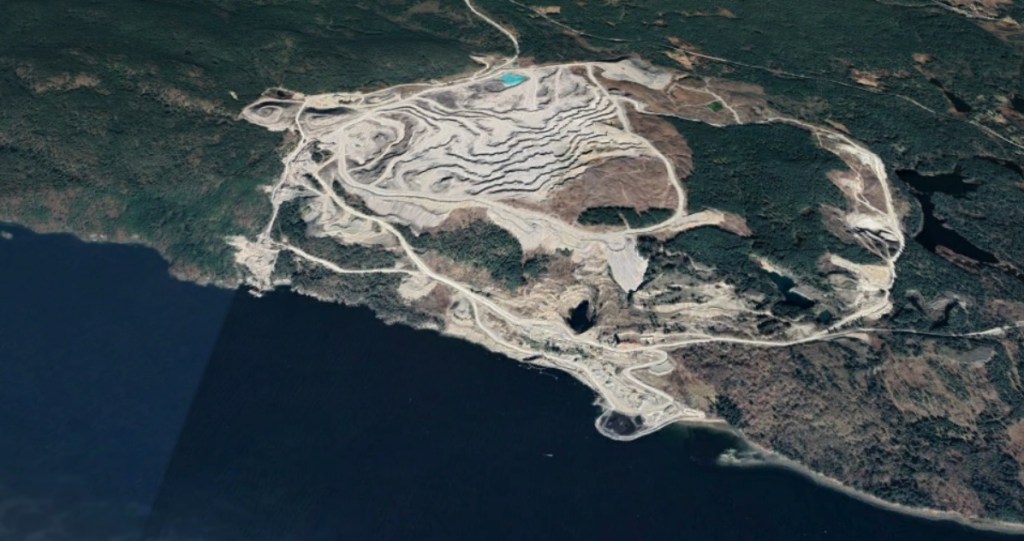
The barge’s destination was the Lafarge Texada Quarrying Ltd. limestone mine north of Vancouver. Limestone is critical to making cement. The cement-making process is responsible for 8% of the world’s carbon emissions. Part of that is from the energy used in production, which requires a kiln heated to 1,400 degrees Celsius. But most of the emissions comes from the limestone itself. Forty percent of the weight of limestone is CO2, and this is burned off in the process. There are efforts to improve the cement-making process, to make it less dependent on limestone, to reduce its carbon emissions. That’s all coming in the future.

The limestone mine at Beale Cove, the barge’s destination.

I’m wondering about the ancient Nazca civilization in what is now Peru. It was dependent on a remarkable network of underground aqueducts that delivered mountain water to their arid home. There’s a theory that they over-harvested a certain tree, which led to erosion of riversides during heavy rains, destroying their water delivery system. I wonder if they had meetings about the problem, if they had new policies in effect, at least at the end, when it was too late.

It’s supposed to be 95F in the Seattle suburbs today. I’m not worried about missing this Nazca Booby. There will be more.

The Nazca Booby on the bow. I’m sure the scope views were better. Photo by Laura Brou.